
The New Era of U.S. Crypto Policy: Strategic Investment Opportunities in Blockchain Infrastructure
The U.S. crypto landscape in 2025 has undergone a seismic shift, marked by regulatory clarity, institutional adoption, and infrastructure innovation. For investors, this evolution represents a pivotal moment: blockchain is no longer a speculative asset class but a foundational layer of the global financial system. The convergence of policy breakthroughs and technological advancements has created a fertile ground for strategic investments in blockchain infrastructure, particularly in stablecoin frameworks, custody solutions, and tokenized assets.
Regulatory Clarity: The Bedrock of Institutional Adoption
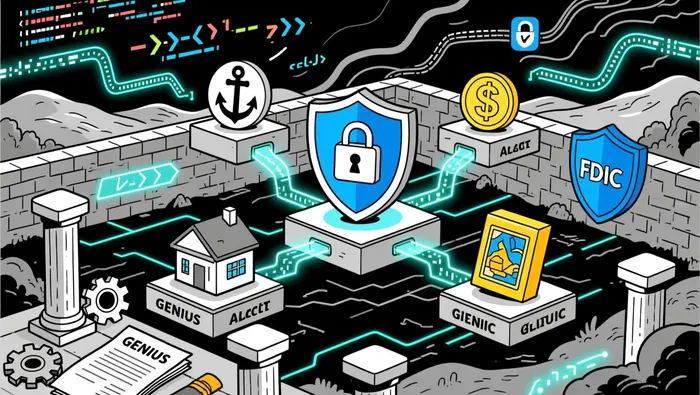
The GENIUS Act, enacted in July 2025, has been the most transformative policy development. By establishing a federal framework for stablecoin issuance, it addressed long-standing regulatory ambiguities, requiring stablecoin issuers to maintain 100% reserve backing and adhere to FDIC-like safeguards. This act not only legitimized stablecoins as a critical component of cross-border payments but also paved the way for insured depository institutions to issue payment stablecoins through subsidiaries, as approved by the FDIC. For investors, this signals a shift from speculative trading to infrastructure-grade utility, with stablecoins now serving as the rails for institutional treasury operations and fintech innovation.
Complementing this, the repeal of SAB 121 in 2025 removed a major barrier for banks to custody digital assets. This change, coupled with the SEC's guidance on secure custody practices, has enabled traditional financial institutions to integrate blockchain into their core services. For example, BitGo's receipt of a national bank charter from the OCC in 2025 exemplifies how regulatory clarity has unlocked new business models, blending blockchain security with institutional-grade compliance.
Institutional Infrastructure: From Experimentation to Execution
The institutionalization of crypto in 2025 was not just about policy-it was about building the infrastructure to support it. Major blockchain networks now process over 3,400 transactions per second, rivaling traditional systems like NASDAQ and Stripe. This throughput, combined with the tokenization of $30 billion in real-world assets (including U.S. Treasuries and private credit), has demonstrated blockchain's scalability for institutional-grade workflows.
The U.S. government's creation of a Strategic Bitcoin Reserve (SBR)-holding over 200,000 seized BTC-has further cemented digital assets as a strategic asset class. This move, akin to a sovereign "air cover", has normalized Bitcoin's role in corporate balance sheets and treasury strategies, with companies increasingly adopting the "MicroStrategy Playbook" to hedge against fiat devaluation. By year-end, institutional holdings accounted for 24% of the crypto market, reflecting a shift from retail speculation to professional capital allocation.
Investment Opportunities: Where to Allocate Capital
For investors, the 2025 policy environment has unlocked three key areas:
Stablecoin Infrastructure: With the GENIUS Act mandating reserve transparency, stablecoin platforms that prioritize compliance and scalability (e.g., those with FDIC-backed reserves) are prime candidates for growth. These platforms are now essential for cross-border payments and institutional liquidity management. This framework has enabled stablecoin platforms to scale.
Custody Solutions: The SEC's custody guidance and the repeal of SAB 121 have spurred demand for secure, institutional-grade custody services. Firms like BitGo, which received a U.S. bank charter in 2025, are positioned to benefit from this trend.
Tokenized Assets: The tokenization of real-world assets (RWAs) has reached a critical inflection point. Projects enabling the digitization of U.S. Treasuries, private credit, and real estate are attracting institutional capital, offering liquidity and yield in previously illiquid markets. This trend is accelerating across institutional portfolios.
The Road Ahead: Convergence and Execution
The groundwork laid in 2025 positions blockchain as a core infrastructure layer for the next decade. With regulatory frameworks in place, infrastructure robustness, and institutional adoption accelerating, 2026 promises to be a year of execution. Investors who align with these trends-whether through stablecoin platforms, custody solutions, or RWA tokenization-stand to benefit from a financial system increasingly built on blockchain's rails.
As the lines between traditional finance and digital assets blurBLUR--, the question is no longer if blockchain will matter, but how quickly it will dominate.







Comentarios
Aún no hay comentarios