
The Equity Selloff and Yield Rally: A Reassessment of Risk and Return in 2025
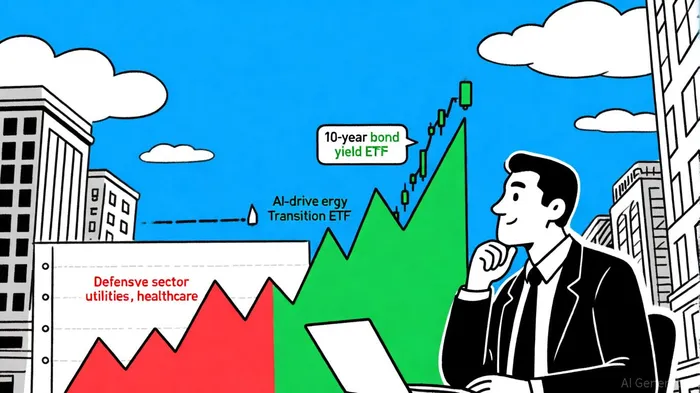
The 2025 investment landscape is defined by a paradox: rising bond yields coexist with a broad equity selloff, forcing investors to recalibrate their understanding of risk and return. This duality reflects a confluence of macroeconomic pressures—geopolitical fragmentation, inflationary headwinds, and the disruptive force of AI—while also unveiling new opportunities for strategic reallocation. As the Global Risks Report 2025 notes, global trade uncertainty and economic polarization are amplifying market volatility, creating a fertile ground for rethinking portfolio construction [1].
The Dual Forces: Yields Rise, Equities Retreat
The yield rally of 2025 has been fueled by central banks' continued resistance to inflation and the re-rating of long-term growth assumptions. With 10-year Treasury yields surpassing 4.5% in Q3 2025, fixed income assets have regained allure as investors seek income in a low-growth environment. Concurrently, equities have faced headwinds from trade wars and sector-specific disruptions. The Trump administration's aggressive tariff policies, for instance, have reshaped global supply chains, triggering uncertainty in manufacturing and export-dependent sectors [4].
This environment has disproportionately impacted cyclical stocks, while defensive sectors like utilities and healthcare have held up better. According to Fidelity's Equity Summary Score, utilities and healthcare stocks with high sentiment scores have demonstrated resilience, driven by their stable cash flows and dividend yields [4]. However, the broader market selloff underscores a shift in risk appetite, with investors increasingly prioritizing capital preservation over growth.
Reallocating for Resilience: Defensive Sectors and Safe Havens
In rising-yield environments, traditional safe-haven assets and defensive sectors often outperform. The Future of Jobs Report 2025 highlights that sectors tied to essential goods and services—such as consumer staples and healthcare—are gaining traction as demand remains inelastic amid economic uncertainty [2]. For example, healthcare stocks have benefited from AI-driven innovations in diagnostics and drug discovery, which are insulating the sector from broader market declines [6].
Gold and other commodities have also regained relevance as inflationary pressures persist. The World Economic Forum notes that 70% of investors increased allocations to gold in H1 2025, viewing it as a hedge against currency devaluation and geopolitical risks [4]. Similarly, infrastructure bonds and inflation-linked Treasuries are attracting capital for their ability to offset real yield erosion.
The New Frontier: AI and Energy Transition
While defensive strategies are critical, 2025 also presents opportunities in high-growth sectors reshaping the global economy. AI and sustainability-linked industries are emerging as dual engines of innovation, offering both downside protection and upside potential.
AI-driven technologies are accelerating across industries. In healthcare, AI's ability to detect diseases at earlier stages is not only improving outcomes but also driving demand for tech-enabled medical services [6]. The Future of Jobs Report 2025 predicts that AI and big data will create 170 million new jobs by 2030, outpacing automation-related job losses [2]. This labor market transformation is translating into capital flows toward AI-focused ETFs and venture capital funds targeting machine learning startups.
The energy transition is another area of strategic reallocation. Renewable energy engineers and environmental technology firms are experiencing robust demand, driven by climate policy and corporate decarbonization goals. Innovations like osmotic power systems and structural battery composites are attracting institutional capital, with green bonds outperforming traditional corporate debt in yield-adjusted returns [5].
Navigating the Trade-Off: Risk Mitigation vs. Growth Capture
The challenge for investors lies in balancing risk mitigation with exposure to growth drivers. A 2025 portfolio must address three key questions:
1. How to hedge against trade fragmentation and geopolitical shocks? Diversifying supply chain investments and increasing allocations to cybersecurity and logistics infrastructure can mitigate exposure to trade disruptions [3].
2. How to capitalize on AI's productivity surge? Overweighting sectors with high AI adoption rates—such as healthcare, fintech, and advanced manufacturing—can position portfolios to benefit from efficiency gains and new revenue streams [6].
3. How to align with the energy transition? Tilting toward renewable energy infrastructure and sustainability-linked bonds offers both regulatory tailwinds and long-term cash flow visibility [5].
Conclusion: A Portfolio for the 2025 Inflection Point
The equity selloff and yield rally of 2025 are not merely cyclical phenomena but symptoms of a structural inflection. Investors must move beyond traditional asset class dichotomies and adopt a framework that integrates macroeconomic resilience with technological and environmental megatrends. By reallocating toward defensive sectors, AI-driven innovation, and energy transition assets, portfolios can navigate volatility while positioning for long-term value creation.
As the World Economic Forum emphasizes, the future belongs to those who can “rethink risk” in a world of accelerating change [2]. The 2025 market environment demands nothing less.







Comentarios
Aún no hay comentarios