
Equity Resilience in a Volatile World: Rieder's Contrarian Play on Tech and Income
The S&P 500's recent ascent has defied macroeconomic headwinds—soaring tariffs, fiscal constraints, and persistent inflation—raising a critical question: Is equity optimism justified, or is it a bubble fueled by short-term gains? Enter Rick Rieder, BlackRock's chief investment officer of global fixed income, whose contrarian strategy argues that both equities and fixed income can thrive in this environment, provided investors focus on the right sectors and instruments.
The Tech Engine Driving Equity Growth
Rieder's bullish stance hinges on the dominance of the "Magnificent Seven" tech giants—Amazon, AppleAAPL--, MicrosoftMSFT--, Google, Meta, and others. These firms have delivered 18.1% year-over-year earnings growth in 2024's third quarter, far outpacing the S&P 500's stagnant 0.1% gain. Their secret? Cash flow resilience. Free cash flow (FCF) for these firms has surged by 20% since 2022, while FCF for the broader index has shrunk. This divergence isn't just a cyclical blip; it reflects structural advantages: oligopolistic market power, pricing discipline, and balance sheets so strong they've become net lenders.
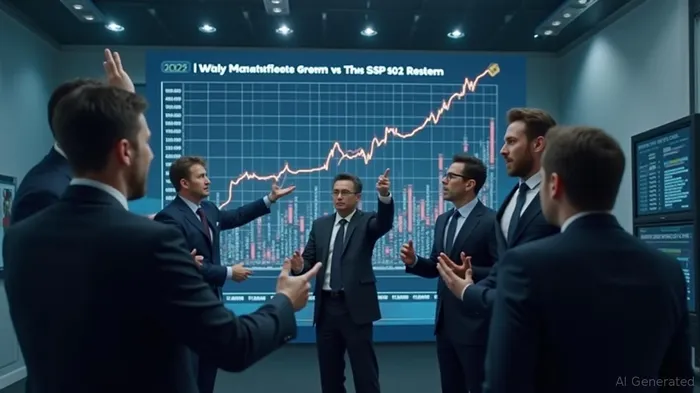
Rieder's valuation argument is clear: While these stocks trade at high multiples, their compound annual growth rate (CAGR) justifies the price. For example, Amazon's 2014 purchase at an 80x P/E multiple delivered a 1,308% return by yesterday, with the P/E compressing to 3.2x. For investors, this underscores a key truth: cash flow, not short-term multiples, dictates long-term equity success.
Fixed Income: The Unseen Ballast for Equity Bets
Equity optimism alone isn't enough in a world where tariffs add 1.5 percentage points to inflation and the U.S. debt burden exceeds $39 trillion. Rieder's genius lies in pairing equity exposure with income-focused fixed-income strategies that mitigate volatility and inflation risks.
1. Short-Duration Treasuries: The New Safe Haven
Traditional 10-year Treasuries have lost their recession-hedging role due to rate volatility. Instead, Rieder advocates 2-year Treasuries, currently yielding ~4%, which offer:
- Lower duration risk: Their short maturity insulates investors from principal losses if rates rise.
- Cash flow stability: They act as a "volatility absorber," cushioning portfolios during equity selloffs.
2. European High-Yield Bonds: A Global Income Play
While U.S. high-yield bonds face Fed rate uncertainty, European peers offer 2% yield premiums via cross-currency swaps. The European Central Bank's likely rate cuts and slower growth stabilize yields, while the euro's strength against the dollar adds kicker returns. This strategy exploits divergent policy environments, turning Europe's weaker growth into an advantage.
3. Securitized Assets: The Hidden Gem
AAA-rated collateralized loan obligations (CLOs) and asset-backed securities (ABS) yield 50–70 basis points more than investment-grade bonds. Their low credit risk and floating-rate structures make them immune to duration risk—a critical shield as the Fed's path remains unclear.
Navigating Risks: Why Equities Still Win
Critics argue that tariffs, debt, and stagnant GDP growth (~0% for Q4 2025) will eventually drag down equities. Rieder counters with three points:
- Debt Dynamics: Corporate balance sheets are strong—interest coverage ratios are at decade lows, and defaults remain historically muted. The S&P 500's cash reserves ($3.2 trillion) are a firewall against shocks.
- AI's Compounding Power: Breakthroughs like Deepseek's energy-efficient AI models reduce costs for tech leaders, enabling them to dominate markets further. This isn't just hype; it's a real earnings multiplier.
- Policy Adaptation: While tariffs threaten inflation, Rieder expects moderation—targeted measures on China, not blanket hikes on Mexico/Canada. Fiscal discipline in infrastructure spending will sustain services-driven GDP growth.
Investment Takeaways
- Buy the "Magnificent Seven": Their cash flow engines and pricing power make them recession-resistant. Consider sector ETFs like XLK (Technology) or QQQ (Nasdaq-100).
- Anchor with Short Treasuries: Use TLDR (20+ Year Treasury ETF) for income, but prioritize SHY (1–3 Year Treasury ETF) for lower risk.
- Diversify Globally: Pair U.S. equities with European high-yield bonds via HYXU (European High Yield ETF) and securitized assets via ABSD (Asset-Backed Securities ETF).
Conclusion: The Case for Patience
Rieder's strategy isn't about ignoring risks—it's about harnessing them. Equity optimism isn't blind faith; it's a calculated bet on tech-driven growth and income-oriented fixed income that thrives in volatility. As he notes, the "no landing" scenario—where growth and inflation persist above secular stagnation—means the best offense is a balanced defense. For investors, this means: Stay long tech, stay short duration, and stay global. The rewards are compounding.





Comentarios
Aún no hay comentarios