
Equity Residential's Dividend Strategy and Its Implications for REIT Investors
In the high-yield REIT landscape of 2025, where investors increasingly prioritize both income generation and long-term sustainability, Equity ResidentialEQR-- (EQR) stands out as a case study in balancing aggressive dividend payouts with prudent financial stewardship. The company's dividend strategy, underpinned by a robust balance sheet and evolving ESG frameworks, offers critical insights for investors navigating the intersection of yield and resilience.
Financial Health: A Foundation for Sustainable Dividends
Equity Residential's balance sheet remains a cornerstone of its dividend sustainability. As of March 31, 2025, the company reported a net debt to normalized EBITDAre of 4.21X, a metric that places it well within conservative thresholds for REITs[1]. This is complemented by nearly $2.2 billion in liquidity, ensuring ample capacity to fund dividends and strategic investments[2]. The company's well-laddered debt maturity schedule and A-rated credit profile further enhance its flexibility, enabling access to favorable financing terms[1]. These factors collectively suggest a strong capacity to maintain, if not grow, its dividend in the face of macroeconomic headwinds.
Dividend Strategy: Yield vs. Payout Ratio
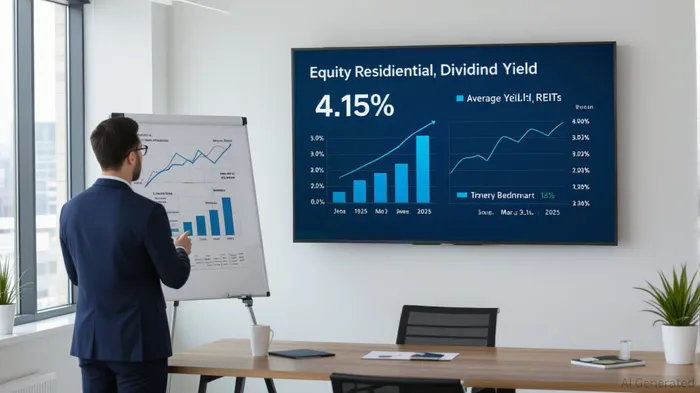
While Equity Residential's current dividend yield of 4.15% is attractive for income-focused investors[3], its payout ratio remains opaque, listed as “NM” (not meaningful) in recent disclosures[4]. This ambiguity could stem from the company's use of non-GAAP metrics or a strategic decision to avoid rigidly defining payout ratios in a volatile market. However, the firm's recent performance—marked by a 2.7% increase in same-store revenues and 2.3% growth in same-store NOI—indicates that its operating cash flow is expanding[4]. This bodes well for sustaining the 4.15% yield, even if the payout ratio remains undefined.
ESG Integration: Aligning with Industry Trends
Equity Residential's ESG strategy, though not explicitly detailed in 2025 filings, aligns with broader industry trends. The company's 2024 Corporate Responsibility Report highlights initiatives to reduce energy and water consumption, manage greenhouse gas emissions, and enhance community engagement[5]. These efforts resonate with the growing emphasis on ESG governance frameworks, such as the Global Reporting Initiative (GRI) and the Task Force for Climate-related Financial Disclosures (TCFD), which are now critical for investor confidence[6]. While 2025-specific ESG metrics are unavailable, the company's historical commitment to sustainability suggests it is well-positioned to meet evolving regulatory and investor expectations.
Implications for Investors
For REIT investors, Equity Residential's strategy underscores the importance of evaluating dividends through a dual lens: financial health and ESG alignment. The company's strong liquidity and conservative leverage ratios provide a buffer against interest rate volatility and economic downturns, which are key risks in 2025[1]. Meanwhile, its ESG initiatives, though not yet quantified in 2025 disclosures, position it to attract capital from institutions prioritizing sustainability[6]. This duality—high yield paired with resilience—makes EQR a compelling option in a market where “sustainable yield” is increasingly the norm.
Conclusion
Equity Residential's dividend strategy exemplifies how high-yield REITs can navigate the 2025 environment by combining fiscal discipline with forward-looking ESG practices. While the lack of a defined payout ratio introduces some uncertainty, the company's operational performance and balance sheet strength mitigate this risk. For investors seeking income without sacrificing long-term growth, EQR's approach offers a blueprint for success in an era where sustainability and profitability are inextricably linked.





Comentarios
Aún no hay comentarios