
U.S. Equity Market Volatility Amid Trump's Tariff Threats: Strategic Sector Positioning in Defense and Industrial Stocks
The U.S. equity market has entered a period of heightened volatility as President Trump's 2025 tariff agenda reshapes trade dynamics and investor sentiment. Defense and industrial sectors, long sensitive to geopolitical tensions and policy shifts, now face a dual challenge: navigating the immediate costs of protectionist measures while capitalizing on long-term opportunities tied to global rearmament and supply chain reshoring. This analysis explores how investors can strategically position themselves in these sectors, balancing risks and rewards amid Trump's trade policies.
Historical Precedents and Current Realities
From 2018 to 2021, Trump's initial tariffs on steel and aluminum triggered negative abnormal returns for defense stocks, as companies like Lockheed MartinLMT-- and Raytheon faced higher input costs and disrupted supply chains, according to a 2023 PLOS ONE study. The study found that investors perceived these tariffs as detrimental to sector performance, particularly for firms reliant on global supply chains. Fast-forward to 2025, and the pattern persists: tariffs on aircraft components (25%), advanced composites (20%), and rare earth materials have driven production costs up by 10–30%, forcing aerospace and defense firms to seek alternative suppliers in India and the EU, according to a Cognitive Market Research analysis.
Yet, the landscape has evolved. Geopolitical tensions-most notably the Russia-Ukraine war and Indo-Pacific instability-have spurred a surge in defense spending. European firms like Rheinmetall (ETR: RHM) have seen their shares rise 367% since 2022, while U.S. contractors report record order backlogs, per a MarketMinute article. This duality-cost pressures versus demand tailwinds-defines the current environment.
Sector-Specific Impacts and Stock Performance
Aerospace and Defense Contractors:
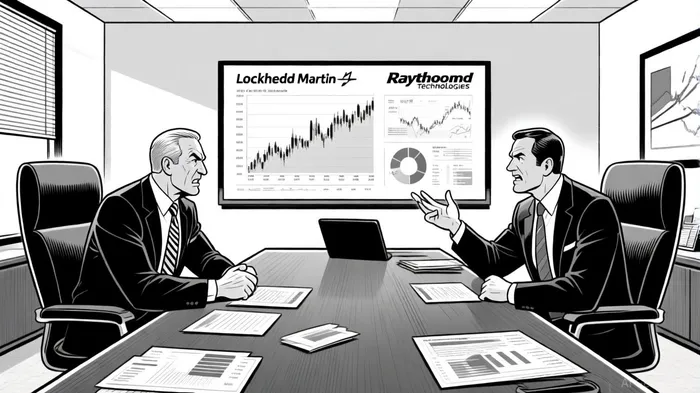
Lockheed Martin (LMT) and Raytheon Technologies (RTX) exemplify the sector's mixed fortunes. In Q4 2025, LMTLMT-- reported $18.62 billion in revenue-a 1.3% decline year-on-year-while its stock price fell 5.8% post-earnings, according to a Q4 results analysis. RTXRTX--, by contrast, outperformed with $21.62 billion in revenue (up 8.5% YoY) and a $218 billion backlog, reflecting its diversified revenue streams in the same report. Analysts attribute RTX's resilience to its commercial aviation segment, which buffers against defense budget fluctuations, as that report notes.
Historical backtesting from 2022 to 2025 reveals nuanced patterns. Lockheed Martin's earnings misses typically triggered short-term dips but showed recovery within three weeks, though average returns never reached statistical significance at the 5% level. Raytheon Technologies' earnings beats, meanwhile, failed to generate immediate outperformance, with post-event drift turning mildly negative in the first half of the 30-day window before converging to market performance. Neither event set produced statistically significant abnormal returns over the full 30-day horizon, underscoring that headline earnings surprises alone may be insufficient signals for these large-cap defense contractors.
Artillery and Industrial Materials:
The artillery market, reliant on steel and copper, has been hit hardest. Tariffs have driven up ammunition prices by 25%, forcing firms to source materials from higher-cost regions, according to a Forecast International report. This has strained margins but also accelerated reshoring efforts, with the Pentagon securing stakes in domestic rare earth producers like MP Materials, as outlined in a Logistics Viewpoints article.
Technology and Cybersecurity:
Palantir Technologies (PLTR) and Northrop GrummanNOC-- (NOC) are benefiting from Trump's push for AI-driven defense systems and NATO modernization. Palantir's stock has attracted investor interest due to its role in data analytics for national security, according to a Liberated Stock Trader note, while NOC's missile defense contracts remain shielded from tariff impacts, as that note observes.
Strategic Positioning for Investors
ETF Exposure for Diversification:
Given the sector's volatility, investors are advised to consider defense-focused ETFs (e.g., XAR, DGAA) to hedge against individual stock risks while gaining broad exposure to supply chain resilience plays, per a Morgan Stanley guide.Defensive Stocks in a Tariff Regime:
Utilities and healthcare sectors, less exposed to tariffs, may outperform in a prolonged trade war, as argued in an Investing.com analysis. However, defense tech and cybersecurity firms-such as HEICOHEI-- (HEI) and Curtiss-WrightCW-- (CWC)-offer a middle ground, combining growth potential with lower foreign revenue exposure, noted in a Forbes list.Reshoring and Supply Chain Plays:
Companies securing federal financing through mechanisms like the International Development Finance Corporation (DFC) are well-positioned. For example, firms involved in semiconductor manufacturing or critical mineral extraction could benefit from Trump's industrial strategy, as discussed in the Logistics Viewpoints article referenced above.
Risks and Mitigation
While tariffs aim to bolster domestic production, they risk retaliatory measures from U.S. allies and supply chain bottlenecks. European defense firms, for instance, are accelerating self-reliance, potentially reducing U.S. contractors' export opportunities, according to a Politico report. Investors must also monitor policy reversals or implementation delays, which could undermine long-term gains, as noted in the Logistics Viewpoints article.
Conclusion
The defense and industrial sectors stand at a crossroads in 2025. Trump's tariffs have introduced near-term costs but also catalyzed a strategic shift toward supply chain resilience and global rearmament. For investors, the key lies in balancing exposure to high-growth defense tech stocks with defensive plays in diversified contractors and ETFs. As geopolitical tensions persist, those who navigate this volatility with a nuanced understanding of policy and market dynamics will be best positioned to capitalize on the sector's transformative phase.





Comentarios
Aún no hay comentarios