
US Equity Market Resilience Amid Fed Policy Shifts: Navigating Weak Labor Market Signals and Sector Rotation
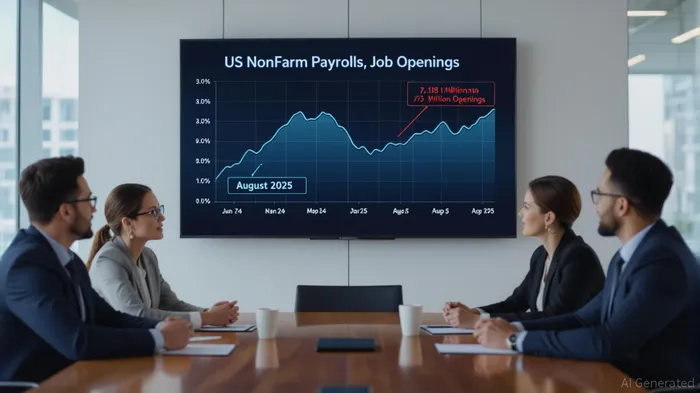
The US labor market has shown signs of cooling, raising questions about its implications for equity valuations and sector dynamics. According to a report by Reuters, the benchmark revision estimate for nonfarm payrolls suggests that the labor market has been weaker than previously thought, with average monthly gains of just 71,000 in the past quarter [2]. August's 22,000 payroll increase—well below forecasts of 75,000—underscores this trend, while the unemployment rate is projected to rise to 4.3%, the highest since 2021 [1]. These developments, coupled with a sharp decline in job openings to 7.18 million in July 2025 (the lowest since September 2024), signal a shift in the labor market's trajectory [2].
Labor Market Weakness and Fed Policy: A Delicate Balance
The Federal Reserve's policy calculus hinges on balancing inflation control with labor market stability. While the central bank has signaled a potential pause in rate hikes, the recent data may compel it to prioritize employment risks. A weaker labor market could justify a dovish pivot, with rate cuts on the horizon to stimulate demand. Historically, equity markets have responded positively to such accommodative policies, as lower borrowing costs buoy corporate earnings and investor sentiment. However, the current environment is complicated by sector-specific divergences.
Equity Market Resilience: Sector Rotation in Focus
Despite the labor market's softening, the S&P 500 has shown resilience, driven by defensive sectors and AI-related growth stocks. Healthcare and social assistance have added jobs, suggesting continued demand in these areas [1]. Conversely, sectors like manufacturing and mining—key drivers of economic output—have seen layoffs, potentially dampening industrial equity performance. This divergence is likely to accelerate sector rotation, with investors favoring industries insulated from macroeconomic headwinds.
For instance, the decline in job openings within healthcare and social assistance (a category that also saw job gains) highlights a paradox: while employment in these sectors remains robust, reduced hiring activity could signal a slowdown in demand for services, potentially affecting related equities [2]. Similarly, the contraction in arts, entertainment, and recreation jobs may weigh on discretionary spending-linked stocks.
The Road Ahead: Policy Uncertainty and Market Adaptation
The Fed's response to this mixed labor market data will be pivotal. If policymakers opt for rate cuts to avert a recession, equities could rally further, particularly in sectors benefiting from lower financing costs. However, if inflation proves sticky, a hawkish stance might pressure valuations. Investors must also contend with the risk of a “wage-price spiral,” where weak job growth fails to curb inflation, forcing the Fed into a difficult balancing act.
In this environment, sector rotation will likely remain a key strategy. Defensive plays—such as healthcare and utilities—may outperform as investors seek safety, while cyclical sectors like industrials could lag unless a policy-driven economic rebound materializes.
Conclusion
The interplay between weak labor market data, Fed policy shifts, and equity valuations underscores the complexity of today's market dynamics. While the S&P 500's resilience suggests confidence in central bank support, sector-specific vulnerabilities highlight the need for nuanced portfolio adjustments. As the Fed navigates its dual mandate, investors must stay attuned to both macroeconomic signals and granular sector trends to capitalize on emerging opportunities.







Comentarios
Aún no hay comentarios