
U.S. Equity Market Resilience Amid Conflicting Fed Signals: Tactical Asset Allocation in a Post-Rate Hike Environment
The U.S. equity market has demonstrated remarkable resilience in 2025 despite a landscape of conflicting Federal Reserve signals, economic uncertainty, and the lingering effects of Trump-era tariffs. As the Fed navigates a delicate balance between inflationary pressures and employment risks, tactical asset allocation strategies have become critical for investors seeking to capitalize on market dynamics while mitigating risks. This analysis explores how the interplay of equity performance, dollar weakness, and evolving central bank messaging shapes investment decisions in a post-rate hike environment.
Conflicting Fed Signals and Market Uncertainty
The Federal Reserve's July 2025 meeting underscored deep internal divisions, with officials maintaining the federal funds rate within the 4.25%-4.50% range for the fifth consecutive session. While the majority emphasized the need for more data before acting, two governors—Christopher Waller and Michelle Bowman—dissented, advocating for a 25-basis-point rate cut to address slowing growth and inflation nearing the 2% target [2]. Meeting minutes highlighted upside inflation risks and downside employment risks, reflecting the Fed's cautious stance amid a complex macroeconomic backdrop [3].
This policy ambiguity has created a tug-of-war in financial markets. On one hand, the Fed's reluctance to cut rates has reinforced expectations of prolonged tight monetary conditions, weighing on risk assets. On the other, dissenting voices and forward guidance suggesting potential rate cuts later in 2025 have fueled speculative optimism. As a result, equity sectors sensitive to Fed sentiment—such as consumer discretionary, financials, and technology—have experienced heightened volatility [5].
Equity Market Resilience and Dollar Weakness
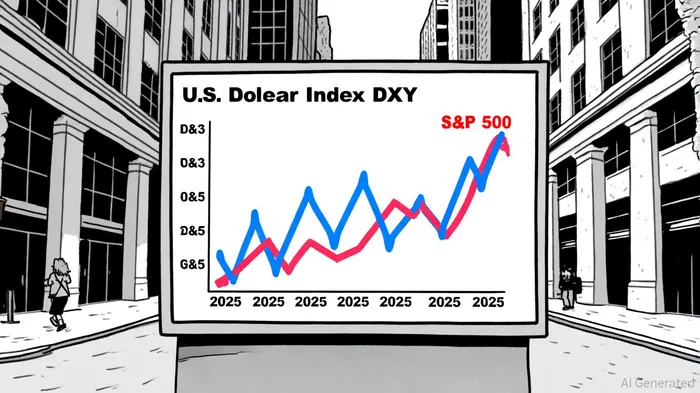
Despite these uncertainties, U.S. equities have shown surprising strength. The S&P 500 reached record levels by mid-2025, driven by a combination of strong corporate earnings, sector rotation toward high-growth industries, and expectations of eventual monetary easing [1]. However, this resilience has coexisted with a notable decline in the U.S. Dollar Index (DXY), which fell from a peak of 107.61 in February 2025 to 97.97 by August 2025 [2].
The inverse relationship between the dollar and equities has historically been a key dynamic, with a weaker dollar often boosting export-driven sectors and enhancing global demand for U.S. assets. Yet, in 2025, the correlation has defied expectations. The S&P 500 and DXY have exhibited an unusually strong positive correlation, suggesting that factors such as carry trade dynamics, geopolitical tensions, and shifting growth expectations are now overriding traditional risk-on/risk-off narratives [3]. This divergence highlights the complexity of current market conditions, where dollar weakness and equity gains may reflect shared drivers—such as accommodative global liquidity—rather than opposing forces.
Tactical Asset Allocation in a Post-Rate Hike Environment
Investors navigating this landscape must adopt strategies that balance adaptability with discipline. Historical precedents from periods of Fed policy uncertainty and dollar weakness (2000–2025) offer valuable insights. For instance, during similar episodes, tactical allocations have prioritized diversification across asset classes and geographies, overweighting international equities and high-quality fixed income to hedge against U.S. dollar volatility [4].
In 2025, the focus has shifted toward sectors poised to benefit from both monetary easing and dollar depreciation. Technology and communication services, for example, have thrived on global demand for innovation, while financials have gained from expectations of rate normalization. Meanwhile, tactical strategies are increasingly leveraging machine learning and macroeconomic regime detection to optimize allocations in real time [3]. These data-driven approaches help investors respond to shifting Fed signals and geopolitical risks without overcommitting to a single narrative.
A key consideration is the role of fixed income in a post-rate hike environment. With inflation showing signs of moderation, short-duration bonds and inflation-protected securities (TIPS) have gained traction as tools to preserve capital while managing interest rate risk [4]. Additionally, investors are exploring non-U.S. markets for yield, particularly in regions where central banks are adopting more accommodative policies.
Conclusion: Navigating the New Normal
The U.S. equity market's resilience in 2025 underscores the importance of tactical asset allocation in an era of conflicting Fed signals and dollar weakness. While the Fed's cautious approach has created uncertainty, it has also opened opportunities for investors who can navigate the interplay of monetary policy, sector dynamics, and global macroeconomic shifts. By prioritizing flexibility, diversification, and data-driven decision-making, investors can position themselves to capitalize on both the risks and rewards of this evolving landscape.







Comentarios
Aún no hay comentarios