
Equity Market Momentum and Risk Appetite: A Technical and Sentiment Analysis of the Dow Jones Industrial Average in 2025
The Dow Jones Industrial Average (DJIA) has emerged as a barometer of global risk appetite in 2025, with technical and sentiment indicators painting a nuanced picture of market dynamics. As the index approached 46,200 in late September 2025, it defied historical seasonal patterns and reflected a blend of sustained momentum and cautionary signals. This analysis dissects the interplay between technical indicators and investor sentiment to assess the DJIA's trajectory and the broader equity market's risk appetite.
Technical Momentum: A Bullish Foundation with Overbought Caution
The DJIA's technical profile in September 2025 suggests a strong, albeit fragile, uptrend. The index has consistently traded above its 200-day simple moving average (SMA), a critical threshold for trend-following strategies, while the Moving Average Convergence Divergence (MACD) remained above its signal line, reinforcing bullish momentum, according to the STL News analysis. However, the Relative Strength Index (RSI) and Stochastic Oscillator both hovered near overbought territory (RSI >70, Stochastic Oscillator >80), signaling potential short-term consolidation, as the STL News analysis also notes.
Key support levels at 44,460 (short-term) and 42,970 (mid-term) remain critical for trend integrity, while the 46,000 resistance level-broken in early September-has become a psychological benchmark for further gains, the STL News piece argues. The Average Directional Index (ADX) reading of 35 underscores a robust trend, but traders are advised to monitor for a potential pullback if the RSI fails to retreat below 70. Analysts at Investtech note that a sustained close above 46,000 could catalyze a push toward 48,000, but overbought conditions necessitate caution.
Sentiment and Risk Appetite: Fed Easing and Sectoral Dynamics
Investor risk appetite in September 2025 has been shaped by two pivotal forces: the Federal Reserve's dovish pivot and sector-specific resilience. The Fed's 25-basis-point rate cut in September, with two more cuts anticipated by year-end, has fueled a "buy the rumor, sell the news" dynamic, pushing the DJIA to a 7.6% year-to-date return, according to Stock Market Watch. This aligns with the State Street Global Advisors' Market Regime Indicator (MRI), which points to a sustained risk-on environment driven by expectations of a global soft landing, a point highlighted in the STL News analysis.
Sectoral performance further highlights this optimism. Technology stocks, particularly AI leaders like Nvidia and Microsoft, have driven much of the DJIA's gains, reflecting confidence in innovation-driven growth, the Stock Market Watch report shows. Meanwhile, defensive sectors such as Consumer Staples and Utilities have seen inflows amid tariff-related uncertainties, as President Trump's expansive tariffs-comparable to those of the 1930s-raise concerns about supply chain disruptions, an observation detailed in a Financial Content analysis. Analysts at Capital.com maintain "buy" ratings for key components like Walmart and Home Depot, citing strong earnings visibility and pricing power, per the Stock Market Watch coverage.
Challenges and Contradictions: The September Effect and Policy Uncertainty
Despite the bullish undercurrents, the DJIA faces headwinds. The so-called "September Effect"-a historical tendency for market weakness in the ninth month of the year-has been amplified in 2025 by geopolitical and policy risks, a theme emphasized in the Financial Content piece. The Trump administration's tariffs, coupled with the Fed's rate-cut cycle, have created a volatile backdrop. For instance, the DJIA experienced a three-day losing streak mid-September before rebounding to fresh highs, illustrating the tug-of-war between macroeconomic optimism and near-term profit-taking, as noted by STL News.
Moreover, while the DJIA's technical indicators suggest a strong trend, the overbought RSI and Stochastic Oscillator readings imply a heightened risk of near-term volatility. LongForecast projects a potential pullback to 45,089 in early October, a -0.9% decline from September's peak, as investors reassess valuations. This aligns with historical patterns where extended rallies often precede corrective phases, particularly in a market dominated by high-growth sectors like AI, a point underscored in the Financial Content analysis.
Conclusion: Balancing Optimism and Prudence
The DJIA's 2025 performance underscores a market caught between robust technical momentum and divergent sentiment drivers. While the Fed's easing cycle and corporate earnings resilience support a bullish case, overbought conditions and policy uncertainties demand caution. Investors should monitor key levels-particularly the 46,000 breakout and 44,460 support-for signals of trend continuation or reversal. For now, the DJIA remains a testament to the delicate balance between risk appetite and macroeconomic reality, offering both opportunities and challenges for equity market participants.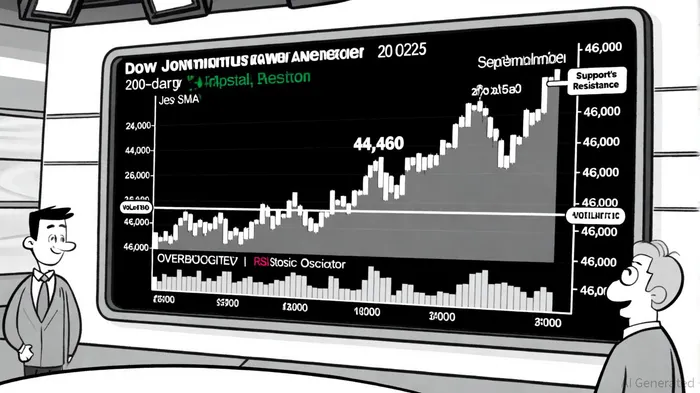







Comentarios
Aún no hay comentarios