
Equities Sink Intraday as Trump Urges Fed to Cut Rates Amid Volatility
Former U.S. President Donald Trump’s call for an immediate 1% interest rate cut by the Federal Reserve sent shockwaves through markets on April 22, 2025, sparking intraday swings that underscored the fragility of investor confidence amid political and monetary crosscurrents. While equities ultimately closed slightly higher, the day’s volatility revealed a market balancing geopolitical risks, corporate earnings, and the enduring politicization of monetary policy.
Market Volatility: A Political and Economic Tightrope
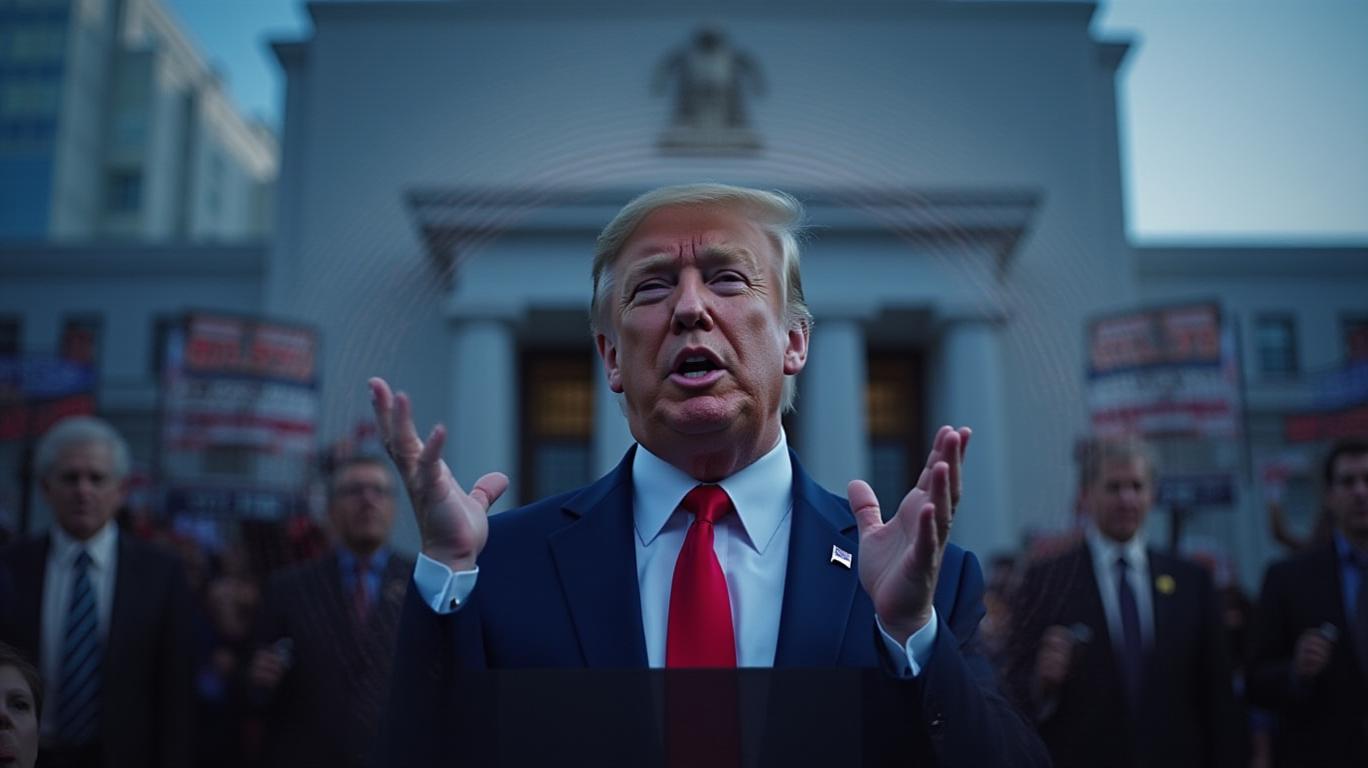
Trump’s remarks, delivered during a campaign-style rally in Houston, framed the Fed’s inaction as a threat to American competitiveness and working-class prosperity. His demand for an aggressive rate cut contrasted sharply with the Fed’s stated “data-dependent” approach, which has prioritized inflation control over growth stimulus. Equity markets initially reacted negatively, with the S&P 500 opening 0.5% lower as traders priced in heightened political pressure on the central bank. However, a late-session rebound—driven by strong AI-driven earnings from MicrosoftMSFT-- and Alphabet—pushed the index to a 0.3% gain by the close at 4,925.33.
Sector Dynamics: Tech’s Rollercoaster Ride
The tech-heavy NASDAQ Composite exemplified the day’s extremes. It opened 1% lower after a Bloomberg report highlighted regulatory scrutiny of generative AI, but rebounded to a 0.5% gain on upgraded sector growth forecasts. NVIDIA, a key beneficiary of AI advancements, saw shares swing from a 2.5% dip at the open to a 4.2% close, reflecting investor optimism in long-term AI adoption. Meanwhile, the Financial Select Sector SPDR Fund (XLF) fell 0.5%, as banks like JPMorgan faced headwinds from widening credit spreads—a sign that even rate-sensitive sectors remain cautious.
Energy and Small Caps Outperform
While tech battled headwinds, the Energy sector surged 2% as WTI crude prices climbed to $89.17/barrel amid OPEC+ supply cuts and tensions in the Strait of Hormuz. Small-cap stocks also outperformed, with the Russell 2000 rising 0.8% on revised GDP growth estimates. This divergence highlighted the market’s reliance on sector-specific catalysts rather than broad macroeconomic trends.
The Fed’s Delicate Balance
The Federal Reserve’s independence faced renewed scrutiny as Trump’s rhetoric amplified partisan divides over monetary policy. While Fed Chair Powell has historically avoided political entanglements, the central bank’s next moves will be scrutinized for any perceived “political put” that could stabilize markets ahead of the 2026 midterms. Bond markets signaled skepticism: the 10-year Treasury yield rose 4 basis points to 4.86%, narrowing the equity-bond yield gap to a perilous 0.01%—a level historically linked to heightened rotation risks between asset classes.
Conclusion: A Market on Edge
April 22, 2025, encapsulated the challenges facing investors in an era of hyper-partisan politics and fragile economic data. While equities closed modestly higher, the intraday swings—from tech’s initial slump to energy’s resilience—highlighted a market in search of clarity. With the VIX volatility index hitting a 2025 low of 17.4, complacency may be premature. The Fed’s next policy decision, due in June, will be pivotal: a rate hike could trigger a sell-off, while a cut risks fueling inflation. For now, the S&P 500’s death cross (a 50-day moving average below its 200-day counterpart) remains unresolved, leaving bulls and bears locked in a battle for control.
As Trump’s influence over monetary policy debates grows, markets will continue to price in not just economic data, but the geopolitical stakes of a Fed caught between inflation and ideology. The path forward is uncertain, but one thing is clear: volatility is here to stay.





Comentarios
Aún no hay comentarios