
EOG Resources’ Strategic Position in the 2025 Energy Transition: Capital Allocation and Long-Term Value Creation
In the evolving energy landscape of 2025, EOG ResourcesEOG-- stands as a case study in balancing traditional hydrocarbon production with forward-looking sustainability initiatives. The company’s capital allocation strategy—prioritizing disciplined spending, strategic acquisitions, and shareholder returns—has positioned it as a resilient player in the energy transition. By aligning operational efficiency with ambitious environmental targets, EOGEOG-- demonstrates how profitability and sustainability can coexist in a sector under pressure to decarbonize.
Capital Allocation: Fueling Growth and Shareholder Value
EOG’s 2025 capital plan of $6.2–6.4 billion underscores its focus on disciplined spending and scalable growth. A significant portion of this allocation—$5.6 billion—was directed toward the acquisition of Encino Acquisition Partners, which added 675,000 net acres in the Utica shale. This expansion not only enhances EOG’s low-cost production capacity but also boosts 2025 EBITDA by 10% and free cash flow by 9% [1]. The Utica shale, a core asset for EOG, exemplifies the company’s ability to leverage unconventional resources for long-term value creation.
Complementing this domestic growth is EOG’s international expansion into the UAE through the Unconventional Onshore Block 3 (UCO3) concession in Abu Dhabi. This 3,609-square-kilometer project, awarded in May 2025, aligns with the UAE’s energy transition goals while leveraging EOG’s expertise in tight oil development [2]. The UCO3 venture is supported by a $60 billion U.S.-UAE energy investment framework, ensuring geopolitical stability and operational efficiency [3].
Shareholder returns remain a cornerstone of EOG’s strategy. In Q1 and Q2 2025, the company returned $1.3 billion and $1.1 billion, respectively, through dividends and share repurchases. This commitment to capital efficiency is reinforced by a projected 70% free cash flow payout ratio and $4.3 billion in total free cash flow for 2025 [4].
Energy Transition: Ambitious Targets and Operational Innovation
EOG’s energy transition strategy is anchored in measurable environmental targets and technological innovation. The company has set a 25% reduction in greenhouse gas (GHG) intensity by 2030 and a methane emission rate of 0.20% or below, already exceeding regulatory benchmarks [1]. These goals are supported by initiatives such as carbon capture and storage (CCS) pilot projects and AI-driven operational efficiencies that reduce well costs and emissions [4].
A critical component of EOG’s ESG framework is its participation in the Oil and Gas Methane Partnership 2.0, which ties 7.5% of executive compensation to environmental metrics like methane emissions and flaring intensity [1]. Additionally, the company’s commitment to zero routine flaring and 99% water reuse in drilling operations highlights its operational rigor in minimizing environmental impact [2].
While EOG’s net-zero GHG emissions target by 2050 aligns with the Paris Agreement’s 1.5°C goal, the absence of medium-term (2028–2035) targets raises questions about the clarity of its decarbonization pathway [2]. Nonetheless, its integration of AI and CCS technologies positions it as a leader in bridging the gapGAP-- between fossil fuels and renewable energy systems.
Strategic Synergies and Market Resilience
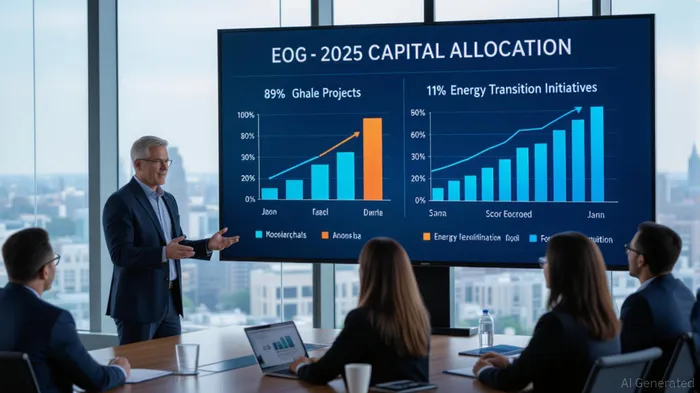
EOG’s dual focus on capital efficiency and sustainability creates a compelling value proposition. The company’s 2025 capital allocation reflects a strategic balance: 89% of spending is directed toward high-margin shale assets, while 11% funds energy transition initiatives [1]. This approach ensures short-term profitability while investing in long-term resilience.
The UAE expansion, for instance, not only diversifies EOG’s geographic exposure but also aligns with global energy transition priorities. By applying its low-cost, high-efficiency production methods to unconventional resources in a politically stable region, EOG mitigates risks associated with traditional oil markets [3].
Moreover, EOG’s financial performance—$973 million in Q2 2025 free cash flow and a projected 10% return on capital employed at $45 WTI—demonstrates its ability to generate returns across market cycles [4]. This financial flexibility allows the company to reinvest in innovation and shareholder rewards, reinforcing its strategic position in the energy transition.
Conclusion
EOG Resources’ 2025 strategy exemplifies how a major energy player can navigate the transition to a low-carbon economy without sacrificing profitability. By prioritizing disciplined capital allocation, strategic acquisitions, and ambitious ESG targets, EOG has created a model that balances shareholder value with environmental stewardship. As the energy sector continues to evolve, EOG’s ability to integrate innovation with operational excellence will likely determine its long-term success in a world increasingly defined by sustainability imperatives.
Source:
[1] EOG Resources' Strategic Position in the Energy Transition [https://www.ainvest.com/news/eog-resources-strategic-position-energy-transition-era-deep-dive-operational-excellence-capital-allocation-2508]
[2] EOG Resources: Strategic Expansion and Shareholder Returns in the Energy Transition Era [https://www.ainvest.com/news/eog-resources-strategic-expansion-shareholder-returns-energy-transition-era-2508]
[3] EOG Resources, Inc. Awarded Onshore Concession to Explore and Appraise Unconventional Shale Block in the UAE [https://investors.eogresources.com/2025-05-16-EOG-Resources-Awarded-Onshore-Concession-to-Explore-and-Appraise-Unconventional-Shale-Block-in-the-UAE]
[4] EOG Resources Reports Second Quarter 2025 Results [https://www.prnewswire.com/news-releases/eog-resources-reports-second-quarter-2025-results-and-updates-2025-guidance-302524793.html]





Comentarios
Aún no hay comentarios