
V.L. Enterprise: Assessing the Value of a Tanker Fleet's Cash Flow
V.L. Enterprise operates a focused shipping business, managing a fleet of 13 vessels with a total deadweight tonnage of 120,628 metric tons. The fleet is almost entirely dedicated to tanker operations, with 92.31% of its vessels classified as Tankers. This model provides a steady, albeit cyclical, cash flow from transporting goods. The company's foundation is built on quality service, safety standards, and good governance, which are non-negotiable in the capital-intensive and regulated shipping industry.
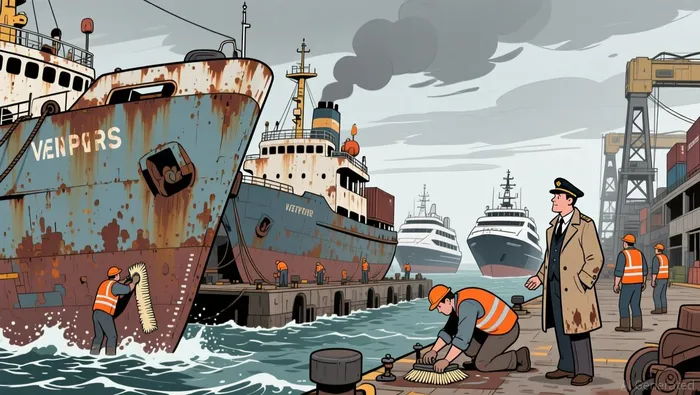 The most significant constraint on the company's long-term value, however, is the age of its fleet. A striking 61.54% of the vessels are over 15 years old. In a sector where vessel efficiency, reliability, and regulatory compliance become more costly with age, this creates a persistent drag. Older ships typically have higher operating expenses, lower fuel efficiency, and may face more frequent maintenance or even early retirement, all of which pressure margins and limit growth options.
Management's stated goals of creating investment value on a fair return and developing professional operations are sound principles. Yet, with a fleet so heavily weighted toward older tonnage, the path to that value creation is narrow. The company's competitive position is thus defined by its ability to manage this aging asset base efficiently, rather than by a strategy of fleet renewal or expansion. This reality means the business's current valuation is heavily dependent on its ability to generate cash flow from existing operations, not on the promise of future growth.
Financial Health, Cash Flow, and Dividend Sustainability
The company's financial health reveals a business generating steady cash flow but facing pressure from its capital-intensive nature and a dividend that stretches its earnings. For the full year 2024, operating cash flow reached 170.94 million THB, a solid figure that demonstrates the core business can produce cash. However, the gap between operating and free cash flow highlights the capital intensity of shipping. After accounting for capital expenditures, free cash flow for the year was 130.21 million THB. This difference of about 40 million THB is the cost of maintaining the fleet, a recurring outlay that limits the cash available for discretionary uses like dividends or debt reduction.
Valuation presents a mixed picture. The stock trades at a trailing price-to-earnings ratio of 28.08, which is elevated for a company with modest profitability. More notably, the price-to-book ratio is 0.89, indicating the market values the company at a discount to its tangible net assets. This discount could reflect skepticism about the quality of those assets, given the fleet's age, or a low expected return on equity. The enterprise value of 1.21 billion THB also suggests the market is pricing in a premium for the business, even as earnings remain subdued.
The most pressing concern is dividend sustainability. The stock offers a yield of 5.06%, a figure that can be attractive. Yet the payout ratio stands at 142.19%, meaning the company is paying out more in dividends than it earns in net income. This is not a sustainable model for a value investor. The dividend is being funded by operating cash flow and likely draws on the company's net cash position of -275.51 million THB, meaning it is effectively using debt or cash reserves to cover the shortfall. While the free cash flow yield of 12.20% provides a buffer, it is not a long-term solution.
The bottom line is a business with a narrow moat and aging assets. It can generate cash, but the capital required to maintain operations leaves little excess. The high dividend yield is a red flag, not a value signal, as it is not covered by earnings. For the company to improve its financial health, it must either grow earnings significantly to cover the payout or reduce the dividend to align with its underlying profitability. Until that happens, the current setup offers a yield at the cost of capital, which is not the path to compounding value.
Valuation, Margin of Safety, and Peer Context
The numbers present a classic value investor's dilemma. On one hand, the enterprise value of 1.21 billion THB implies a multiple of 5.86x EV/EBITDA. For a shipping firm, that's a reasonable price, especially given the sector's cyclical nature. Yet, this multiple tells only part of the story. It does not account for the quality of the asset base generating that cash flow. The fleet's age, with over 60% of vessels more than 15 years old, is a critical factor that a simple multiple overlooks. A lower multiple might be warranted for a younger, more efficient fleet, but here it may simply reflect the market's discount for aging assets.
This leads directly to the margin of safety. The stock trades at a price-to-book ratio of 0.89, meaning the market values the company for less than its tangible net assets. That's a potential buffer. However, the company's financial health indicators suggest this buffer is not without risk. The Altman Z-Score of 2.24 falls below the 3.0 threshold often seen as a safe zone, signaling a moderate risk of financial distress. This is compounded by a current ratio of 0.95 and a net cash position of -275.51 million THB. The business is effectively leveraged, using debt to fund operations and its high dividend. In a downturn, this leverage could quickly erode the margin of safety.
The Piotroski F-Score of 7 offers a more nuanced view. It indicates a financially healthy company with positive earnings, improving asset turnover, and no new debt issuance. This is a "strong" score, but not the highest possible. It confirms the business is not in distress, but it also shows room for improvement. The score does not capture the fleet age or the high dividend payout, which are structural issues.
Contextually, the valuation must be anchored to the asset base and cash-generating potential. The company's free cash flow margin of 15.59% is respectable, but the return on equity of just 3.16% reveals how inefficiently it is deploying capital. For a value investor, the goal is to buy a dollar of business for less than a dollar of net assets, and then see that capital compound at a high rate. Here, the capital is not compounding well, and the asset base is depreciating in value. The discount to book value is real, but the risks-leverage, fleet age, and an unsustainable dividend-mean that real value is not simply sitting on the balance sheet waiting to be discovered. The setup requires a much deeper analysis of the cash flow trajectory and management's plan for the aging fleet before a true margin of safety can be established.
Catalysts, Risks, and What to Watch
The near-term catalyst for V.L. Enterprise is straightforward: the company is scheduled to report its next earnings on February 23, 2026. Investors should watch for trends in revenue and, more critically, the company's ability to control costs. Given the fleet's age, any increase in maintenance or repair expenses would directly compress margins. The operating cash flow of 170.94 million THB for 2024 shows the business can generate cash, but the path to improving free cash flow and, ultimately, the unsustainable dividend payout, hinges on disciplined cost management.
The primary risk remains the fleet's age. With over 60% of vessels more than 15 years old, the company faces a persistent vulnerability. Any significant increase in maintenance costs, a regulatory push for stricter emissions standards on older tonnage, or a sudden need for unplanned repairs could pressure profitability. This risk is not hypothetical; it is the central constraint on the business's ability to compound value. The market's low price-to-book ratio of 0.89 may reflect this very risk, pricing in a discount for depreciating assets.
The company's stated plan for fleet expansion via IPO proceeds is a potential long-term catalyst, but it remains a future possibility, not a current driver. The plan, outlined years ago, aimed to raise capital for building or acquiring new vessels to increase transportation volume. However, the IPO filing was submitted in 2018, and there has been no recent update. For now, this remains a speculative future option, not a near-term event that will alter the investment thesis.
So, what should investors watch for? The key is to gauge whether the stock is moving toward or away from intrinsic value. Monitor the February earnings report for any signs of margin pressure or cost control. More broadly, watch for any management commentary on the fleet's condition or plans for renewal. The high dividend yield is a red flag, so watch for any change in the payout ratio. The bottom line is that the stock's movement will be dictated by the company's ability to manage its aging asset base and generate cash flow that can eventually support a sustainable return to shareholders. Until then, the setup offers a yield at the cost of capital.







Comentarios
Aún no hay comentarios