
Enphase's IQ Bidirectional EV Charger: A Catalyst for Residential Energy Autonomy and Grid Resilience
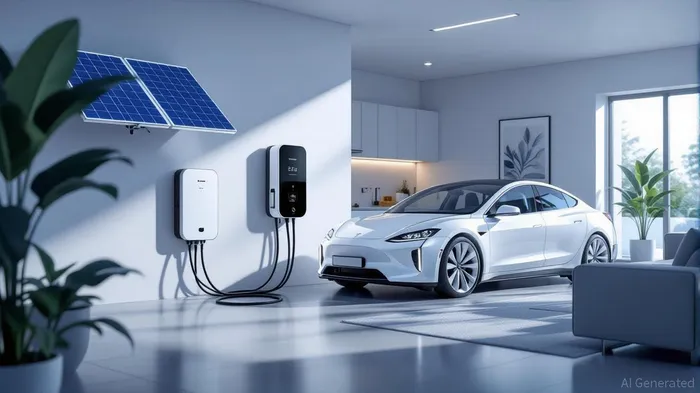
The global energy landscape is undergoing a seismic shift, driven by the convergence of renewable energy adoption, grid decentralization, and the rise of electric vehicles (EVs). At the forefront of this transformation is Enphase EnergyENPH--, whose IQ Bidirectional EV Charger is poised to redefine residential energy systems. By enabling seamless energy exchange between EVs, homes, and the grid, the charger addresses critical pain points in energy autonomy and grid stability, positioning EnphaseENPH-- as a key player in the decentralized energy revolution.
Strategic Innovation: Bridging EVs and Energy Systems
Enphase’s IQ EV Charger 2, launched in 2025, is a solar-aware, bidirectional Level 2 charger designed to integrate with its solar and battery ecosystems. It supports dynamic load balancing, surplus photovoltaic (PV) charging, and AI-powered optimization, allowing homeowners to maximize self-consumption of solar energy while avoiding grid overloads [1]. The charger’s compatibility with ISO 15118-20 standards ensures future-readiness for vehicle-to-home (V2H) and vehicle-to-grid (V2G) applications, which are expected to launch in 2026 [4]. This bidirectional capability is a game-changer: during outages, the EV battery can power critical home loads, while during peak grid demand, it can export energy to reduce costs or participate in demand-response programs [1].
The charger’s technical robustness—IP55 weatherproofing, a 7.5m Type 2 cable, and MID-certified metering—ensures reliability and precision in energy tracking. Priced at $2,200 in Australia, it includes a five-year warranty and integrates with France’s Linky smart meter system to enable real-time load balancing [3]. These features align with European market demands, where 53% of residential customers prioritize energy autonomy [3], and the charger’s E.V. READY certification in France further validates its compatibility with diverse EVs and smart home systems [2].
Market Expansion and Grid Decentralization Trends
Enphase’s global rollout of the IQ EV Charger 2 to 18 countries, including new European markets like Greece and Ireland, underscores its strategic focus on scalability. The charger’s configurable power (up to 32A per phase) and AI-driven optimization cater to three-phase systems, addressing grid constraints in regions with aging infrastructure [2]. This expansion aligns with broader trends: the residential energy storage market, valued at $2.84 billion in 2025, is projected to grow at a 38.6% CAGR through 2034, driven by solar-plus-storage adoption [3].
Grid decentralization is accelerating as 49% of end-users shift to solar-plus-storage setups, and 27% of off-grid communities integrate localized storage networks [3]. Enphase’s bidirectional charger enhances this trend by transforming EVs into mobile energy assets. For instance, during high-rate periods, homeowners can export 11.5 kW of bidirectional AC power to the grid, monetizing their EV’s battery capacity [1]. This capability is critical for virtual power plant (V2P) programs, where aggregated EV storage can stabilize grids during peak demand [4].
Financial and Regulatory Tailwinds
The bidirectional EV charger market is forecasted to grow from $6.3 billion in 2025 to $16.9 billion by 2030, with a 21.7% CAGR, driven by EV adoption and smart grid infrastructure [1]. Enphase’s entry into this market is well-timed: the U.S. alone is expected to see 35 million EV charge points by 2030, with the EVSE market reaching $100 billion by 2040 [4]. Regulatory support, such as the U.S. Bipartisan Infrastructure Law’s $7,500 EV tax credit, further accelerates demand for V2G-compatible infrastructure [1].
Enphase’s product roadmap, including fifth-generation batteries and the IQ9 microinverter, reinforces its competitive edge. While the bidirectional charger’s 2026 launch has been delayed, the company’s focus on innovation—such as GaN architecture and AI-powered control—positions it to capture market share in the $27.51 billion V2G market by 2030 [3].
Challenges and Considerations
Despite its promise, Enphase faces hurdles. The delayed bidirectional functionality and reliance on ISO 15118-20-compliant EVs (which are still niche) may slow adoption. Additionally, competition from Tesla’s V2G plans and Fermata’s pilot programs in the U.S. could pressure Enphase’s market share [4]. However, its ecosystem integration, global certifications, and first-mover advantage in Europe mitigate these risks.
Conclusion: A Disruptive Force in Energy Autonomy
Enphase’s IQ Bidirectional EV Charger is more than a product—it’s a linchpin in the transition to decentralized, resilient energy systems. By enabling V2H/V2G, it empowers homeowners to become active participants in grid management, reducing reliance on centralized utilities. As energy autonomy trends accelerate and grid decentralization becomes imperative, Enphase’s strategic innovations position it to lead the next phase of the energy transition. For investors, the company’s alignment with market dynamics, regulatory tailwinds, and technological foresight makes it a compelling bet in the $100 billion EVSE market.
Source:
[1] Enphase Bidirectional EV Charger [https://enphase.com/ev-chargers/bidirectional]
[2] Enphase Energy Expands IQ EV Charger 2 in Europe [https://newsroom.enphase.com/news-releases/news-release-details/enphase-energy-expands-iq-ev-charger-2-europe-new-markets/]
[3] Residential Energy Storage Systems Market Report [https://www.industryresearch.biz/market-reports/residential-energy-storage-systems-market-101152]
[4] Vehicle-to-Grid Market Analysis [https://www.nextmsc.com/report/vehicle-to-grid-market-ep3192]







Comentarios
Aún no hay comentarios