
Enphase Energy's Post-Momentum Valuation: Justified Growth or Overhyped Speculation?
Enphase Energy (ENPH) has emerged as a standout performer in the solar sector, with Q2 2025 results showcasing robust revenue growth, margin expansion, and a strong balance sheet. However, the question remains: Is the stock's current valuation, which still trades at a premium to industry averages, justified by fundamentals, or does it reflect speculative fervor amid broader market optimism?
Financial Performance: A Foundation of Growth
Enphase's Q2 2025 earnings report underscored its operational strength. Total revenue surged to $363.2 million, driven by the shipment of 1.53 million microinverters and 190.9 MWh of IQ® Batteries [1]. Non-GAAP gross margins hit 48.6%, while net income reached $89.9 million, translating to $0.69 earnings per share—$0.05 above estimates [1]. Free cash flow of $18.4 million and $1.53 billion in cash reserves further solidify its financial flexibility [1].
Geographically, U.S. revenue rose 3% sequentially, bolstered by seasonal demand, while European revenue grew 11% [1]. The company's alignment with the Inflation Reduction Act (IRA) also provides a strategic edge, as domestically produced microinverters and IQIQ-- Battery 5P systems qualify for domestic content bonuses [1]. Despite a 2% gross margin drag from tariffs, supply chain diversification efforts have mitigated Q3 headwinds to 3%-5% [1].
Valuation Metrics: A Premium with Caveats
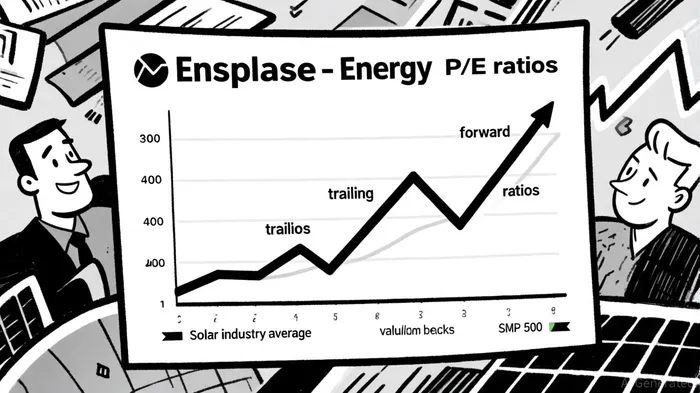
Enphase's trailing price-to-earnings (P/E) ratio of 30.11 and forward P/E of 15.41 [1] place it above the solar industry's average P/E of 20.63 [2]. While this premium reflects investor confidence in its innovation pipeline—such as fourth-generation batteries with 30% higher energy density and balcony solar systems—it also raises questions about sustainability. Historically, ENPH's P/E peaked at 245.7 in September 2024 but has since corrected to 30.27 as of September 2025, a 69% drop from its seven-year average of 96.86 [3].
The price-to-sales (P/S) ratio of 3.45 [1] is similarly elevated compared to the S&P 500's 2.84 but in line with peers like First SolarFSLR-- (17.27) and NextrackerNXT-- (18.07) [4]. Meanwhile, the price-to-book (P/B) ratio of 5.70–5.85 [5] suggests the market values Enphase's intangible assets (e.g., R&D, IRA eligibility) at a significant premium to its tangible book value.
Industry Context: Headwinds and Opportunities
The broader solar industry faces mixed signals. Q2 2025 saw U.S. installations drop 24% year-over-year and 28% quarter-over-quarter to 7.5 GWdc, driven by high interest rates and policy uncertainty [6]. The One Big Beautiful Bill Act (OBBBA), which phases out key tax credits after 2025 and 2027, has further clouded long-term growth prospects [6]. Yet, Enphase's focus on residential and commercial markets—segments expected to outperform utility-scale projects—positions it to capitalize on IRA-driven demand [1].
Sustainability of Growth: Innovation vs. Margin Pressures
Enphase's product roadmap, including next-gen batteries and financing options, addresses key pain points like space constraints and upfront costs. However, margin pressures from tariffs and supply chain costs remain a near-term risk. The company's Q3 revenue guidance of $330–370 million [1] implies a sequential decline, reflecting seasonal softness and macroeconomic headwinds.
Investor enthusiasm may also be tempered by the solar industry's broader valuation compression. While Enphase's forward P/E of 15.41 is attractive relative to its historical averages, it still trades at a 46% premium to the industry average [2]. This premium hinges on the assumption that Enphase can maintain its technological edge and scale IRA-eligible deployments faster than peers.
Conclusion: A Tug-of-War Between Fundamentals and Sentiment
Enphase Energy's Q2 performance demonstrates its ability to execute in a challenging environment, with strong cash flow generation and product innovation. However, its valuation remains a double-edged sword. The forward P/E and P/S ratios suggest the market is pricing in aggressive growth, which may be difficult to sustain given industry-wide headwinds like OBBBA and declining solar installations.
For investors, the key question is whether Enphase's IRA-eligibility and R&D pipeline can offset macroeconomic and policy risks. While the fundamentals are sound, the current valuation reflects a degree of optimism that may not fully align with the sector's near-term trajectory. In this context, Enphase appears to be a stock with justified momentum—but one that demands careful monitoring of both execution and external catalysts.





Comentarios
Aún no hay comentarios