
Ennis Inc.: Navigating Erosion and Acquisitions in a Digital-Driven Market
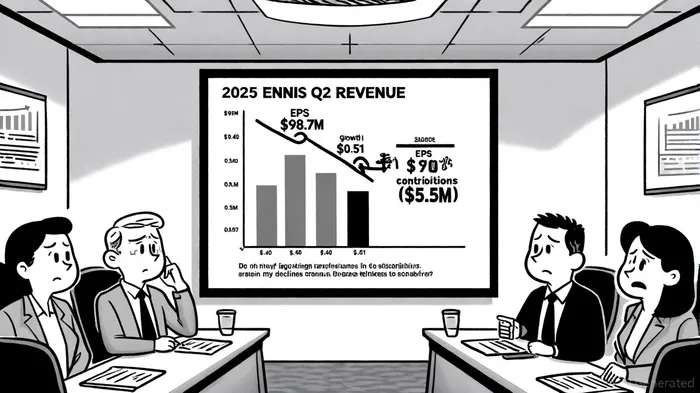
Ennis Inc. (EBF) has navigated a challenging Q2 fiscal 2025 with a mix of resilience and strategic recalibration. While the company reported a marginal 0.3% year-over-year revenue decline to $98.7 million[1], its earnings per diluted share (EPS) surged 27.5% to $0.51, driven by cost discipline and a $5.7 million legal settlement[2]. This performance underscores the company's ability to extract value from a shrinking core market, even as broader industry headwinds persist.
Operational Momentum: A Tale of Two Forces
Ennis' operational momentum is split between organic erosion and acquisition-driven growth. Organic revenue fell 6% in Q2 and 8.5% year-to-date, reflecting the ongoing shift away from traditional print products to digital solutions[3]. This trend aligns with industry-wide data showing a 40% increase in renewable energy adoption and a 7.2% CAGR for eco-friendly paper markets[4], both of which EnnisEBF-- must address to avoid further margin compression.
However, acquisitions have provided a critical counterbalance. The integration of Printing Technologies, Inc. (PTI) and Northeastern Envelope Company (NEC) contributed $5.5 million in Q2 revenue[1], with PTI's ERP integration and NEC's envelope expertise enhancing Ennis' diversification. While PTI has yet to meet profitability targets[3], its inclusion in the company's digital transformation strategy—such as AI-driven workflow tools—positions it as a long-term asset[4].
Inventory Strategy: A Double-Edged Sword
A pivotal move in Q2 was Ennis' decision to build inventory in carbonless paper, a response to the closure of the sole domestic producer. This strategy, while securing supply chain stability, has tied up significant capital. Inventory levels rose 60% year-to-date to $62.1 million[3], raising concerns about obsolescence risk as digital adoption accelerates. The company's cash reserves, though robust at $72.5 million[3], have declined 52.4% over six months due to inventory buildup and $8.5 million in share repurchases[1]. This cash burn highlights a tension between short-term operational security and long-term capital efficiency.
Balance Sheet Strength and Shareholder Returns
Ennis' debt-free balance sheet and 3.0x current ratio[3] provide flexibility to pursue further acquisitions or weather industry volatility. The company's commitment to shareholder returns—$92 million returned in fiscal 2025, including a special dividend[3]—reinforces its appeal to income-focused investors. However, the sustainability of these returns hinges on the successful integration of recent acquisitions and the ability to offset organic declines.
Industry Tailwinds and Strategic Risks
The printing industry's pivot toward sustainability and digital integration presents both opportunities and threats. Ennis' inventory of carbonless paper, while currently strategic, risks becoming obsolete as eco-friendly alternatives gain traction[4]. Conversely, the company's investments in digital printing technologies and ERP systems[1] align with the 2025 State of Print Production Report's emphasis on AI-driven efficiency[4].
A critical test for Ennis will be its ability to balance inventory management with innovation. The closure of the domestic carbonless paper producer could either be a temporary disruption or a catalyst for Ennis to accelerate its pivot toward sustainable materials.
Conclusion: A Precarious Equilibrium
Ennis' Q2 results reflect a company in transition. While its acquisition strategy and balance sheet strength offer a buffer against organic decline, the sustainability of its growth model remains unproven. Investors must weigh the short-term benefits of inventory security and shareholder returns against the long-term risks of market obsolescence and integration challenges. For Ennis, the path forward lies in leveraging its financial flexibility to adapt to a digital-first, sustainability-driven industry—before its traditional assets become liabilities.
Historical backtesting of EBF's earnings events from 2022 to 2025 reveals that a simple buy-and-hold strategy around these dates yielded a median return of -0.3% in the first week, improving to +1.3% by day 30, with a win rate rising from 43% to 64%. However, these gains were not statistically significant, underscoring the stock's weak post-earnings drift.





Comentarios
Aún no hay comentarios