
Enhancing Risk-Adjusted Returns with DBMF: A Diversification Play in Volatile Markets
DBMF's Strategy: A Hedge Against Equity Volatility
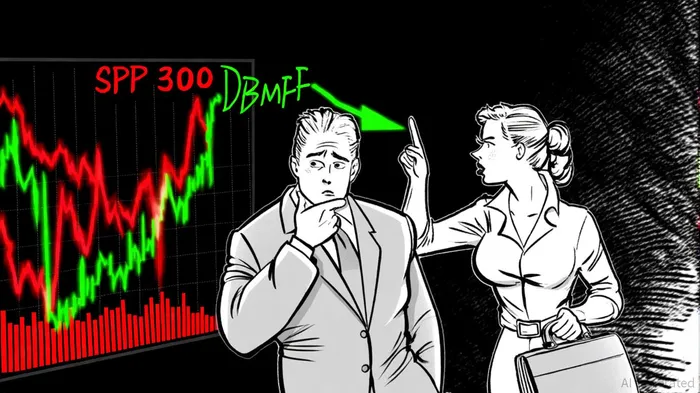
DBMF operates by replicating the performance of leading managed futures hedge funds, employing long and short positions in futures and forward contracts across equities, fixed income, currencies, and commodities (iMGP DBi Managed Futures Strategy ETF). This systematic approach allows the fund to capitalize on trends and volatility, often generating returns that diverge from traditional asset classes. According to a Seeking Alpha article, DBMF has demonstrated a low correlation with equities, functioning as a "zigzag" counterbalance to the S&P 500's "zag" during downturns. For instance, during the 2022 market selloff, when the S&P 500 plummeted, DBMF delivered strong returns, underscoring its potential as a risk-mitigation tool, as the Seeking Alpha article notes.
Performance During Market Downturns: A Resilience Test
While specific metrics for the 2008 financial crisis and 2020 market crash remain elusive in public records, the Seeking Alpha article observes that DBMF's 2022 performance offers a telling case study. During that year, the fund's exposure to fixed income and short positions in the Japanese yen contributed to gains amid declining 10-year yields, according to the same Seeking Alpha coverage. This adaptability aligns with the core thesis of managed futures strategies: to profit from volatility rather than merely endure it.
Comparative data from Seeking Alpha highlights the importance of risk-adjusted returns in evaluating such strategies. For example, a Seeking Alpha piece on ICVT shows the ICVT ETF (iShares Convertible Bond ETF) has a Sharpe ratio of 0.57 since 2015, compared to the S&P 500's 0.8. While DBMF's Sharpe ratio is not explicitly disclosed, its Four Star Overall Morningstar Rating™ (as of September 30, 2025) among 62 US ETF Systematic Trend Funds suggests competitive risk-adjusted performance, as noted on the issuer's site.
Strategic Role in a Balanced Portfolio
DBMF's appeal lies in its dual role as a diversifier and a source of uncorrelated returns. Historical data indicates it outperforms the Bloomberg US Agg bond index by 532 basis points annually, as noted in the May 2025 update, a critical edge for investors seeking alternatives to traditional fixed income. By integrating DBMF into equity-heavy portfolios, investors can reduce downside risk without sacrificing growth potential.
However, it is not a perfect hedge. Broader market movements-such as the 2023 inflationary surge-can still impact its performance, a limitation the Seeking Alpha article highlights. This underscores the need for a balanced approach, combining DBMF with other uncorrelated assets to optimize risk-adjusted returns.
Conclusion: A Forward-Thinking Allocation
As markets grapple with geopolitical tensions, inflationary pressures, and interest rate uncertainty, the demand for resilient, low-correlation assets will only grow. DBMF's systematic trend-following strategy, coupled with its historical resilience during downturns, positions it as a strategic complement to traditional equities. While investors should remain mindful of its limitations, the fund's Morningstar rating and performance during the 2022 crisis make a compelling case for its inclusion in a diversified, forward-thinking portfolio.





Comentarios
Aún no hay comentarios