
Enhabit's Strategic Positioning and 2026 Pricing Outlook: Navigating Regulatory Headwinds with Valuation Resilience
The home healthcare sector faces a pivotal inflection point in 2026, as CMS's proposed 6.4% Medicare payment reduction threatens to reshape industry dynamics. For Enhabit Inc.EHAB-- (NYSE: EHAB), a leader in home health and hospice services, the challenge is twofold: mitigating the financial impact of reimbursement cuts while maintaining operational scalability in a fragmented market. This analysis examines Enhabit's strategic initiatives, financial resilience, and valuation positioning amid regulatory headwinds, drawing on recent data and management commentary.
Regulatory and Reimbursement Challenges: A 2026 Crossroads
According to CMS's proposed 2026 rule, a 6.4% payment reduction is introduced, driven by productivity adjustments, overpayment recoupments, and a permanent 1% cut to align spending with costs. These changes, if finalized, would exacerbate existing pressures on home health agencies (HHAs), particularly in rural and underserved areas where margins are already thin. For EnhabitEHAB--, which operates in 35 states and serves over 100,000 patients monthly, the cuts risk eroding profitability unless offset by operational efficiencies or strategic consolidation.
The 2025 final rule, which included a 0.5% aggregate payment increase but recalibrated PDGM case-mix weights and wage index adjustments, already signaled CMS's intent to refine reimbursement models. Enhabit's leadership has acknowledged these shifts as a catalyst for industry consolidation, with smaller providers potentially exiting the market.
Strategic Initiatives: Efficiency, Innovation, and Expansion
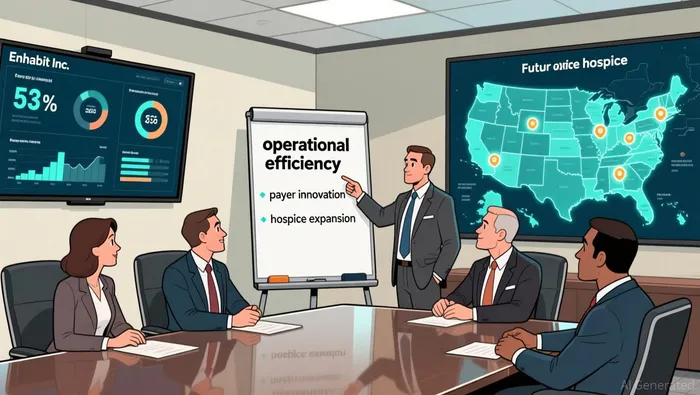
Enhabit's response to these challenges centers on three pillars: operational efficiency, payer innovation, and strategic growth.
Visit-Per-Episode (VPE) Optimization
Enhabit's advanced VPE management program, piloted in 2025, has reduced average visits per episode from 15 to 13 in test locations. By expanding this initiative to 80+ sites by year-end, the company aims to save $5–8 million annually per half-visit reduction. This approach aligns with CMS's PDGM framework, which ties payments to patient acuity rather than service volume, incentivizing care coordination over excessive visits.Payer Innovation and Contract Renegotiation
Renegotiated national payer contracts and the addition of 64 new payor agreements since 2022 have bolstered Enhabit's revenue streams. These efforts have improved access to services and stabilized patient census, with sequential growth reported in Q3 2025. The company's focus on non-Medicare payers-such as commercial insurers and state Medicaid programs-reduces reliance on a single reimbursement source, a critical hedge against CMS volatility.Hospice Expansion and De Novo Growth
Enhabit's hospice segment has emerged as a key growth driver, with Q3 2025 net service revenue up 20% year-over-year to $63.1 million. The company plans to open 10 de novo hospice locations in 2025, leveraging its existing infrastructure to capitalize on the aging U.S. population and rising demand for end-of-life care. This diversification into hospice, which typically generates higher margins, strengthens Enhabit's long-term financial profile.
Financial Resilience: Balancing Debt Reduction and Strategic Investment
Enhabit's Q3 2025 financials underscore its ability to navigate headwinds. Total net service revenue rose 3.9% year-over-year to $263.6 million, with hospice contributing 24% of total revenue according to market data. Adjusted EBITDA reached $27.0 million, driven by a 72% year-over-year increase in hospice EBITDA as reported in financials.
The company has also made progress in deleveraging its balance sheet, reducing net debt to Adjusted EBITDA leverage from 4.9x in late 2023 to 3.9x in Q3 2025. A $100 million reduction in bank debt since Q4 2023 has generated $19.2 million in annualized cash interest savings, providing flexibility for strategic investments. Analysts at the UBS Global Healthcare Conference noted Enhabit's disciplined cost management, including general and administrative (G&A) savings and labor cost optimization.
Valuation Resilience: A Case for Strategic Positioning
Despite the proposed 2026 cuts, Enhabit's valuation appears resilient. The company's focus on high-margin hospice services, operational efficiency, and payer diversification positions it to outperform peers. For instance, its VPE initiative could offset up to 40% of the 2026 payment reduction based on current savings estimates. Additionally, the potential for industry consolidation-driven by smaller providers' inability to absorb rate cuts-creates acquisition opportunities for Enhabit, which has signaled readiness to expand in underserved markets.
However, risks remain. Enhabit's overall earnings have declined at an annual rate of -55.2% over the past five years, significantly below the healthcare industry's 3.6% growth. While hospice performance is robust, home health revenue in Q3 2025 was flat year-over-year, highlighting the sector's vulnerability to reimbursement pressures.
Conclusion: A Calculated Path Forward
Enhabit's strategic initiatives-rooted in efficiency, innovation, and diversification-demonstrate a proactive approach to mitigating 2026's regulatory challenges. By reducing visit intensity, renegotiating payer contracts, and expanding hospice services, the company is positioning itself to maintain profitability even under a 6.4% Medicare cut. Its strong balance sheet and disciplined cost structure further reinforce valuation resilience.
For investors, Enhabit represents a compelling case study in adaptive leadership within a high-growth, high-risk sector. While the 2026 outlook is uncertain, the company's ability to balance operational rigor with strategic growth suggests it is well-equipped to navigate the evolving home healthcare landscape.





Comentarios
Aún no hay comentarios