
The Energy Transition and Fossil Fuel Valuation: Navigating Opportunities Amid Declining Gasoline Demand
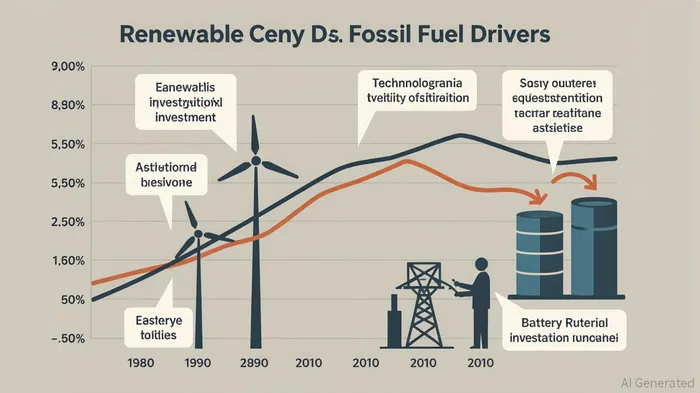
The global energy landscape in 2025 is defined by a tectonic shift: the accelerating energy transition is reshaping demand fundamentals, equity valuations, and sector rotation strategies. As gasoline demand faces a long-term decline driven by electrification and renewable adoption, investors must navigate a complex interplay of decarbonization goals, geopolitical volatility, and evolving infrastructure needs. This analysis explores how strategic sector rotation and energy equity positioning can unlock value in this dynamic environment.
The Gasoline Demand Dilemma: Stability vs. Long-Term Decline
Global gasoline demand remains resilient in the near term, supported by urbanization and vehicle ownership in emerging markets. However, long-term projections point to a structural decline. BloombergNEF's Energy Transition Investment Trends 2025 highlights that $2.1 trillion in energy transition investments in 2024—focused on EVs, solar PV, and wind—will erode gasoline's dominance as electrification gains traction [1]. The International Energy Agency (IEA) reinforces this, noting that clean energyCETY-- technologies' market value surpassed $700 billion in 2023 and is projected to triple by 2035 [2].
Yet, the transition is uneven. While developed economies prioritize EV adoption and grid modernization, emerging markets like India and Indonesia may rely on gasoline for longer due to infrastructure gaps and cost barriers [2]. This divergence creates a “two-speed” demand trajectory: modest growth in the short term, but a clear long-term contraction as electrification and synthetic fuels (e.g., e-gasoline) scale [2].
Strategic Sector Rotation: From Tech to Energy and Industrials
The energy transition is not just a decarbonization story—it's a catalyst for sector rotation. In 2025, capital is increasingly shifting from overvalued tech and AI stocks to cyclical sectors like energy and industrials, driven by macroeconomic realities and the energy demands of AI itself [1]. For instance, companies like ExxonMobil and ChevronCVX-- are benefiting from sustained oil demand in hard-to-abate sectors (e.g., aviation, shipping) and infrastructure investments tied to the Inflation Reduction Act (IRA) [1].
Meanwhile, midstream energy infrastructure—pipelines, LNG terminals, and storage—is emerging as a critical growth lever. The IRA's tax incentives for clean energy projects have spurred demand for construction contractors and nuclear providers, while geopolitical tensions (e.g., U.S.-Russia sanctions, OPEC+ output adjustments) continue to drive oil price volatility [1]. Investors are also pivoting toward industrial players like CaterpillarCAT-- and General Electric, which supply equipment for advanced manufacturing and grid modernization [1].
Energy Equity Valuations: The Renewables Premium and Fossil Fuel Paradox
Renewables are outpacing fossil fuels in capital allocation, with $2.2 trillion directed to clean energy in 2025 versus $1.1 trillion for oil, gas, and coal [4]. Solar power alone attracted $450 billion in investments, pushing clean energy past 40% of global electricity generation in 2024 [2]. However, public market valuations for renewables remain constrained by regulatory uncertainty and grid bottlenecks, despite robust private sector interest [4].
Conversely, fossil fuels face a valuation paradox. While upstream oil investments are projected to decline by 6% in 2025—the first drop since 2020—private equity has funneled $15.31 billion into fossil fuels in 2024, a 131% surge year-over-year [4]. This reflects lingering energy security concerns and the slow phase-out of coal in countries like China and India [1]. For investors, this duality underscores the need to differentiate between transitional assets (e.g., LNG terminals) and stranded ones (e.g., coal plants).
Navigating the Transition: A Balanced Approach
The energy transition is not a zero-sum game. Investors who align with both the risks and opportunities of this shift can capitalize on three key themes:
1. Infrastructure as a Growth Engine: Midstream energy and grid modernization will benefit from IRA-driven spending and AI's insatiable power demands.
2. Synthetic Fuels as a Bridge: E-gasoline and green hydrogen could fill gaps in sectors where electrification is impractical, creating niche opportunities for chemical and energy firms [2].
3. Geopolitical Hedging: Diversified portfolios that balance exposure to oil (for stability) and renewables (for growth) can weather macroeconomic shocks and policy shifts.
Conclusion
The energy transition is redefining the rules of the game for investors. While gasoline demand will wane over the next decade, the pace of decline and the rise of synthetic alternatives offer flexibility for strategic positioning. By rotating into energy and industrials, prioritizing infrastructure, and hedging against fossil fuel volatility, investors can navigate the transition's uncertainties while capturing long-term value. As BP's chief economist notes, oil demand may peak at 100 million barrels per day by 2035—but the path to that peak is paved with opportunities for those who adapt [2].







Comentarios
Aún no hay comentarios