
Energy Transfer: A High-Yield Dividend Powerhouse in a Low-Yield World
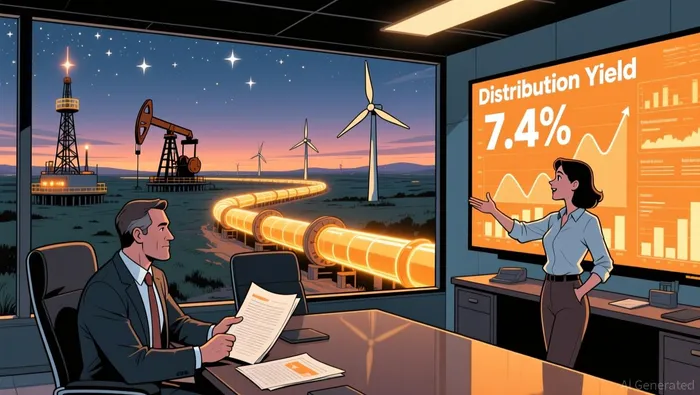
In an era where traditional fixed-income assets like U.S. Treasury bonds and broad-market indices offer meager yields, income-focused investors are increasingly turning to alternative avenues to meet their cash flow needs. Energy Transfer LPET-- (ET), a midstream energy infrastructure giant, has emerged as a compelling option. With a forward distribution yield of 7.4% to 7.9%-significantly outpacing the 4.3% yield of 10-year Treasuries and the 1.2% average yield of the S&P 500-ET offers a rare combination of high income and long-term capital appreciation potential. This article evaluates Energy Transfer's historical performance, dividend sustainability, and strategic value for investors navigating today's low-yield environment.
Long-Term Total Returns: Compounding Power Through Dividend Reinvestment
Energy Transfer's long-term performance underscores its appeal for patient, income-oriented investors. Over the past five years, the stock has delivered a total return of 325.53% with reinvested dividends, far outpacing the S&P 500's 86.5% return during the same period according to data. This outperformance is even more striking when considering the 19-year total return from February 2006 to September 2025, which reached 1,058.26%, translating to a compound annual growth rate (CAGR) of 13.31% according to total real returns.
While the 10-year total return (as of September 2025) is reported at 226.82%, a more recent data point up to November 2025 shows a 10-year total return of 49.42%, or a CAGR of 4.05% according to Yahoo Finance. This apparent discrepancy likely reflects differing time frames or valuation assumptions. Regardless, the broader trend remains clear: Energy TransferET-- has historically delivered robust returns, driven by consistent dividend reinvestment and compounding.
Dividend Sustainability: A Foundation of Cash Flow and Growth
A critical factor in Energy Transfer's appeal is its sustainable and growing dividend. The company's distributable cash flow (DCF) has consistently exceeded its payout, with a coverage ratio of 1.9x in 2024 (DCF of $8.36 billion vs. distributions of $4.39 billion) . This strong coverage, combined with conservative payout ratios, provides a buffer against economic downturns and reinforces confidence in the dividend's stability.
Management has also set ambitious growth targets, aiming for annual distribution growth of 3% to 5% . Analysts project that Energy Transfer's adjusted EBITDA will grow at a 5% CAGR from 2024 to 2027, further supporting its ability to sustain and expand payouts . These metrics position ET as a rare high-yield stock with credible growth prospects, a critical consideration in a market where many high-dividend equities lack reinvestment potential.
Strategic Value in a Low-Yield Environment
The current yield environment underscores Energy Transfer's strategic value. With the S&P 500's 2025 dividend yield estimated at 1.15% and 10-year Treasury yields at 4.3% , investors seeking income face a stark trade-off between safety and return. Energy Transfer bridges this gap by offering a 7.4% to 7.9% yield , backed by the operational resilience of its midstream energy infrastructure.
This yield premium is not without risk, however. Energy Transfer's stock has experienced volatility, including a -7.49% total return in 2025 (YTD) according to total real returns, reflecting broader market pressures on energy infrastructure. Yet, its long-term performance-particularly its 53.88% rebound in 2024 according to total real returns-demonstrates its ability to recover and compound value over cycles. For investors with a multi-year horizon, these fluctuations are less concerning than the compounding power of its dividend reinvestment and growth trajectory.
Conclusion: A Compelling Case for Income Investors
Energy Transfer LP presents a compelling case for income-focused investors in a low-yield world. Its historical total returns, combined with a high-yield, sustainable dividend and strong cash flow coverage, make it a rare asset class that balances income generation with long-term capital growth. While market volatility and energy sector risks remain, the company's disciplined capital allocation, robust DCF, and growth-oriented management team position it to deliver value over the long term. For investors seeking to enhance their portfolios with a high-yielding, compounding engine, Energy Transfer deserves serious consideration.





Comentarios
Aún no hay comentarios