
Energy Transfer: A Compelling Value Play in the Midstream Sector
The midstream energy sector has long been a cornerstone of stable, fee-based cash flows, but few companies exemplify the intersection of undervaluation, growth potential, and income generation as compellingly as Energy Transfer LPET-- (ET). As of November 2025, ET trades at a forward Enterprise Value-to-EBITDA (EV/EBITDA) multiple of 7.8x, significantly below the sector average, while simultaneously positioning itself to capitalize on the AI-driven energy transition. With a robust project pipeline, a dividend yield approaching 8%, and a valuation that appears disconnected from its fundamentals, Energy TransferET-- offers a rare combination of value and growth.
Undervaluation: A Mispricing Amidst Transient Headwinds
Energy Transfer's current valuation reflects a market that may be underappreciating its long-term cash flow durability. As of November 2025, the company's enterprise value stood at $116.57 billion, with a trailing twelve months (TTM) EBITDA of $15.196 billion, yielding an EV/EBITDA multiple of approximately 7.7x. This represents a discount to historical midstream averages, which typically trade at 8.5x to 9.5x, and suggests the market is discounting near-term challenges rather than long-term potential.
The third quarter of 2025 saw adjusted EBITDA dip to $3.84 billion, down from $3.96 billion in the same period in 2024, due to one-time items. However, this decline was partially offset by strong volume growth in key segments such as NGL and Permian midstream operations according to Q3 results. The company's extensive infrastructure-spanning natural gas transportation, crude oil logistics, and NGL fractionation-provides a durable cash flow base that is less cyclical than upstream peers. With 3.456 billion shares outstanding as of September 30, 2025, and a growth capital expenditure plan of $4.6 billion for 2025, Energy Transfer is investing in projects that should bolster EBITDA in the coming years.
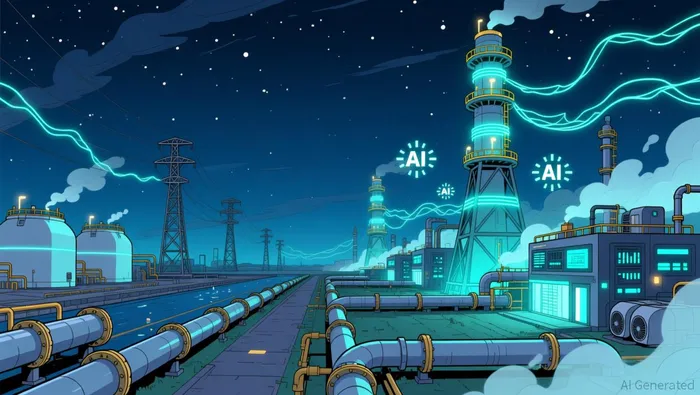
AI-Driven Natural Gas Demand: A Tailwind for Future Growth
The AI boom is reshaping energy demand, and Energy Transfer is strategically positioned to benefit. Natural gas is emerging as a critical fuel for powering data centers, which require reliable, affordable energy to support AI workloads. Energy Transfer has already secured long-term supply agreements with major tech firms, including Oracle, to deliver 900,000 cubic feet of natural gas per day for data center operations as per market analysis.
Moreover, the company is expanding its involvement in AI-related infrastructure. Projects such as the Lake Charles LNG terminal and the Hugh Brinson Pipeline are designed to enhance its fee-based cash flow visibility, with the latter expected to add over $1 billion in annual throughput by 2027. These initiatives align with broader industry trends: AI applications are projected to drive a 20% increase in power demand by 2030, with natural gas serving as a bridge to decarbonization due to its lower emissions profile compared to coal and its reliability against intermittent renewables.
Robust Yield: A Dividend Backed by Strong Cash Flow Coverage
Energy Transfer's 8% forward dividend yield is among the most attractive in the energy sector, supported by a distribution coverage ratio of 1.7x in Q3 2025. This level of coverage-where cash flow exceeds dividend obligations-ensures the sustainability of payouts even amid near-term volatility. The company's project backlog, including $4.6 billion in 2025 growth capital expenditures, further strengthens its ability to grow distributions over time.
Critically, Energy Transfer's low valuation amplifies its yield appeal. At a forward EV/EBITDA of 7.8x, the company trades at a discount to peers such as Kinder Morgan (8.9x) and Enterprise Products Partners (9.1x), despite having a stronger project pipeline and higher yield. This discrepancy suggests the market is not fully pricing in its AI-driven growth prospects or the resilience of its fee-based business model.
Conclusion: A Strategic Buy for Income and Growth
Energy Transfer's combination of undervaluation, AI-driven growth catalysts, and a robust dividend yield makes it a standout in the midstream sector. The company's low EV/EBITDA multiple reflects a market that may be underestimating its ability to adapt to the energy transition, particularly as natural gas becomes a critical enabler of AI infrastructure. With a distribution coverage ratio that ensures yield sustainability and a project pipeline that should drive EBITDA growth, Energy Transfer offers investors a rare opportunity to capture both income and capital appreciation in a sector often overlooked in favor of higher-risk alternatives.







Comentarios
Aún no hay comentarios