
Energy Security and Geopolitical Risk: Navigating Oil Market Volatility in 2025
The global oil market in late 2025 remains a theater of geopolitical fragility, with tensions in Iran, Russia, and Venezuela creating persistent risks to energy security. While these developments have yet to trigger sharp price spikes-due in part to a global supply surplus-they underscore the growing complexity of hedging against geopolitical shocks in an era of fragmented markets and energy transition pressures. For investors, the interplay of near-term volatility and long-term structural shifts demands a nuanced approach to positioning in energy equities and commodities.
Geopolitical Fault Lines and Supply Chain Vulnerabilities
Iran continues to face domestic unrest and external pressures that threaten its oil exports. Protests and civil instability have raised concerns about potential disruptions to production, with at least 1.9 million barrels per day at risk of being offline. While immediate supply shocks are unlikely to materialize due to the current global surplus, the long-term risk of a regime change or broader Middle East realignment could reshape energy flows. Chinese independent refiners, already shifting away from Venezuelan crude due to U.S. sanctions, are increasingly turning to Iranian heavy crude to fill gaps. This trend highlights the growing bifurcation of global energy markets, where sanctioned regimes rely on "flag-hopping" and alternative trade routes to maintain exports.
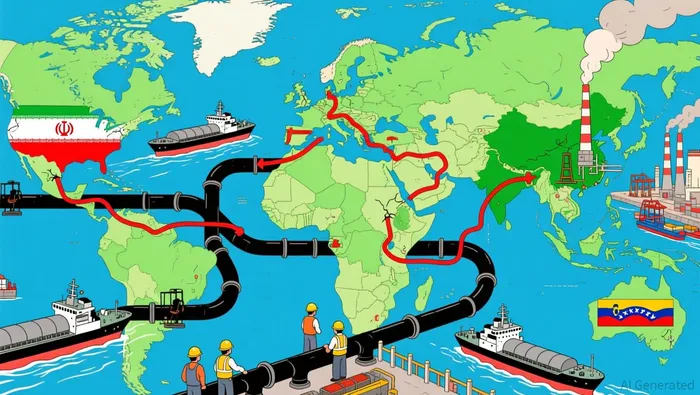 Russia's pivot to Asian markets has further complicated the global oil balance. Despite Western sanctions, Moscow has sustained crude exports to China and India, extending average voyage distances and boosting tanker demand. However, recent partnerships with Iran and Venezuela have yielded limited success, raising questions about Russia's ability to serve as a reliable geopolitical ally. This erosion of credibility may prompt realignments in the coming years, creating both risks and opportunities for investors attuned to shifting alliances.
Venezuela remains a case study in underutilized potential. The U.S.-led removal of Nicolás Maduro and the prospect of a new administration could eventually unlock multi-billion-dollar investments in oil infrastructure. Yet, in the short term, production shortfalls persist, with exports unlikely to significantly impact global supply until political and economic stability improve. U.S. Gulf Coast refiners, however, may benefit from potential increases in Venezuelan heavy crude imports, which could enhance refining margins.
Investment Strategies: Hedging Against Uncertainty
Historically, energy commodities and equities have served as hedges during geopolitical crises, but their effectiveness in 2025 is tempered by evolving market dynamics. A report by the International Energy Agency notes that oil prices have not surged despite major disruptions in Iran, Russia, and Venezuela, as structural supply constraints and demand-side factors-such as electrification and efficiency gains-have dampened volatility. Strategic reserves and spare production capacity also act as buffers, limiting the immediate impact of supply shocks.
For investors, the key lies in balancing short-term volatility with long-term fundamentals. In the near term, energy infrastructure upgrades and regional realignments present opportunities. For example, companies involved in tanker operations or midstream logistics may benefit from extended voyage distances and increased demand for seaborne oil transport. Equities in refining sectors, particularly those with access to discounted heavy crude from Venezuela or Iran, could also see margin improvements.
Long-term positioning requires a broader lens. The energy transition is accelerating, with renewables and gas gaining prominence. Solar power, for instance, is projected to attract USD 450 billion in investment in 2025, driven by cost declines and scalability. Nuclear energy, too, is gaining traction, with small modular reactors attracting USD 70 billion in annual spending. These sectors offer resilience against geopolitical risks by diversifying energy sources and reducing reliance on hydrocarbon markets.
Disciplined Risk Management and Strategic Positioning
Experts recommend an "all-of-the-above" approach to energy investment, combining exposure to traditional hydrocarbons with emerging technologies. For example, energy transition-focused equities-such as Ramaco Resources Inc. (METC) and NextDecade Corp. (NEXT)-have shown strong 30-day returns, reflecting investor appetite for innovation amid uncertainty. Similarly, diversified energy firms with operations in both fossil fuels and renewables are well-positioned to navigate fragmented markets.
However, investors must remain cautious. Geopolitical risks in Iran, Russia, and Venezuela remain fluid, with outcomes dependent on political stability, sanctions relief, and technological advancements. As one analysis notes, "the credibility of Russian support for its allies is increasingly in question, opening windows for realignment with Western-aligned economies". This underscores the need for active security selection and disciplined risk management.
Conclusion
The oil markets of 2025 are defined by a delicate balance between geopolitical fragility and energy transition momentum. While supply shocks from Iran, Russia, and Venezuela have yet to drive significant price volatility, the long-term implications of these tensions-coupled with the rise of renewables-demand a strategic, diversified approach to energy investing. By prioritizing infrastructure resilience, regional realignments, and exposure to emerging technologies, investors can hedge against uncertainty while aligning with the evolving energy landscape.







Comentarios
Aún no hay comentarios