
Energy Sector Rebalancing: How American Oil Majors Are Outperforming Smaller Producers Amid Persistent Price Pressure
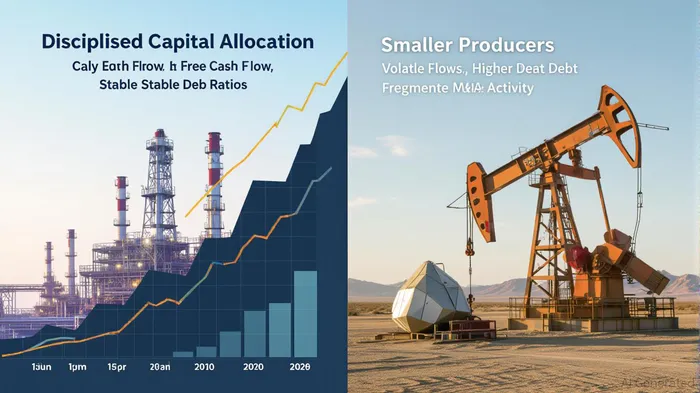
The global energy sector is undergoing a significant rebalancing, driven by persistent price pressures and divergent capital allocation strategies between American oil majors and smaller independent producers. As market dynamics shift, the ability of firms to prioritize efficiency, resilience, and strategic focus has become a critical determinant of performance. Recent trends underscore a clear divide: major oil companies are leveraging disciplined capital management and operational scale to outperform smaller peers, while independent producers grapple with profitability challenges and fragmented growth strategies.
Capital Allocation Efficiency: Discipline vs. Expansion
American oil majors such as ExxonMobil, ChevronCVX--, and BPBP-- have adopted a disciplined approach to capital allocation, prioritizing shareholder returns and core upstream operations over speculative investments in renewables. For instance, ExxonMobil's 2025 acquisition of Pioneer Natural Resources in the U.S. Permian Basin exemplifies a strategic focus on high-margin, resource-rich assets[1]. This move not only bolstered its production capacity but also enhanced free cash flow generation, a metric critical for sustaining dividends and share repurchases. In contrast, smaller producers—represented by a group of 22 U.S.-listed exploration and production (E&P) companies—have increased capital expenditures in 2025, driven by M&A activity and asset integration[3]. However, their spending remains constrained by consolidation cycles and weaker balance sheets, limiting their ability to scale operations or withstand price volatility.
The majors' emphasis on core oil and gas operations has also led to a retreat from renewable energy investments, a shift that reflects a pragmatic response to current market realities[3]. By reallocating capital to high-return projects and reducing exposure to unproven technologies, these firms have strengthened their financial resilience. Smaller producers, meanwhile, lack the scale and liquidity to make similar adjustments, often relying on debt financing to fund expansion—a strategy that amplifies vulnerability during downturns.
Financial Resilience: Stability vs. Volatility
The financial performance of oil majors in 2025 highlights their superior resilience. Despite broader industry challenges, companies like ExxonMobil maintained robust profitability, supported by cost optimization and operational efficiency[1]. Their debt ratios remain relatively stable, enabling them to fund dividends and strategic acquisitions without overleveraging. Independent producers, however, face a different reality. Weaker upstream performance and restructuring costs have eroded earnings, as seen in BP's and Chevron's recent results[1]. Smaller firms also struggle with higher debt burdens, which constrain flexibility and force them to prioritize short-term liquidity over long-term growth.
Strategic Resilience: M&A and Reserve Additions
M&A activity further illustrates the strategic divergence. Oil majors are consolidating their positions through targeted acquisitions, such as ExxonMobil's Permian Basin expansion, which adds low-cost reserves and enhances operational leverage[1]. These moves are underpinned by strong balance sheets and access to capital markets. Smaller producers, by contrast, are often on the receiving end of such deals, with many retreating from aggressive expansion due to price pressures[2]. Their capital allocation remains fragmented, with spending concentrated in high-risk, high-reward shale plays that offer limited downside protection.
Future Implications
The current rebalancing underscores a broader trend: the energy sector is increasingly favoring firms that can combine operational discipline with strategic agility. For oil majors, this means maintaining a focus on core competencies while selectively exploring hybrid opportunities in the energy transition. For smaller producers, the path forward will likely involve further consolidation or a pivot to niche markets where they can leverage agility. Investors, meanwhile, must weigh the trade-offs between the stability of majors and the growth potential of smaller firms, recognizing that capital allocation efficiency will remain a defining factor in sector performance.







Comentarios
Aún no hay comentarios