
Energy Policy Reforms and the Risk of Regional Fragmentation in Canada
Canada's energy sector in 2025 stands at a crossroads, shaped by a patchwork of provincial and federal policies that reflect both ambition and contradiction. While the federal government has championed the Climate Competitiveness Strategy-a framework emphasizing industrial carbon pricing, clean energy investment, and critical minerals development-provincial priorities remain deeply fragmented. This divergence, particularly between oil-dependent provinces like Alberta and climate-focused jurisdictions such as Quebec, has created a volatile landscape with significant political and economic risks for investors.
Political Conflicts and Policy Divergence
The tension between federal climate goals and provincial economic priorities is most evident in the oil and gas sector. Provinces like Alberta and Saskatchewan, which rely heavily on fossil fuel extraction, have resisted aligning production with national emissions reduction targets. For instance, Alberta's recent electricity market restructuring, which introduces location-based pricing and financial incentives for incumbents, underscores its commitment to maintaining fossil fuel dominance. Conversely, Quebec has positioned itself as a climate leader by forgoing fossil fuel development altogether.
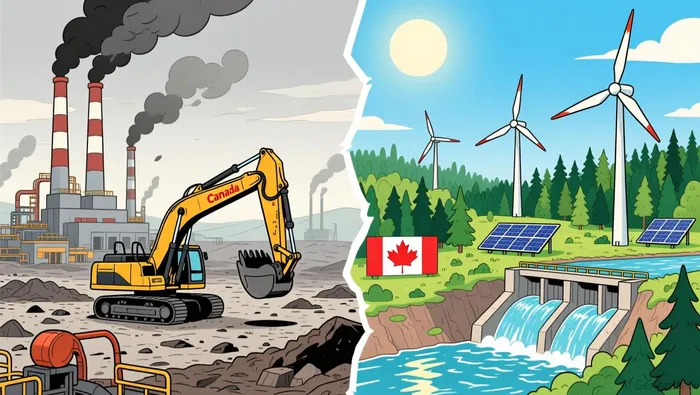 This divergence has escalated into direct conflicts over jurisdiction. The federal Clean Electricity Regulations, designed to reduce CO₂ emissions from power generation, faced pushback from Alberta and Saskatchewan, who accused Ottawa of overstepping provincial authority. Such disputes highlight the fragility of Canada's unified climate strategy, with the federal government increasingly forced to negotiate compromises, such as the recent rollbacks of climate rules in an energy deal with Alberta.
Economic Risks: Market Instability and Investment Shifts
The policy fragmentation has tangible economic consequences. Canada's oil and gas sector, responsible for nearly a third of the country's emissions, faces mounting risks as global demand shifts toward low-carbon alternatives. Provinces dependent on fossil fuels are projected to see oil and gas revenues decline by over 80% in the 2030s, necessitating a costly pivot to clean energy and critical minerals. Meanwhile, capital expenditures in the energy sector reached $89 billion in 2024, with oil and gas extraction accounting for $43 billion according to data. However, rising U.S. tariffs and trade uncertainties under the USMCA/CUSMA framework have already dampened investment momentum.
Investors are also navigating a rapidly evolving regulatory environment. The Competition Bureau's expanded authority to review energy mergers has extended approval timelines and increased the risk of conditional deals. For example, the Major Projects Office (MPO) was established to fast-track projects aligned with clean growth and Indigenous engagement, but its focus on "nationally significant" initiatives has left smaller, provincial-level projects in limbo. This bifurcation of priorities creates market instability, as seen in the mixed fortunes of projects like LNG Canada's Phase 2 and the Darlington New Nuclear Project.
Trade Implications and Global Market Volatility
Trade dynamics further complicate the outlook. Canada's exports surged to $997 billion in 2024, driven by gold shipments to the UK and a strategic shift away from Chinese suppliers. However, U.S. tariff threats under President Donald Trump's administration have forced Canadian businesses to localize production and diversify supply chains. For energy exports, this means a growing emphasis on non-U.S. markets, particularly in Asia, where demand for LNG remains strong but is increasingly tied to decarbonization commitments.
The Canadian dollar has also been affected, with the loonie projected to average 0.66 cents per U.S. dollar in 2025 due to divergent interest rate policies between the two countries. This volatility adds another layer of risk for energy exporters, particularly those reliant on U.S. markets.
Investment Implications and Strategic Considerations
For investors, the key challenge lies in balancing short-term gains with long-term sustainability. Provinces like Quebec and British Columbia, which have embraced net-zero building codes and renewable energy incentives, offer stable environments for clean energy investments. In contrast, oil-dependent provinces present higher risks, including potential stranded asset scenarios as global demand wanes.
However, opportunities exist in transitional sectors. The expansion of CO₂ pipeline networks and carbon capture and storage (CCS) projects-backed by federal subsidies-could mitigate some of the sector's risks. Similarly, critical minerals development, prioritized under the Climate Competitiveness Strategy, is attracting capital as global supply chains shift toward electrification and green technologies.
Conclusion
Canada's energy policy landscape in 2025 is defined by a precarious balance between federal climate ambitions and provincial economic realities. While harmonized policies account for the majority of projected emission reductions, the persistence of regional fragmentation threatens to undermine national goals and destabilize markets. For investors, the path forward requires a nuanced understanding of these divergent priorities, with a focus on sectors and regions that align with both regulatory trends and global decarbonization trajectories.







Comentarios
Aún no hay comentarios