
Energy Infrastructure as the Hidden Catalyst in the AI Revolution
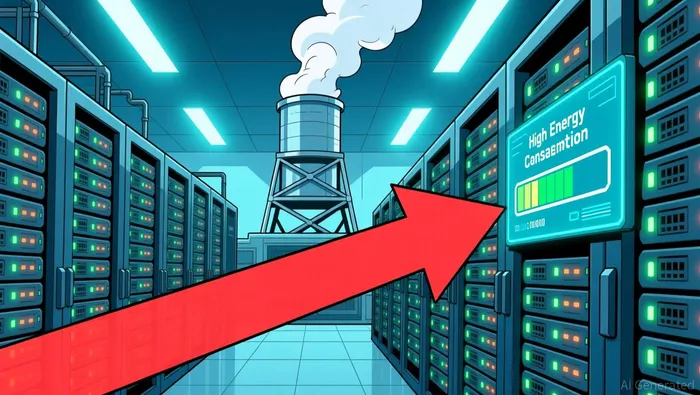
The artificial intelligence (AI) revolution is no longer a distant promise but a present-day reality, reshaping industries and economies. Yet, beneath the algorithms and neural networks lies a critical, often overlooked enabler: energy infrastructure. As AI workloads surge, so does the demand for power, cooling, and grid resilience. This creates a unique opportunity for investors to identify undervalued energy infrastructure plays poised to profit from the AI and data center boom.
Data Center Infrastructure: The New Gold Rush
The foundation of AI's growth is the data center, a power-hungry beast requiring robust infrastructure. Applied Digital (via its Polaris Forge campuses) has emerged as a key player, securing a 150-megawatt lease with CoreWeave and planning a 200-megawatt expansion to meet future demand. Similarly, CoreWeave itself has become a poster child for AI-driven growth, with revenue topping estimates and a $14.2 billion computing power contract with MetaMETA--. These developments highlight the critical role of specialized data center infrastructure in supporting AI's exponential scaling.
Meanwhile, Intel offers an undervalued angle. With a low P/E ratio and a renewed focus on foundry services and AI-driven chips under the CHIPS Act, IntelINTC-- is repositioning itself as a critical supplier for AI hardware according to analyst reports. Its government-backed initiatives and cost-competitive AI accelerators position it to reclaim market share in a sector dominated by Nvidia.
Cooling Technology: The Unsung Hero of AI Efficiency
As AI workloads intensify, so does the need for advanced cooling solutions. Data centers could consume over 1,000 terawatt-hours (TWh) annually by 2026, driven largely by AI. Companies like Vertiv and Amphenol are leading the charge. Vertiv, dubbed the "AI Capacity King," has delivered a 60.8% return over the past year by expanding into AI-ready power and cooling solutions. Amphenol, with a commanding 33% market share in AI and data center interconnects, supports high-speed data throughput essential for large language model training according to industry analysis.
nVent Electric is another standout, recently unveiling modular liquid cooling solutions in collaboration with Siemens and Google. These partnerships underscore the growing importance of thermal management in maintaining the performance of AI hardware.
Grid Modernization: Powering the Future
The surge in AI demand is straining existing electrical grids, prompting massive investments in modernization. The U.S. energy sector faces a $1.4 trillion investment need between 2025 and 2030 to reshape electricity generation and distribution. Xcel Energy is at the forefront, deploying AI-powered grid management tools like digital twins and Virtual Power Plants (VPPs) in collaboration with EY, Itron, and Tesla. Its $60 billion capital plan for 2026–2030 explicitly targets grid resilience and data center integration.
Quanta Services is also capitalizing on this trend, constructing the electrical grids and infrastructure required for next-generation AI data centers in North America. These projects highlight the critical role of grid operators in ensuring uninterrupted power supply for AI operations.
Renewables and Nuclear: The Long Game
While renewables and nuclear energy face regulatory and technical hurdles, they remain integral to the AI infrastructure equation. Nano Nuclear Energy and Oklo are exploring small modular reactors (SMRs) to provide clean, scalable power for data centers according to industry reports. However, mainstream adoption is likely decades away, making these plays more speculative.
Conclusion: Seizing the Infrastructure Opportunity
The AI revolution is not just about software-it's about the physical infrastructure that sustains it. From data center developers like Applied DigitalAPLD-- and CoreWeaveCRWV-- to cooling innovators like Vertiv and Amphenol, and grid modernizers like Xcel Energy, the opportunities are vast. These companies are not only addressing immediate energy demands but also aligning with long-term sustainability goals. For investors, the key lies in identifying undervalued players with strong partnerships and clear growth trajectories in this high-stakes sector.







Comentarios
Aún no hay comentarios