
Energy Fuels' Breakthrough in U.S. Heavy Rare Earth Production and the Strategic Implications for Supply Chain Independence
In an era where global supply chains are increasingly weaponized, the ability to produce critical minerals domestically has become a matter of both economic and national security. Energy Fuels Inc.UUUU--, a U.S.-based uranium and rare earth elements (REE) producer, has emerged as a pivotal player in this high-stakes arena. The company's recent breakthrough in producing high-purity —a key heavy rare earth element (HREE)—marks a turning point in the race to decouple the United States from China's dominance in the HREE market. For investors, this development raises a compelling question: Can Energy FuelsUUUU-- capitalize on its technological and geopolitical advantages to deliver outsized returns in a sector poised for strategic investment?
A Domestic HREE Supply Chain Takes Shape
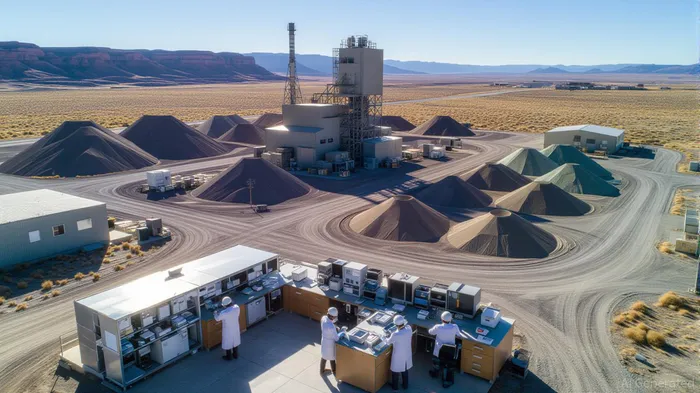
Energy Fuels' White Mesa Mill in Utah has achieved what many once deemed improbable: the production of 99.9% pure dysprosium oxide, a material essential for high-temperature permanent magnets used in electric vehicles (EVs), wind turbines, and defense systems. This milestone, achieved in August 2025, is the first of its kind in the U.S. and underscores the company's ability to process HREEs from monazite sands sourced in Florida and Georgia. By the end of 2025, Energy Fuels plans to transition to terbium oxide production, with samarium oxide following in early 2026.
The strategic significance of these efforts cannot be overstated. China currently controls over 85% of global HREE production, a vulnerability that has spurred U.S. government initiatives to diversify supply chains. Energy Fuels' pilot-scale success at White Mesa, combined with its access to high-grade HREE resources in Australia's Donald Project, positions the company to fill this gap. The Donald Project, a joint venture with Astron Corporation, is projected to yield 129 tonnes of samarium, 16 tonnes of terbium, and 92 tonnes of dysprosium annually by 2027—enough to meet a significant portion of U.S. demand for these critical materials.
Geopolitical Tailwinds and Market Dynamics
The U.S. government has recognized the urgency of securing HREE supply chains, allocating over $439 million since 2020 to support domestic production. Energy Fuels' progress aligns with this agenda, particularly as the Department of Defense and automakers seek to reduce reliance on foreign sources. The company's partnerships with and POSCOPKX-- International further illustrate its integration into the U.S. industrial ecosystem, with the latter collaboration aiming to establish a non-China-dependent magnet supply chain.
From a market perspective, HREEs are expected to grow at a 5.8% through 2030, driven by their role in high-performance magnets and advanced technologies. While light rare earth elements (LREEs) dominate in volume, HREEs command higher margins due to their scarcity and specialized applications. Energy Fuels' ability to produce high-purity HREEs at scale could position it as a premium supplier in this niche but high-value segment.
Risks and Rewards for Investors
Investing in Energy Fuels is not without risks. The company's expansion into HREE production requires significant capital expenditure, and scaling from pilot to commercial production carries operational uncertainties. Additionally, the rare earths market is cyclical, with prices subject to geopolitical and economic volatility. However, the company's strategic acquisitions—such as ' Toliara project in Madagascar and RadTran LLC for medical isotopes—demonstrate a diversified approach to mitigating these risks.
For the long-term investor, the rewards are substantial. Energy Fuels' alignment with U.S. policy goals, its vertically integrated production model, and its access to high-grade HREE resources create a compelling value proposition. The company's recent uranium production record at the Pinyon Plain Mine also provides a stable cash flow to fund its rare earths ambitions.
A Strategic Investment in the New Energy Era
Energy Fuels is more than a rare earths producer; it is a cornerstone of the U.S. effort to secure critical minerals in a world where supply chains are battlegrounds. For investors, the company represents a unique opportunity to participate in a sector that is both economically transformative and geopolitically essential. While the path to commercial-scale HREE production is not without challenges, Energy Fuels' technical expertise, strategic partnerships, and government support make it a standout in a market defined by scarcity and strategic intent.
As the clean energy transition accelerates and global tensions over resource control intensify, Energy Fuels' ability to deliver a domestic HREE supply chain could prove to be one of the most consequential investments of the decade. For those willing to bet on the intersection of technology, policy, and geopolitics, the company's stock offers a high-conviction play in a sector where the stakes—and the potential rewards—are nothing short of monumental.





Comentarios
Aún no hay comentarios