
The New Energy Frontier: Grid Modernization and Renewable Infrastructure as High-Conviction Investment Opportunities in 2025
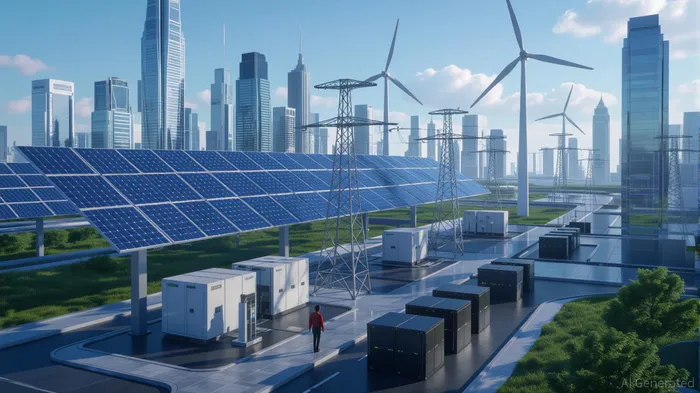
The U.S. power market is undergoing a seismic shift, driven by a confluence of federal and state-level policies, technological innovation, and surging demand for clean energy. The Inflation Reduction Act (IRA), state-level green banks, and the rise of AI-driven data centers have created a perfect storm of opportunity for investors willing to act decisively. Yet, despite the scale of this transformation, many of the most compelling assets in grid modernization and renewable infrastructure remain undervalued—offering a rare window to capitalize on the energy transition before the market fully prices in their potential.
The Policy Tailwinds: A $500 Billion Annual Investment Opportunity
The IRA has injected $369 billion into the clean energy sector since 2022, with tax credits, grants, and loan guarantees accelerating the deployment of solar, wind, battery storage, and grid modernization. By 2030, the U.S. aims to triple its renewable energy capacity, a goal that requires $500 billion in annual investments. State-level initiatives, such as the Greenhouse Gas Reduction Fund's $27 billion allocation to sub-federal projects, further amplify this momentum.
However, the market has yet to fully price in the urgency of these reforms. For example, the One Big Beautiful Bill Act (H.R. 1), passed in July 2025, has accelerated the phaseout of tax credits for wind and solar projects, creating a scramble among developers to secure permits and financing. This has compressed timelines and inflated valuations for late-stage projects, but it has also left early-stage innovators and infrastructure operators undervalued.
Grid Modernization: The Overlooked Backbone of the Energy Transition
Grid modernization is the linchpin of the clean energy transition, yet it remains one of the most undervalued sectors. Utilities like Eversource EnergyES-- (ESV) and Consolidated EdisonED-- (CONED) are leading the charge, investing billions in smart grid technologies, AI-driven analytics, and decentralized systems. EversourceES--, for instance, trades at a forward P/E of 22.13 with a 3.19% dividend yield, while ConEdison offers a 4.65% yield and a P/E of 21.33—both significantly below the sector average.
These companies are not just beneficiaries of policy; they are active participants in reshaping the grid. Eversource's demand response programs have avoided 44,000 kg of CO₂ emissions during peak demand, while ConEdison's $100 million investment in AI startups like AiDASH is revolutionizing infrastructure monitoring.
Renewable Infrastructure: The Undervalued Giants
The renewable infrastructure sector is equally ripe for opportunity. Avangrid (AGR), a subsidiary of Iberdrola, is investing $20 billion in grid upgrades by 2030, with a 2024 U.S. supplier investment of $4.3 billion. Its P/E ratio of 24.8 and 3.5% dividend yield make it a compelling value play. Meanwhile, NextEra EnergyNEE-- (NEE), with a market cap of $153.87 billion, is leveraging IRA incentives to expand offshore wind and solar capacity, despite a P/E of 27.99 that still reflects its growth potential.
The market's underreaction to these opportunities is stark. While the S&P 500 has clawed back from 2024 lows, utilities and energy storage stocks remain in the doldrums, trading at multi-year lows relative to their growth prospects. This mispricing is particularly evident in energy storage, where the Q1 2025 U.S. Energy Storage Monitor reported 2 GW of new capacity added—driven by utility-scale projects and falling costs.
The High-Conviction Plays: Enphase Energy and the Storage Revolution
Enphase Energy (ENPH) is a standout in the energy storage space. The company's fourth-generation IQ Battery, with 30% higher energy density, and its upcoming IQ9 microinverter position it to dominate residential and commercial storage. Despite a 42.3% year-to-date decline in its stock price versus the S&P 500's 7.2% gain, Enphase's ecosystem of tools—such as SolarGraph and Enphase Care—creates a durable moat. Analysts like OppenheimerOPY-- have set a $86 price target, implying 117% upside.
The Risks and the Roadmap
Investors must navigate short-term risks, including regulatory uncertainty under a potential Trump administration and the phaseout of tax credits under H.R. 1. However, these risks are largely temporary. Electricity demand is projected to grow 1%–2% annually through 2035, driven by data centers, EVs, and industrial electrification. Energy storage costs have fallen 80% since 2015, making it a critical tool for grid stability.
For those seeking exposure, a diversified portfolio of undervalued utilities and energy storage innovators—coupled with a hedging strategy against policy risks—offers a compelling risk-reward profile. The window to act is narrowing: as the IRA's incentives mature and the energy transition accelerates, the cost of waiting will rise.
Conclusion: The Time to Act Is Now
The U.S. power market is at a pivotal inflection pointIPCX--. Grid modernization and renewable infrastructure are no longer speculative—they are foundational to the energy transition. For investors, the key is to focus on firms with strong balance sheets, IRA-aligned strategies, and pricing power. Eversource, ConEdison, Avangrid, and Enphase EnergyENPH-- exemplify this thesis.
As the market grapples with the urgency of decarbonization, the best time to plant the seeds of long-term capital growth is now. The energy transition is not a distant future—it is happening today, and the most forward-thinking investors are already positioning themselves to reap the rewards.







Comentarios
Aún no hay comentarios