
U.S. Energy Firms and Venezuela's Oil Sector: A High-Stakes Gamble or Strategic Opportunity?
The removal of Nicolás Maduro from power in early 2026 has reignited global interest in Venezuela's oil sector, a resource-rich but politically volatile asset. , yet its production has , . U.S. President Donald Trump has positioned American energy firms as central to revitalizing this sector, promising billions in investments to rebuild infrastructure and unlock Venezuela's oil wealth. However, the path forward is fraught with geopolitical risks, institutional decay, and uncertain policy continuity. This analysis evaluates whether Trump's vision represents a viable long-term opportunity or a politically charged gamble for investors.
The Opportunity: Reserves, Refineries, and Trump's Vision
Venezuela's oil reserves are unmatched, and its heavy crude is particularly suited for U.S. Gulf Coast refineries, which are optimized for this feedstock. Trump has framed the U.S. military intervention as a means to reclaim "stolen" assets from the Chávez-era nationalizations and to restore production to levels that could rival OPEC+ members. According to a report by , the Trump administration has encouraged companies like ExxonMobilXOM-- and ConocoPhillipsCOP-- to invest in Venezuela, .
The potential rewards are substantial. , as some analysts project, U.S. refineries could benefit from a stable supply of heavy crude, reducing reliance on Canadian and Middle Eastern imports. Moreover, Venezuela's oil sector could generate significant revenue for the country, provided infrastructure is restored and governance reforms are enacted.
Infrastructure and Investment Needs: A $100 Billion Challenge
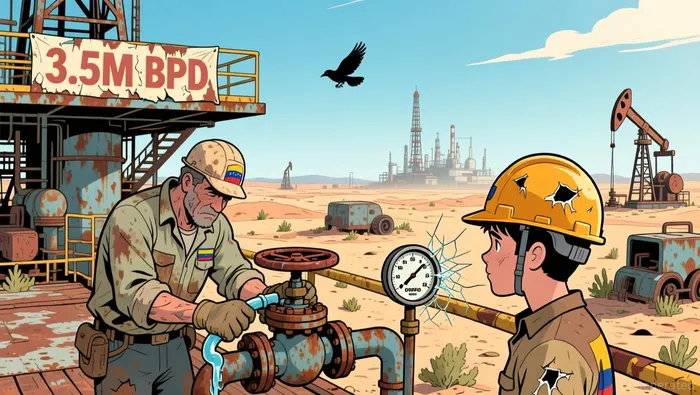
Reviving Venezuela's oil sector, however, requires addressing its crumbling infrastructure. Aging pipelines, outdated processing facilities, and a lack of technical expertise have left the industry in disrepair. Analysts estimate that restoring production , with full recovery to peak levels potentially taking a decade.
The U.S. government has signaled its intent to facilitate this investment, but private firms remain cautious. ChevronCVX--, the only major U.S. company still operating in Venezuela, has not announced expansion plans, citing the need for political stability and legal clarity. ConocoPhillips and ExxonMobil, which previously operated in the country, have similarly hesitated, wary of repeating past expropriation risks.
Political and Legal Risks: Instability and Institutional Decay
The post-Maduro landscape is marked by uncertainty. Interim leader , while seen as a stabilizing figure, retains ties to the Chavista regime and has not fully aligned with U.S. interests. The military's role in the transition further complicates governance, as its loyalty to the new administration remains untested.
Legal frameworks for foreign investment are also in flux. Venezuela's oil laws, historically favoring state control, must be restructured to attract private capital. The U.S. has not yet enacted specific legal reforms to ease sanctions or provide contractual assurances, leaving investors in limbo. As noted by , U.S. oil companies require clear terms on asset recovery, revenue-sharing, and political stability before committing capital.
U.S. Policy Continuity: Trump's Push vs. Biden's Caution
The Trump administration's aggressive stance contrasts with the Biden era's measured approach. While Biden offered limited sanctions relief to incentivize fair elections, Trump has prioritized rapid U.S. energy sector involvement, even at the expense of diplomatic friction. This shift has raised questions about policy continuity: if a future administration adopts a different strategy, investments could face abrupt reversals.
Chevron's experience illustrates this risk. The Biden administration granted it limited operational licenses, but Trump's 2025 policies revoked its ability to fully export Venezuelan oil, reducing U.S. exports by half. Such policy swings underscore the vulnerability of long-term investments in a sector where political winds can change with presidential elections.
Geopolitical Implications: China, Russia, and the Global Energy Balance
 Venezuela's oil sector is not just a domestic issue but a geopolitical battleground. China, , faces potential disruptions as U.S. firms gain access to Venezuelan reserves. Russia and Iran, long-standing allies of , have also seen their influence wane. The U.S. blockade of oil tankers and designation of Venezuelan militant groups as terrorist organizations further isolate the country from its traditional partners.
For U.S. investors, this shift could create a strategic advantage. However, it also invites retaliation from global powers and could destabilize regional alliances. The long-term viability of U.S. investments will depend on maintaining this geopolitical edge while navigating international pushback.
Conclusion: A Calculated Gamble with High Stakes
Trump's vision for Venezuela's oil sector offers a tantalizing mix of opportunity and risk. . refineries is undeniable, but the path to recovery is littered with obstacles. Infrastructure decay, political instability, and uncertain policy continuity mean that even the most optimistic projections require a decade or more to materialize.
For investors, the key question is whether the rewards outweigh the risks. While the U.S. government's backing provides a degree of confidence, the absence of clear legal frameworks and the volatility of Venezuela's political landscape make this a high-stakes proposition. Those willing to endure the long-term challenges may find themselves positioned to benefit from one of the world's most underutilized energy assets-but only if they navigate the geopolitical and institutional hurdles with precision.





Comentarios
Aún no hay comentarios