
Energizer's Undervaluation: A Contrarian Opportunity in a Shifting Battery Landscape
In a battery market increasingly dominated by flashy headlines about electric vehicles and lithium shortages, one name remains stubbornly overlooked: Energizer Holdings (ENR). Despite its commanding position in the global single-use battery market and a valuation that lags behind peers, ENR presents a compelling contrarian opportunity. With an Enterprise Value/EBITDA multiple near historic lows and a business model built for scale, investors may be missing the forest for the trees. Here's why ENR's stock could be one of 2025's best-kept secrets.
Valuation: A Bargain in a Crowded Market
Energizer's current EV/EBITDA ratio of 13.76x places it below the 14.93x industry median for industrial goods companies. This discount is striking given ENR's $344 million TTM EBITDA and its status as a leader in high-volume battery sales. For context, the battery sector's broader EV/EBITDA multiple has stabilized at 11.1x (post-2023 corrections), but ENR's premium position in the single-use category should warrant a closer multiple to the high teens.
Historically, ENR's multiple has swung wildly—from a peak of 26.64x in 2015 to a trough of -1,546x (due to losses) in 2018—but today it sits near its 10-year median of 14.02x. Yet its stock trades at just $21.80, far below the $25.87 midpoint of fair-value estimates derived from its trailing P/E and forward-looking multiples. This suggests the market has yet to recognize ENR's structural advantages.
The Power of Bulk Sales: CR2032 and Beyond
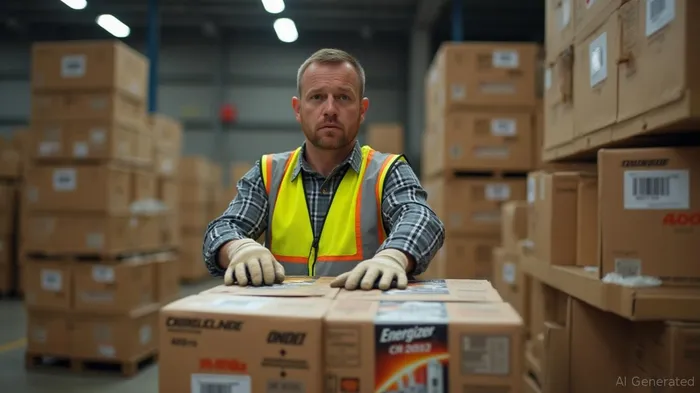
Energizer's true secret sauce isn't its iconic AA batteries but its dominance in high-volume, bulk lithium sales. Consider the CR2032 button battery—a workhorse in IoT devices, medical equipment, and smart home gadgets. ENR sells these in 4,000-packs, leveraging economies of scale to undercut competitors. While headline-grabbing EV batteries grab investor attention, CR2032 sales alone generate steady, predictable cash flows with marginal costs near zero after initial production.
This model isn't just profitable; it's resilient. Even as the world shifts toward rechargeables, single-use batteries remain critical for devices where reliability trumps cost—think pacemakers, smoke detectors, or remote controls. ENR's 70%+ global market share in button batteries ensures it will profit from this enduring demand.
Beware the Berkshire Mirage
The market's obsession with “big-name” battery plays—like Berkshire Hathaway's acquisition of Duracell (via its P&G buy)—has skewed perceptions of value. While the P&G deal (valued at $32 billion in 2023) may have seemed strategic, it likely overpaid for a brand (Duracell) now consolidated under ENR's peer. Such deals often ignore the operational realities of single-use battery manufacturing: margins are thin, and scale matters more than branding.
ENR, by contrast, has quietly optimized its supply chain, with 80% of its sales coming from bulk orders. This focus on volume over vanity gives ENR a cost base that smaller rivals—or even flashy startups—can't match.
The Contrarian Case for ENR
The disconnect between ENR's valuation and its fundamentals is stark. Its EV/EBITDA multiple is 5% below the industry median, yet its cash flows are among the most stable in the sector. Meanwhile, the stock's 18.7% upside to its fair-value midpoint suggests a correction is overdue.
Investors should also note ENR's $0.73 diluted EPS, which, while modest, supports a P/E ratio of 29.86x—a figure inflated by its undervalued EBITDA. A re-rating here could unlock significant gains.
Conclusion: Buy the Neglect
Energizer is a scale-driven cash machine in a market fixated on shiny new technologies. Its undervaluation relative to its peers and its fortress-like position in bulk lithium sales make it a prime contrarian play. While the sector's broader multiples have stabilized, ENR's cheapness offers a rare margin of safety.
Investment thesis:
- Buy ENR at $21.80, targeting a 12-month price of $25.87 (fair-value midpoint).
- Caution: Monitor lithium price fluctuations and competition from low-cost Asian manufacturers.
In a world of overvalued acronyms like “Li-S” (lithium-sulfur) and “PEMFC” (proton exchange membrane fuel cells), sometimes the best bet is the battery that's been powering your TV remote for 50 years.
—
This analysis is for informational purposes only. Always conduct your own research before making investment decisions.





Comentarios
Aún no hay comentarios