
The Enduring Power of Bitcoin: How Long-Term Hodling Transforms Volatility into Wealth
Bitcoin's journey from a niche digital experiment to a global financial phenomenon has been defined by its ability to defy conventional wisdom. For long-term hodlers—those who have weathered its volatility and embraced its compounding potential—Bitcoin has emerged as a transformative force in wealth creation. Over the past decade, its price has surged from near-zero to over $94,000, with annualized returns far outpacing traditional assets like gold and the S&P 500. This article examines Bitcoin's enduring store-of-value proposition and the compounding gains that have made it a cornerstone of modern portfolio strategies.
A Decade of Volatility and Resilience
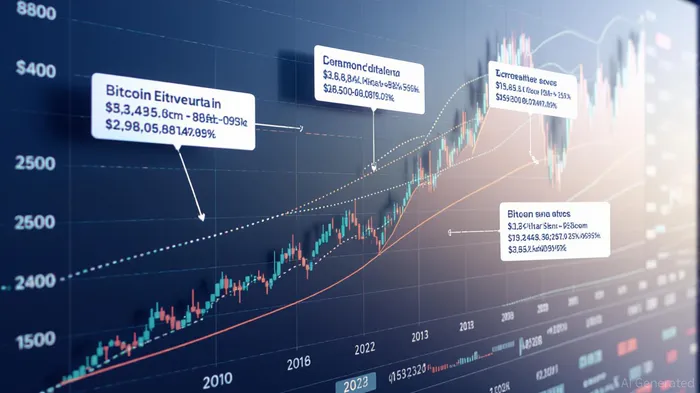
Bitcoin's price history is a rollercoaster of extremes. In 2010, it traded for less than $0.10 [1], a far cry from its 2013 peak of $1,000 [1]. By 2017, it had surged to $19,188, only to plummet to $3,843.52 by 2018 [5]. Yet, the narrative of BitcoinBTC-- as a speculative asset began to shift in 2020–2021, when it reached an all-time high of $64,894.20 [5]. Despite a 2022 correction, Bitcoin rebounded in 2023 and 2024, culminating in a 2025 price of $94,419.76 [5]. These cycles underscore its resilience: even after sharp declines, Bitcoin has consistently regained and exceeded prior highs.
Compounding Gains: The Hodler's Edge
Bitcoin's compounding potential is its most compelling feature. According to data from casebitcoin.com, Bitcoin's Compound Annual Growth Rate (CAGR) over a 10-year period has averaged around 86% [2], dwarfing the 12% CAGR of gold and the S&P 500 over the same period [3]. This exponential growth means that even small, early investments have yielded extraordinary returns. For instance, a $1,000 investment in 2010 would have grown to over $94 million by 2025, assuming no selling [1].
Moreover, Bitcoin's lack of correlation with traditional assets enhances its appeal. A 3% allocation to Bitcoin in a diversified portfolio could have boosted annualized returns from 8% to 12% over a decade [3]. This is not merely speculative: Bitcoin's Sharpe ratio—a measure of risk-adjusted returns—has outperformed many traditional assets, suggesting it offers superior returns for the level of risk taken [2].
Store of Value: Scarcity and Decentralization
Bitcoin's store-of-value narrative is rooted in its scarcity. With a capped supply of 21 million coins, it mirrors gold's finite nature but with the added advantage of digital portability and divisibility. Unlike fiat currencies, which can be inflated by central banks, Bitcoin's supply is algorithmically fixed, making it a hedge against inflation. This scarcity has driven demand, particularly in economies with unstable currencies or political uncertainty.
Institutional adoption has further solidified Bitcoin's status as a store of value. Companies like MicroStrategy and TeslaTSLA-- have added Bitcoin to their balance sheets, while financial products such as Bitcoin ETFs have made it accessible to mainstream investors. These developments signal a shift from viewing Bitcoin as a speculative asset to recognizing it as a legitimate, long-term store of value.
Risks and Considerations
Bitcoin's volatility remains a double-edged sword. A 2018 crash erased 80% of its value, and the 2022 bear market tested even the most committed hodlers. Regulatory uncertainty and technological risks—such as 51% attacks or scalability issues—also persist. However, for investors with a 10+ year horizon, these risks are often secondary to the asset's compounding potential.
Conclusion: The Future of Hodling
Bitcoin's journey from obscurity to financial mainstream is a testament to its unique properties. For those willing to embrace its volatility, the rewards are immense. As the asset continues to mature, its role as a store of value and compounding engine is likely to expand, offering a compelling case for long-term hodling. In a world of diminishing returns on traditional assets, Bitcoin represents a paradigm shift—one where patience and conviction are rewarded with exponential growth.






Comentarios
Aún no hay comentarios