
EnBW Energie Baden-Württemberg's Path to Post-Earnings Recovery and Long-Term Energy Transition Value
EnBW Energie Baden-Württemberg (ETR:EBK) has navigated a challenging Q2 2025 earnings season, marked by a 8.7% revenue decline to €8.12 billion and a net loss of €91 million. While these figures starkly contrast with the €541.9 million profit in Q2 2024, the company's strategic investments and operational resilience position it as a compelling long-term play in the energy transition. This article dissects how EnBW's capital structure, renewable energy growth, and grid infrastructure expansion could drive sustainable earnings recovery.
Operational Performance: Weathering the Storm
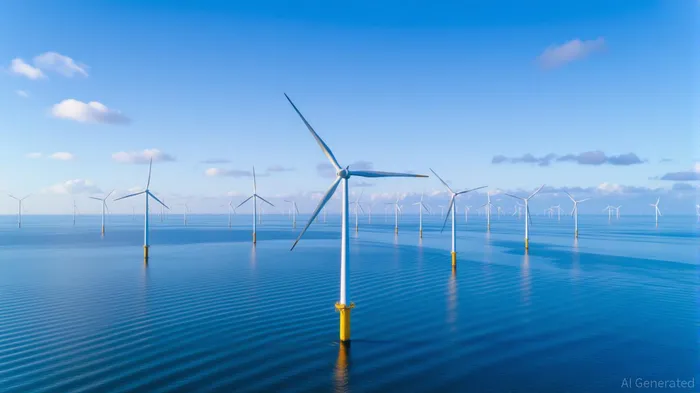
EnBW's Q2 2025 results were heavily influenced by external factors. The Sustainable Generation Infrastructure segment, which includes renewables and thermal generation, reported a 26% drop in adjusted EBITDA to €1.1 billion, primarily due to weak offshore wind conditions and limited rainfall affecting run-of-river power generation. Meanwhile, the Renewable Energies subsegment saw a 12% decline in EBITDA to €525 million. These challenges underscore the vulnerability of renewable energy to weather volatility but also highlight the company's proactive diversification.
In contrast, the System Critical Infrastructure segment delivered a 12% year-over-year increase in adjusted EBITDA to €1.3 billion, driven by grid expansion and reduced maintenance costs. The Retail Segment also outperformed, with a 35% EBITDA jump to €233 million, reflecting growing demand for EnBW's customer-centric services. These contrasting performances illustrate EnBW's balanced approach: while renewable generation faces short-term headwinds, its grid and retail operations provide stable cash flows.
Capital Structure and One-Off Costs: A Strategic Rebalance
EnBW's July 2025 capital increase of €3.1 billion—executed through a share issuance at €58.00 per share—was a pivotal move to fund its €50 billion investment plan through 2030. While the company did not disclose specific one-off expenses tied to the capital raise, the transaction likely involved underwriting fees, legal costs, and shareholder communication expenses. These costs, though non-trivial, are offset by the €3.1 billion injection, which strengthens EnBW's equity base and liquidity.
The capital increase, combined with a €500 million green hybrid bond issuance and favorable bank financing, ensures EnBW can meet its ambitious targets: 75–80% renewable energy capacity by 2030 and a lignite-free status by 2025. The company's net debt rose to €15 billion, but its retained cash flow of €1.1 billion (up 18% year-over-year) and investment-grade credit ratings provide a buffer against rising interest rates.
Long-Term Energy Transition Value: Grids and Renewables as Growth Engines
EnBW's renewable energy portfolio now accounts for 60% of its generation capacity, with 6.8 gigawatts of installed capacity. The company added 220 megawatts of new onshore wind and solar projects in H1 2025 and is constructing 1.7 gigawatts of additional capacity. By 2030, renewables are expected to dominate its portfolio, aligning with Germany's decarbonization goals.
The System Critical Infrastructure segment further cements EnBW's value proposition. Grid expansion investments—fueled by the capital increase—position the company to benefit from Germany's €100 billion infrastructure fund and the EU's upcoming capacity auction for gas power stations. These initiatives could unlock indirect revenue streams for EnBW, particularly as it develops hydrogen-ready gas plants to complement renewables.
Risks and Mitigation
EnBW's path to recovery is not without risks. Weather-dependent earnings in the renewables segment and rising interest rates (which increased financial expenses by €100 million in H1 2025) could pressure margins. However, the company's diversified business model, strong cash flow generation, and strategic focus on grid infrastructure mitigate these risks.
Investment Thesis: A Buy for the Energy Transition
EnBW's capital discipline, renewable growth trajectory, and grid infrastructure investments make it a compelling long-term holding. The company's full-year adjusted EBITDA guidance of €4.8–5.3 billion, supported by the He Dreiht offshore wind farm and expanded retail operations, suggests a path to earnings normalization. Investors should monitor the EU capacity auction and Germany's Power Plant Security Act, which could accelerate EnBW's gas plant projects and enhance returns.
For risk-tolerant investors, EnBW offers exposure to the energy transition at a valuation that reflects its strategic importance. With a forward P/E ratio of 8.5x (as of August 2025) and a dividend yield of 3.2%, the stock balances growth and income. However, those seeking short-term gains may find the company's earnings volatility and capital-intensive strategy less appealing.
In conclusion, EnBW's ability to transform its capital structure, navigate operational challenges, and leverage its renewable and grid assets positions it as a key player in Europe's energy transition. For investors with a 5–10 year horizon, EnBW represents a high-conviction opportunity to capitalize on the shift toward clean energy.







Comentarios
Aún no hay comentarios