
Employment Data and Market Sentiment: Unraveling Political Influence and Historical Precedents
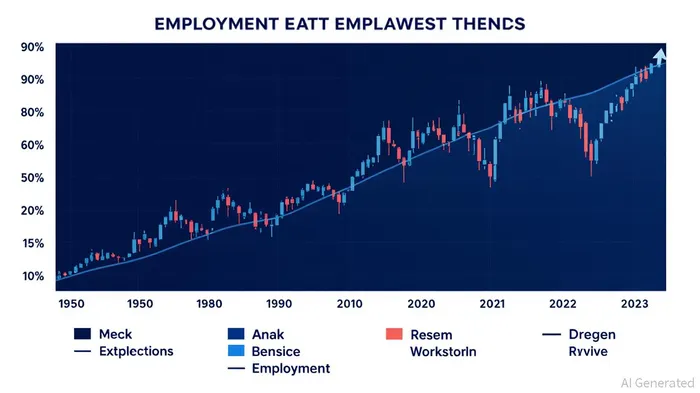
The reliability of employment data has long been a cornerstone for investors, yet its susceptibility to political influence and historical anomalies often goes underappreciated. From the post-WWII labor boom to the polarization-driven erosion of union power, political forces have shaped not only the numbers but the narratives that drive market sentiment. As today's investors grapple with fragmented data and shifting policy landscapes, understanding these dynamics is critical to avoiding misjudged bets.
Historical Precedents: Data as a Political Mirror
The Bureau of Labor Statistics (BLS) has evolved since 1913, introducing tools like the Consumer Price Index (CPI) and Current Employment Statistics (CES) to standardize labor metrics. Yet, even these pillars are not immune to political context. For instance, the 1940s saw the BLS launch productivity studies amid wartime mobilization, while the 1960s brought labor-force projections as civil rights movements reshaped workplace demographics. These developments highlight how political priorities can redefine what data is collected—and how it is interpreted.
A striking example is the decline of unionization. By 2023, union membership had dropped to 9.7% of U.S. workers, down from 33% in 1954. The Economic Policy Institute (EPI) links this trend to reduced civic engagement in workplaces, where unionized workers are 60% more likely to participate in political discussions at work. This decline has not only weakened collective bargaining but also diminished the political clout of labor data itself. When workers feel their voices are absent, market signals about labor costs and productivity can become distorted, creating blind spots for investors.
Political Polarization and Data Reliability
The EPI study underscores a paradox: while employment data has grown more granular (e.g., JOLTS job openings, green jobs metrics), its perceived reliability has waned in polarized environments. For example, during the 2020 pandemic, partisan disputes over unemployment numbers and stimulus packages led to divergent market reactions. Retail investors and institutional players interpreted the same data through different lenses, amplifying volatility.
This dynamic is not new. The 1970s inflation crisis saw employment data weaponized in debates over deregulation, with policymakers cherry-picking metrics to justify conflicting strategies. Today, similar fragmentation is evident in debates over automation and AI's impact on labor. Investors must ask: Are employment reports capturing the true story of workforce displacement, or are they skewed by political narratives about “tech-driven growth”?
Current Market Vulnerabilities
Modern investors face a unique challenge: the rise of “electronically mediated employment” (e.g., gig work, remote labor) has outpaced data collection methods. The BLS's 2022 expansion to include race and ethnicity breakdowns in labor-force data is a step forward, but gaps remain. For instance, how do we quantify the economic impact of AI-driven hiring platforms or the gig economy's role in underemployment?
Political interventions further complicate matters. Recent labor reforms, such as the 2022 National Labor Relations Board (NLRB) rulings favoring unionization, signal a shift in power dynamics. If these trends continue, employment data may soon reflect a resurgence in collective bargaining, potentially altering wage growth trajectories and corporate profit margins. Conversely, if political resistance to labor reforms intensifies, data may understate labor market fragility.
Investment Implications: Navigating the Uncertainty
- Sector Diversification: Sectors with high unionization rates (e.g., manufacturing, transportation) may face upward pressure on wages and costs, while non-union sectors (e.g., tech, services) could see labor arbitrage opportunities. Investors should weigh these dynamics against employment data trends.
- Data-Centric Plays: Companies like offer insights into how employment data intersects with innovation. Tesla's reliance on automation and its controversial labor practices highlight the tension between productivity gains and worker dissatisfaction—a microcosm of broader market forces.
- Policy Hedging: Investors should monitor political developments that could reshape labor data reliability. For example, if AI-driven workforce analytics gain regulatory traction, industries leveraging these tools (e.g., fintech, logistics) may see their valuations decoupled from traditional employment metrics.
Conclusion: Trust, but Verify
Employment data remains a vital barometer, but its reliability hinges on political and institutional contexts. History shows that when civic engagement in workplaces wanes, so does the accuracy of the data we rely on. For investors, this means treating employment reports not as static facts but as dynamic narratives shaped by power imbalances and policy shifts. The key to navigating this terrain lies in skepticism tempered by historical perspective—and a willingness to adapt when the numbers themselves are in flux.







Comentarios
Aún no hay comentarios