
Empire Metals' Pitfield Project: A Titanium Titan with Asymmetric Upside
The global titanium market is on the cusp of a paradigm shift, and at the center of this transformation sits Empire Metals Limited's (LON:EMP) Pitfield Project in Western Australia. With a JORC Exploration Target of 26.4–32.2 billion tonnes of titanium dioxide (TiO₂) grading 4.5–5.5%, Pitfield is not just another mining play—it's a once-in-a-generation discovery that could redefine the critical mineral's supply chain. Here's why investors should pay close attention.
The Scale of Pitfield: A Titan in the Making
Pitfield's Exploration Target dwarfs every other titanium project in the pipeline. To put this in perspective, the world's largest operating titanium mine, Australia's Mount Witta, produces around 1.2 million tonnes annually. Pitfield's target represents over 20 times that scale, and this is before considering its weathered zone subset of 4.0–4.9 billion tonnes grading 4.8–5.9% TiO₂—a high-margin feedstock that could be mined at surface with minimal stripping.
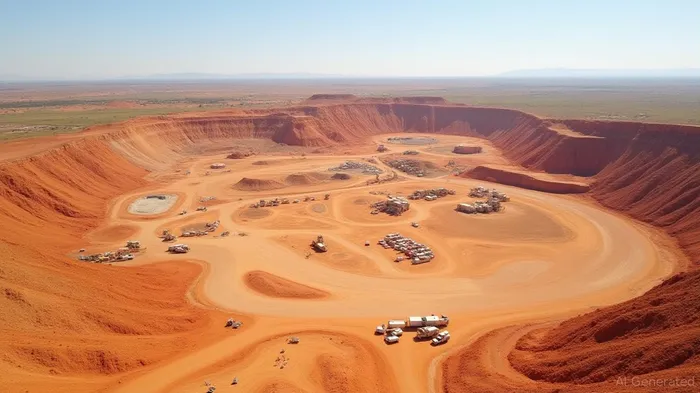
The project's geological complexity adds further upside. The mineralized system spans 40km by 8km, with only 20% of its potential explored to date. Ongoing drilling campaigns, including a current 10,700-meter program targeting the Thomas Prospect, aim to convert this Exploration Target into a JORC-compliant Maiden Mineral Resource Estimate (MRE) by late 2025. This milestone will be a catalyst for valuation—successful conversion could unlock a resource exceeding 10 billion tonnes, solidifying Pitfield's position as the world's largest undeveloped titanium deposit.
The Breakthrough: High-Grade Saprolite Zones and Metallurgical Precision
Pitfield's true game-changer lies in its near-surface saprolite zones—soft, friable weathered material rich in anatase and rutile (>95% TiO₂). These zones offer a fast-tracked development path, as they can be extracted using low-cost bulk-mining methods (e.g., log washers or scrapers) without requiring energy-intensive crushing or grinding. Early metallurgical tests have already yielded a 91.7% TiO₂ concentrate using conventional methods, with gravity separation and flotation techniques further refining purity.
The implications are profound. Pitfield's orebody requires no smelting, avoiding the high carbon emissions and operational complexity of traditional titanium processing. This not only reduces costs but also aligns with the growing demand for sustainable, low-impact production—a key selling point for pigment and aerospace markets.
Institutional Backing and Financial Fortitude
Empire Metals' financial health is a cornerstone of its execution risk. A £4.5 million institutional subscription in May 2025, led by Asian Investment Management Services Ltd, has bolstered its cash balance to £7.1 million—sufficient to fund drilling, metallurgical studies, and feasibility work through 2025.
This funding round reflects institutional confidence in Pitfield's potential. As Managing Director Shaun Bunn noted, the investment underscores the project's “scale and quality,” which include its high-purity TiO₂ (free of uranium/thorium contaminants) and strategic location near Geraldton Port and energy infrastructure. With Australia ranked among the world's top mining jurisdictions, Pitfield benefits from a supportive regulatory environment and proximity to rail, road, and emerging green hydrogen hubs.
Why Titanium Matters: A Critical Mineral in a Critical Decade
Titanium's role in aerospace, defense, and clean energy is non-negotiable. Its combination of light weight, strength, and corrosion resistance makes it indispensable for next-gen batteries, hydrogen storage, and high-performance alloys. The EU and U.S. classify titanium as a critical mineral, yet global supply remains concentrated in politically unstable regions like China and Southeast Asia.
Pitfield's emergence could disrupt this dynamic. With a resource base capable of supporting decades of production, Empire Metals is well-positioned to capitalize on a $24 billion titanium market projected to grow at 5.2% CAGR through 2030.
Near-Term Catalysts: A Timeline to Value Creation
- Q3 2025: Maiden MRE announcement, with results expected to confirm Pitfield's scale and grade.
- Q4 2025: Metallurgical testwork completion, including pilot plant trials for hydrometallurgical leaching.
- 2026: Feasibility study results, including capital costs and project economics.
Each milestone reduces technical risk and paves the way for a definitive development plan. A successful MRE could catalyze a re-rating of the stock, with valuations potentially tripling if resource estimates hit the upper end of projections.
Risks and Considerations
While Pitfield's potential is undeniable, investors must weigh execution risks. Permitting timelines, indigenous landowner agreements, and metallurgical optimization could delay timelines. Additionally, titanium pricing volatility (currently ~$1,500/tonne for pigment-grade TiO₂) remains a macroeconomic wildcard. However, the project's low-strip ratio and high-margin saprolite zones mitigate some cost pressures.
The Investment Thesis: Buy the Dip, Target Asymmetric Upside
Empire Metals is a high-conviction speculative play for investors willing to bet on critical minerals and project execution. With a market cap of £45 million against a potential resource worth billions, the stock offers asymmetric upside. Key catalysts—MRE delivery, process flow validation, and offtake agreements—could drive a 3x–5x return if milestones are met.
Recommendation: Accumulate positions ahead of the MRE announcement, with a price target of 18–25p per share (vs. current 9.5p) if the project achieves full potential. The stock's AIM listing provides liquidity for active investors, while the strong institutional backing signals a long-term commitment to Pitfield's success.
In a world hungry for sustainable, high-performance materials, Empire Metals' Pitfield Project is primed to deliver. This isn't just a titanium play—it's a blueprint for the critical minerals revolution.





Comentarios
Aún no hay comentarios