
Emerging Trends in Cryptocurrency: Why $MOBU and the New Breed of Meme Coins Are Capturing Institutional Attention
The cryptocurrency market in 2025 is witnessing a seismic shift. Once dismissed as speculative novelties, memeMEME-- coins are now attracting institutional scrutiny-and in some cases, capital-thanks to a wave of utility-driven innovation. At the forefront of this evolution is MoonBull ($MOBU), a project that exemplifies how meme coins are transcending their viral origins to build ecosystems with tangible value. This article unpacks the forces reshaping market sentiment, the role of token utility in institutional adoption, and why projects like $MOBU are redefining the narrative around meme coins.
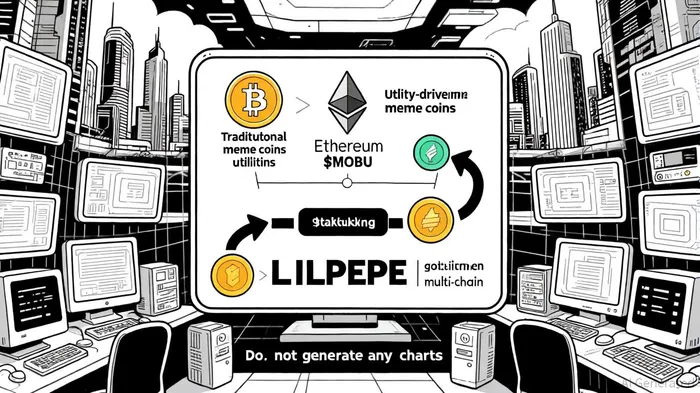
Institutional Curiosity: From Skepticism to Strategic Allocation
Institutional investors have historically favored BitcoinBTC-- and EthereumETH-- for their foundational utility and regulatory clarity. However, 2025 data reveals a subtle but significant shift: 68% of institutional crypto portfolios now include niche assets, including meme coins with utility features, according to institutional investor trends. This trend is driven by three factors:
- Utility-Driven Tokenomics: Projects like $MOBU integrate staking rewards, governance mechanisms, and multi-chain compatibility, addressing institutional concerns about volatility and purpose, per a FinanceFeeds analysis.
- Community-Driven Liquidity: Meme coins with active, engaged communities (e.g., MoonBull's referral system) create organic demand, reducing reliance on speculative trading, as FinanceFeeds also notes.
- Regulatory Adaptation: While still a hurdle, the emergence of "Meme Coins 2.0" with deflationary models and decentralized governance is attracting cautious institutional interest, according to an OKX guide.
According to OKX's MoonBull report, MoonBull's Ethereum-based whitelist model-offering early adopters "private roadmap insights" and "secret token drops"-has positioned it as a hybrid between speculative hype and structured utility. This blend appeals to institutions seeking exposure to high-growth assets without sacrificing governance frameworks.
$MOBU: A Case Study in Meme Coin Evolution
MoonBull ($MOBU) epitomizes the new breed of meme coins. Unlike its predecessors, which relied solely on social media virality, $MOBU's ecosystem includes:
- Staking Rewards: Holders earn yield by locking tokens, incentivizing long-term participation.
- Governance Access: Token owners vote on project upgrades, aligning incentives between developers and investors.
- Multi-Chain Expansion: The project's compatibility with Ethereum and other blockchains enhances scalability and interoperability.
These features have attracted both retail and institutional attention. FinanceFeeds projects an 11,800% ROI for $MOBU at its listing, citing its structured tokenomics and community engagement. Meanwhile, institutional investors are drawn to its potential as a "bridge" between meme culture and DeFi infrastructure.
Market Sentiment: Optimism Amid Volatility
The broader meme coin market remains a high-risk, high-reward arena. September 2025 data highlights key trends in an AMBCrypto roundup:
- Little Pepe (LILPEPE): Presale raised $24 million, with a projected 42% gain post-listing.
- SPX6900 (SPX): Technical indicators suggest a breakout to $1.74, with targets up to $3.15.
- Dogecoin (DOGE): Resilient at $0.21, showing signs of breaking through $0.22.
However, projects like Shiba InuSHIB-- (SHIB) struggle with weak momentum, underscoring the importance of utility-driven differentiation. As AMBCrypto notes, success now hinges on "community engagement and real utility."
Utility vs. Speculation: The Institutional Dilemma
Traditional cryptocurrencies like Bitcoin and Ethereum remain institutional favorites due to their established use cases in payments, smart contracts, and DeFi, as the institutional investor trends report shows. Meme coins, by contrast, face skepticism over their lack of foundational infrastructure. Yet, the rise of "Meme Coins 2.0" is blurring these lines.
Projects like Dawgz AI and PNUT are integrating AI-driven tools and play-to-earn mechanics, offering utilities that rival traditional cryptos, a trend described in the OKX guide. This evolution is critical: as Kenson Investments observes, institutions are increasingly allocating capital to meme coins that "combine viral appeal with functional ecosystems," a point echoed by FinanceFeeds.
Regulatory Risks and the Road Ahead
Despite progress, challenges persist. The SEC's focus on the Howey Test-determining whether tokens qualify as securities-remains a wildcard, a concern highlighted in the OKX guide. Meme coins with governance and staking features risk regulatory pushback, as seen with Shiba Inu's ShibaSwap.
However, the market is adapting. Developers are prioritizing transparency and decentralization to mitigate scrutiny. For instance, $MOBU's emphasis on community governance and multi-chain compatibility aligns with institutional demands for accountability, a synergy noted by FinanceFeeds.
Conclusion: A New Era for Meme Coins
The 2025 crypto landscape is defined by a duality: institutions seek stability, while retail investors chase innovation. Meme coins like $MOBU are bridging this gap by embedding utility into their DNA. While volatility and regulation remain hurdles, the integration of staking, governance, and DeFi features is reshaping market sentiment.
For investors, the lesson is clear: utility-driven meme coins are no longer a niche curiosity. They are a legitimate, if still nascent, asset class. As the line between "meme" and "mainstream" continues to blurBLUR--, projects that balance virality with value creation will dominate the next chapter of crypto.






Comentarios
Aún no hay comentarios