
Emerging "Next SOL" Cryptocurrency: A 35x Growth Opportunity Unfolding
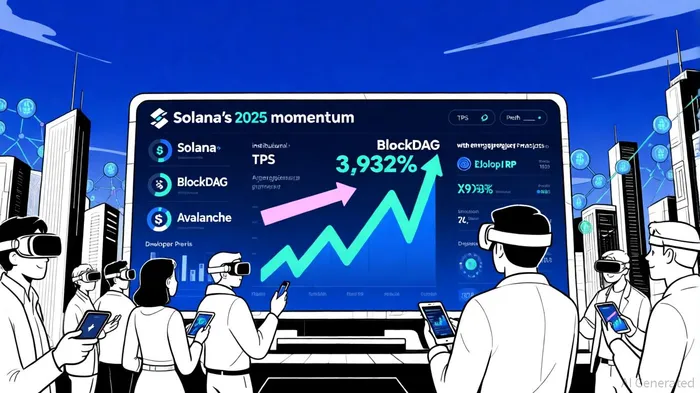
In 2025, SolanaSOL-- (SOL) has cemented its dominance as the fastest-growing blockchain, driven by institutional adoption, technological innovation, and explosive network effects. Yet, the crypto landscape is evolving rapidly, and investors are now turning their attention to the next project poised to replicate Solana's success—a 35x growth opportunity unfolding in real time.
Solana's Momentum: A Blueprint for Success
Solana's ascent is no accident. The platform's 2025 roadmap has delivered transformative upgrades, including Firedancer, a validator client that slashed latency and boosted reliability[1], and Alpenglow, which enhanced finality and reduced node requirements[3]. These innovations have enabled Solana to process 65,000 transactions per second (TPS) at $0.00025 per transaction, outpacing Ethereum's 15 TPS and 15-cent fees[2].
Institutional adoption has further accelerated Solana's growth. Major players like Visa, Stripe, and Shopify now leverage Solana for low-cost payments and loyalty programs[1], while HSBC and Bank of America tokenize bonds and stocks on the network[3]. This real-world utility has driven Solana's stablecoin supply to $12 billion, a 200% increase in 2025 alone[4], reinforcing demand for SOLSOL-- and its network effects.
The Next SOL: High-Velocity Momentum and Network Effects
The next big opportunity lies in projects that mirror Solana's strengths: high throughput, low fees, and real-world adoption. Among these, BlockDAG stands out. Built on a directed acyclic graph (DAG) architecture, BlockDAG processes 100,000 TPS while maintaining decentralization[5]. With $210 million in presale funding and partnerships with HackerEarth to onboard developers, the project aims to launch 200 dApps by 2025[5]. Analysts project a 3,932% return if BlockDAG reaches $1 by year-end[5], a trajectory reminiscent of Solana's 2023–2024 surge.
Other contenders include XRP, which is regaining traction in cross-border payments despite regulatory hurdles[5], and Avalanche (AVAX), which is expanding in gaming via subnets and developer incentives[5]. Meanwhile, Sui and Aptos—both built on high-performance models—process 500,000 TPS in lab tests[5], targeting DeFi and gaming use cases.
Why the Next SOL Could Deliver 35x Growth
The key to a 35x return lies in network effects and first-mover advantage. Solana's success was fueled by its ability to attract developers and institutions simultaneously. BlockDAG, for instance, is replicating this strategy by offering $50 million in grants to dApp builders[5], while XRP's RippleNet continues to dominate cross-border transactions[5].
Moreover, AI-driven projects like Ozak AI are emerging as disruptors, offering predictive analytics for crypto investors[5]. With institutional-grade tools and AI-driven utility, these projects could capture market share traditionally held by EthereumETH-- and Solana.
Risks and Considerations
While the potential is vast, investors must remain cautious. Regulatory uncertainty, competition from Ethereum's upgrades, and technical risks (e.g., DAG scalability) could hinder growth. However, projects with clear use cases, institutional backing, and developer ecosystems—like BlockDAG—position themselves to weather volatility.
Conclusion
Solana's 2025 dominance underscores the power of high-velocity momentum and network effects. As the crypto market shifts toward utility-driven adoption, the next SOL will likely emerge from projects that combine scalability, real-world applications, and developer incentives. For investors seeking a 35x opportunity, the data points to BlockDAG, XRPXRP--, and Avalanche—each with the potential to redefine blockchain's next chapter.





Comentarios
Aún no hay comentarios