
Emerging Opportunities in Higher Education Tech Programs: A 2025 Investment Outlook
Strategic Alignment: STEM Expansion and Workforce Needs
The urgency to bridge the skills gap in AI and cybersecurity is evident. According to the AI Workforce Consortium, nearly 80% of information and communications technology roles now require formal AI skills, underscoring an inflection point in workforce development. Institutions are responding by co-designing programs with employers to deliver stackable credentials and degreed apprenticeships, ensuring learners gain job-ready skills without leaving the workforce. Farmingdale State College exemplifies this trend, with its newly funded $75 million Computer Sciences Center set to double enrollment in AI Management and cybersecurity programs. This facility, part of a national surge in STEM enrollment (U.S. AI bachelor's programs rose 114.4% by 2025), reflects a broader shift toward skill-oriented training. According to industry analysis, the shift is driven by employers' demand for technical and ethical skills.
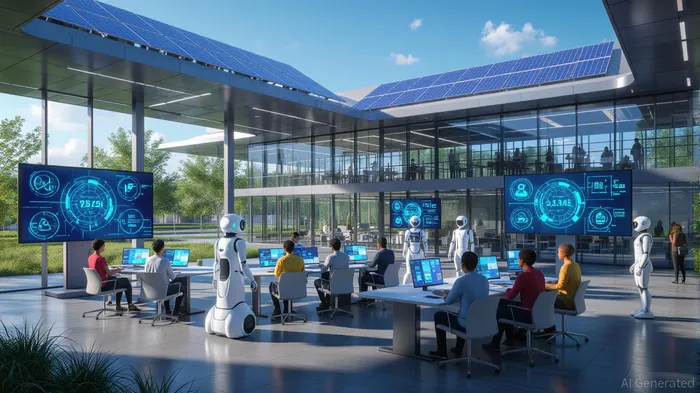
Farmingdale's integration of AI into education is particularly noteworthy. A $164,000+ National Science Foundation (NSF) grant supports the "SMILE" project, which uses AI and Socratic metacognitive techniques to enhance critical thinking in introductory programming courses. By fostering problem-solving and adaptability, the initiative aligns with the transdisciplinary skills demanded by AI-driven economies. Such programs are critical as employers increasingly seek candidates with both technical expertise and ethical reasoning.
Renewable Energy and Infrastructure Partnerships
Renewable energy programs are another growth area, with Farmingdale's Renewable Energy and Sustainability Center (RESC) collaborating with industry leaders like National Grid and PSEG Long Island. These partnerships advance smart grid technologies and train students for entry-level roles in natural gas and offshore wind sectors. For instance, National Grid's certificate program guarantees employment for graduates, addressing workforce shortages in the energy transition. Similarly, the college's involvement in the $12.5 million U.S. Department of Energy-funded Smart Energy Corridor Project highlights its role in modeling renewable energy solutions and training workers for emerging jobs.
Infrastructure investments are equally pivotal. Farmingdale's Rams Design-Build Team, in partnership with Skanska Clean Energy Builders, is tackling projects like the South Brooklyn Marine Terminal, a critical hub for New York's offshore wind ambitions. These collaborations underscore the importance of infrastructure providers in scaling renewable energy initiatives, a sector projected to grow as global decarbonization goals intensify.
Investment Potential in Edtech and Workforce Platforms
The AI EdTech market, forecasted to grow from $5.3 billion in 2025 to $98.1 billion by 2034, is a prime investment opportunity. Platforms enabling personalized learning, such as AI Study Partners that allow educators to upload customized resources, are gaining traction. Farmingdale's adoption of such tools aligns with national trends, where states like Utah and North Carolina are already investing in AI training for teachers.
Workforce training providers are also poised for growth. Initiatives like the Texas Green Careers Academy and Florida's AI-powered labor market analysis programs demonstrate how partnerships between institutions and employers can tailor training to industry needs. The National Science Foundation's Artificial Intelligence Education Act of 2025 further amplifies this trend, funding scholarships and Centers of AI Excellence at community colleges.
Infrastructure companies, too, stand to benefit. Farmingdale's collaborations with Orsted, GE Renewable Energy, and Vestas highlight the demand for specialized training in wind turbine technology. As offshore wind projects expand, infrastructure firms with expertise in smart grid deployment and energy-efficient systems will see increased demand.
Conclusion
The alignment of STEM curriculum expansion with workforce demand in 2025 is not merely an educational imperative but a strategic investment opportunity. Institutions like Farmingdale State College are demonstrating how partnerships with edtech platforms, infrastructure providers, and industry leaders can drive innovation and economic growth. For investors, the focus should be on scalable solutions-AI-driven learning tools, renewable energy training programs, and infrastructure projects-that address both immediate labor market needs and long-term sustainability goals. As the AI Workforce Consortium notes, the most successful models will be those that remain adaptable to real-time industry shifts. The time to act is now.







Comentarios
Aún no hay comentarios