
Emerging Opportunities in Gulf-Linked Derivatives Markets: How Middle East Hedge-Fund Strategies Are Reshaping CME Group's Global Trading Dynamics
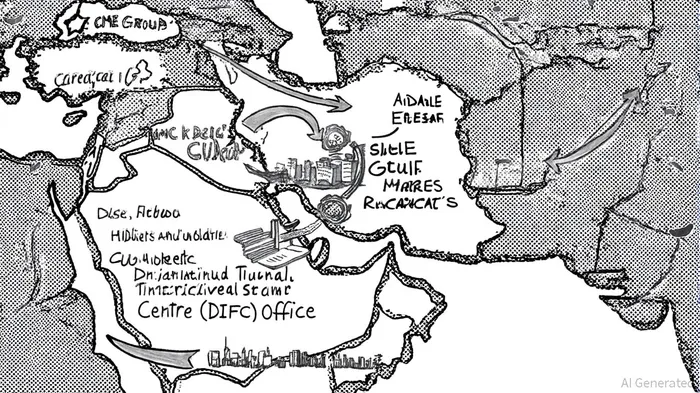
The Gulf's financial landscape is undergoing a seismic shift, driven by a confluence of geopolitical realignments, capital inflows, and a surge in hedge-fund activity. At the center of this transformation is the CME GroupCME--, whose strategic expansion into the Middle East—marked by the 2025 opening of its Dubai International Financial Centre (DIFC) office—has positioned the region as a critical node in global derivatives markets. A Coinotag analysis cites CMECME-- Group's statement that the move was designed to "meet the growing demand for financial market access in the region" and notes it has already catalyzed a 16% year-on-year increase in average daily trading volume (ADV) from the Middle East, reaching 193,000 contracts per day. This growth is not merely a byproduct of regional economic diversification but a direct result of hedge-fund strategies that are redefining the dynamics of global trading.
Strategic Expansion and Product Innovation
CME Group's foray into the Gulf has been underpinned by a suite of product innovations tailored to the region's unique needs. In June 2025, the exchange introduced the spot U.S. Dollar / United Arab Emirates Dirham (USD/AED) currency pair on its EBS platforms, a move that aligns with the UAE's growing role as a financial hub, according to a PR Newswire release. Simultaneously, the launch of the 1-Ounce Gold (1OZ) futures contract and Lithium Hydroxide (LTH) futures has broadened access to commodities critical for both traditional and green energy sectors, as noted by Coinotag. These offerings are not isolated initiatives but part of a broader strategy to capture liquidity from Gulf-based hedge funds, which are increasingly leveraging derivatives to hedge against currency volatility and commodity price swings.
The impact of these innovations is evident in CME's Q2 2025 performance: CME Group reported that average daily volume (ADV) hit a record 30.2 million contracts, with cryptocurrency products seeing a 136% surge in ADV, reflecting the Middle East's appetite for digital assets as a store of value amid geopolitical uncertainties, according to a CME Group press release. This trend is further amplified by the region's 4.95% share of the global derivatives market in 2025, valued at $32.57 billion, according to Cognitive Market Research, a figure that underscores the Gulf's growing influence.
Hedge-Fund Relocation and Trading Dynamics
The relocation of Gulf-based hedge funds to Dubai and Abu Dhabi has been a game-changer for CME Group. As noted in a Coinotag analysis, the 30% rise in hedge-fund trading from the Gulf is largely attributable to firms seeking access to regional capital and regulatory clarity. These funds are not only increasing their participation in CME's products but also reshaping the exchange's global trading dynamics. For instance, the introduction of Platinum and Palladium Friday Weekly options has seen a 99% year-to-date increase in trading volume, driven by Middle Eastern investors hedging against industrial metal price volatility, as Coinotag reports.
This shift is also evident in the Middle East's single-digit but fastest-growing share of CME's global derivatives trading. While the region accounts for less than 10% of total volume, its trajectory suggests a structural reorientation of CME's client base. The exchange's Derivatives Trading Challenge in the Middle East and North Africa (MENA) region, a collaboration with the Gulf Capital Market Association (GCMA) and Gulf Mercantile Exchange (GME), further illustrates its commitment to nurturing local talent and institutional participation, per CME Group.
Market Dynamics and Future Opportunities
The interplay between Gulf-linked derivatives and global markets is creating new opportunities for investors. Coinotag highlights CME's Q3 2025 Metals Update, noting the surge in Platinum options trading with record daily volumes driven by Middle Eastern demand. Similarly, the launch of Ferrous Scrap options and Lithium Hydroxide futures has provided tools for managing risks in sectors critical to the energy transition. These products are particularly attractive to Gulf-based funds, which are increasingly allocating capital to commodities tied to decarbonization and technological innovation.
However, challenges remain. Regulatory fragmentation across Gulf states and the need for infrastructure upgrades could slow the pace of adoption. Additionally, the U.S. dollar-pegged currencies in the Gulf, while providing stability, may limit the diversification potential of certain derivatives strategies.
Conclusion
The Middle East's emergence as a derivatives market powerhouse is no longer a speculative narrative but a data-driven reality. CME Group's strategic expansion, coupled with the relocation of Gulf-based hedge funds, has created a virtuous cycle of innovation and liquidity. For investors, the key takeaway is clear: Gulf-linked derivatives are not just a regional phenomenon but a catalyst for redefining global trading dynamics. As CME continues to roll out products tailored to the Gulf's evolving needs, the intersection of Middle Eastern capital and global markets will likely yield untapped opportunities for those who position themselves at the forefront of this transformation.





Comentarios
Aún no hay comentarios