
Emerging Opportunities in the APEX Token Amid Whale Accumulation Activity
In the dynamic landscape of cryptocurrency markets, whale behavior has emerged as a critical barometer for gauging momentum and timing investment decisions. Recent on-chain activity surrounding the APEX token underscores this phenomenon, offering a compelling case study for investors seeking to align with market-moving forces.
Whale Accumulation and APEX's Strategic Positioning
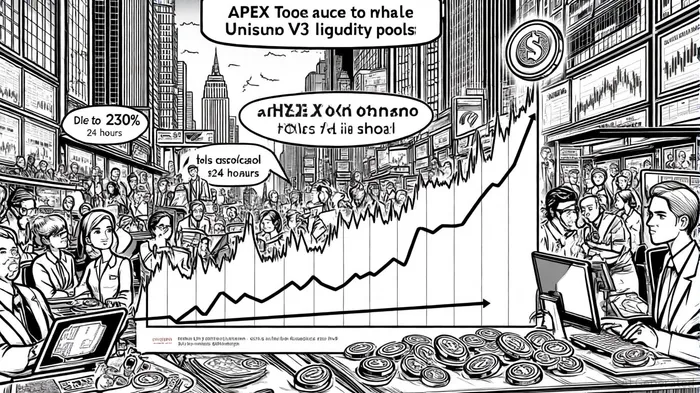
A pivotal development in late September 2025 saw a whale transfer 3.15 million APEX tokens ($5.7 million) from Bybit to UniswapUNI-- V3 liquidity pools, coinciding with a 230% price surge in 24 hours [2]. This move not only enhanced liquidity but also signaled confidence in APEX's ecosystem. By depositing tokens into Uniswap V3, the whale reduced slippage and positioned APEX for increased trading volume, a strategic maneuver often associated with bullish sentiment [2]. Such actions align with broader trends where whales capitalize on market dips to consolidate positions, as seen in the accumulation of tokens like World Liberty FinancialWLFI-- (WLFI) and Polygon Ecosystem Token (POL) during Bitcoin's decline below $110,000 [2].
Historical Precedents and Market Psychology
Whale accumulation is not a novel concept but one with historical resonance. For instance, EthereumETH-- whales doubled their holdings in 2025, amassing 818,410 ETH ($2.5 billion), a pattern reminiscent of the 2018 bear market that preceded Ethereum's rise from $80 to $4,800 [1]. Academic research further validates this behavior, with studies showing that large transfers by whales significantly impact returns for top cryptocurrencies within 6–24 hours post-transaction [4]. The "Moby Dick effect," as documented in academic literature, highlights how whale activity can drive contagion across markets, amplifying price movements through liquidity shifts and investor psychology [4].
Institutional Confidence and Tokenomics
APEX's appeal to whales is compounded by its tokenomics. The token's integration into Uniswap V3 liquidity pools suggests a focus on scalability and real-world utility, traits that align with institutional preferences in 2025 [3]. Tokens with deflationary mechanisms, such as buyback-and-burn strategies, further attract whale interest by creating scarcity and long-term value [1]. This dynamic is evident in projects like Dawgz AI ($DAGZ), where whale accumulation surged due to AI-driven tools and deflationary models [5]. For APEX, the strategic deployment of liquidity pools may serve a similar purpose, reinforcing its position in a competitive market.
Risks and Mitigation Strategies
While whale accumulation often signals optimism, it carries inherent risks. Sudden sell-offs or manipulative tactics can destabilize markets, as seen in Cardano's price decline following a large ADAADA-- sell-off by whales [1]. Retail investors must remain vigilant, leveraging tools like Nansen and ChainExposed's Whale Accumulation Heat Map to monitor wallet balances and transaction flows [4]. Additionally, regulatory frameworks are increasingly addressing whale activity to mitigate market distortions, a trend that could shape APEX's trajectory in the coming months [3].
Conclusion: APEX as a High-Potential Play
The convergence of whale accumulation, liquidity enhancement, and favorable tokenomics positions APEX as a high-potential asset in 2025. Historical precedents and academic insights affirm that whale behavior often precedes significant price movements, making it a leading indicator for investors. However, success hinges on balancing optimism with caution, particularly in markets where liquidity dynamics can shift rapidly. For those attuned to on-chain signals, APEX's recent trajectory offers a compelling opportunity to participate in a token poised for growth.






Comentarios
Aún no hay comentarios