
Emerging Natural Gas Infrastructure Expansion: Strategic Market Access and Pricing Power in 2025
The U.S. natural gas sector is undergoing a transformative phase in 2025, driven by a surge in infrastructure expansion projects that are reshaping market access and pricing dynamics. With record supply and demand fundamentals, the industry is capitalizing on a $75+ billion investment wave to unlock new export corridors, stabilize domestic pricing, and position North America as a global LNG powerhouse. However, geopolitical uncertainties and regulatory headwinds remain critical variables for investors.
U.S. Infrastructure: A Catalyst for Market Access
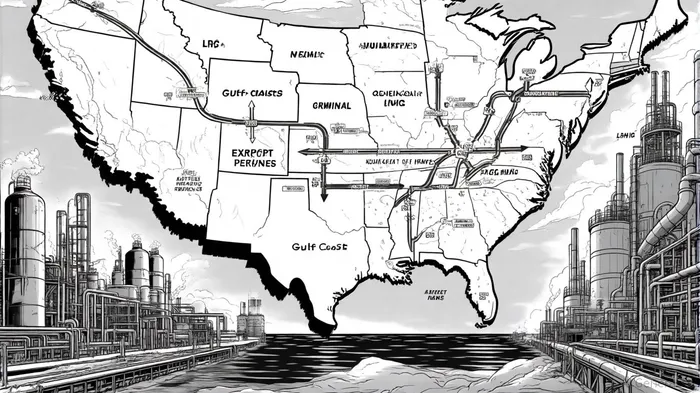
The backbone of this transformation lies in the rapid development of pipeline and LNG export infrastructure. In the Permian and Haynesville basins, projects like the 3.5 Bcf/d Black Fin pipeline and 1.8 Bcf/d Louisiana Gateway pipeline are set to resolve long-standing transportation bottlenecks by late 2025, enabling efficient gas movement to the Gulf Coast [2]. Similarly, the 2.5 Bcf/d Matterhorn Express Pipeline will connect the Permian to Houston, enhancing supply flexibility for export terminals [4].
In the Haynesville Shale, Momentum Midstream's New Generation Gas Gathering (NG3) project (1.7 Bcf/d) and DT Midstream's LEAP Gathering System are addressing regional supply constraints, with both projects targeting Q4 2025 in-service dates [3]. These developments are critical for feeding new LNG export facilities like Golden Pass, which is expected to ramp up operations in the second half of 2025 [3].
Regulatory progress is also accelerating, with FERC overseeing projects such as the 2.2 Bcf/d Hugh Brinson and 2.5 Bcf/d Blackcomb pipelines, which will bolster supply resilience in Texas and the Gulf Coast [4]. However, projects in the Northeast and Midwest, such as the Constitution Pipeline revival, face delays due to environmental and political challenges [4].
Pricing Power and Global Market Access
The expansion of LNG export capacity is redefining the U.S. natural gas market's global footprint. North America is projected to account for 85% of incremental LNG supply in 2025, led by projects like Venture Global LNG's Plaquemines facility and LNG Canada [1]. This surge in export capacity is fueling a global LNG trade boom, with the market expected to grow from $129.8 billion in 2023 to $255.2 billion by 2030 at a 10.1% compound annual growth rate [6].
Strategically, the U.S. is leveraging its infrastructure to diversify global demand. Europe, for instance, is increasing LNG import capacity to reduce reliance on Russian pipeline gas, while India's imports are projected to more than double by 2030 due to industrial and power generation needs [1]. These trends are creating pricing asymmetry: while domestic production has moderated U.S. prices (Enverus forecasts an average of $3.90/MMBtu for 2025), global markets remain volatile due to geopolitical tensions like the Russia-Ukraine conflict and U.S. tariffs [1].
Strategic Risks and Investment Considerations
Despite optimism, investors must navigate several risks. First, regulatory delays in the Northeast and Midwest could disrupt regional supply chains, as seen with the Constitution Pipeline and Iroquois Enhancement projects [4]. Second, geopolitical volatility—including U.S. trade policies and Middle East tensions—could destabilize long-term pricing forecasts. Third, the energy transition poses a paradox: while natural gas is a bridge fuel, its displacement of coal in power generation is slowing due to low prices [1].
For investors, the key lies in balancing short-term gains from infrastructure-driven demand with long-term exposure to decarbonization trends. Midstream operators with projects aligned to the South Central U.S.—where 90% of new pipeline capacity is concentrated—are particularly well-positioned [2].
Conclusion
The 2025 natural gas infrastructure boom is a strategic inflection point for the U.S. energy sector. By expanding market access through LNG and pipeline projects, the country is not only stabilizing domestic pricing but also securing a pivotal role in global energy markets. However, success hinges on navigating regulatory, geopolitical, and environmental challenges. For investors, this dynamic landscape offers opportunities in midstream infrastructure, LNG export terminals, and regional supply chain optimization.





Comentarios
Aún no hay comentarios