
Emerging Markets Equity Exposure: A Strategic Play for Dividend Stability and Income Generation
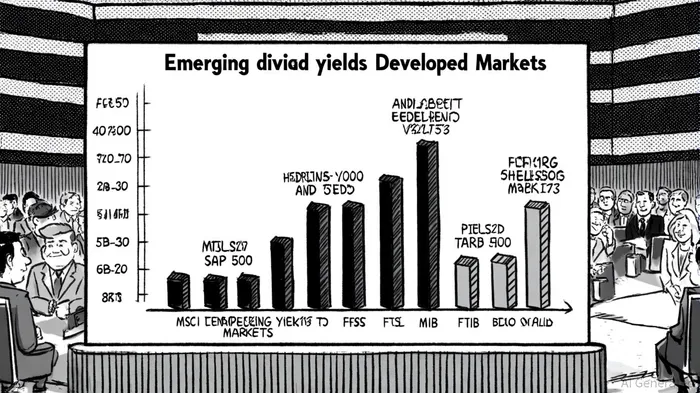
In the evolving landscape of global equities, emerging markets have re-emerged as a compelling arena for income-focused investors. While developed markets, particularly the United States, remain dominated by high-growth, low-dividend technology stocks, emerging economies are carving out a niche for themselves through higher dividend yields and resilient income generation. According to a report by Siblis Research, as of 2025, Italy's FTSE MIB Index offered a dividend yield of 5.16%, Australia's All Ordinaries Index delivered 3.77%, and the UK's FTSE 100 Index yielded 3.62%—all significantly outpacing the U.S. large-cap yield of 1.24% [1]. This divergence underscores a structural shift in where investors can find reliable income streams.
The Allure of Emerging Markets: Yields and Valuation Gaps
Emerging markets have historically provided higher dividend yields than their developed counterparts, a trend that has persisted despite macroeconomic headwinds. Data from the MSCIMSCI-- Emerging Markets Index reveals that these markets concluded 2023 on a stronger note than developed markets, driven by stronger demand conditions and better inflation control [2]. The valuation gap further amplifies their appeal: international dividend ETFs like the Vanguard International High Dividend Yield Index ETF (VYMI) now offer yields of up to 4.73%, attracting investors seeking alternatives to the low-yield U.S. market [3].
However, the story is not uniformly positive. Regional disparities are stark. For instance, while Poland's equity index surged over 35% in Q3 2025 due to political and economic stability, Thailand and parts of Asia lagged due to weak exports and political uncertainty [4]. China's SSE Composite Index, a bellwether for the region, reported a modest 2.69% yield in early 2025, reflecting cautious optimism amid an uneven economic recovery [1]. These variations highlight the importance of granular analysis when allocating capital to emerging markets.
Historical Resilience: Lessons from Crises
The 2008 financial crisis and the 2020–2025 pandemic-era downturns offer critical insights into dividend stability in emerging markets. During the 2008 crisis, Vietnamese firms with weak corporate governance paradoxically maintained or even increased dividend payouts, adhering to the "bird in hand" theory—where shareholders prioritize immediate returns over uncertain future gains [5]. Conversely, large or highly leveraged firms in the same period showed weaker sensitivity to the crisis, preserving dividends despite declining earnings [5].
More recently, economic policy uncertainty (EPU) has shaped dividend strategies in emerging markets. A 2024 study found that higher EPU correlates with increased cash dividend payouts, as companies use dividends to signal stability and align management with shareholder interests [6]. For example, Chinese non-state-owned firms with lower equity concentration raised dividends during the 2020–2025 recovery phase, even as structural policy adjustments and global instability persisted [6]. This trend underscores the role of dividends as both a signaling mechanism and a tool for investor confidence.
Risks and Mitigation: Navigating Volatility
Despite their allure, emerging markets are not without risks. The 2013 "taper tantrum" demonstrated their vulnerability to advanced economy monetary policy shifts, with currency depreciation and capital outflows crippling economies with weak foreign exchange reserves [7]. Today, similar risks loom as China's uncertain recovery and geopolitical tensions in regions like the Middle East and Eastern Europe threaten stability [3].
Investors must also contend with sectoral disparities. Non-cyclical sectors like utilities and healthcare have historically maintained dividend stability during crises, while cyclical sectors such as energy and industrials often face cuts [6]. For instance, during the 2020 pandemic, global energy firms in emerging markets slashed dividends to preserve liquidity, whereas consumer staples firms maintained payouts [6].
Strategic Allocation: Balancing Yield and Risk
For investors seeking to capitalize on emerging markets' income potential, a balanced approach is essential. Diversification across regions and sectors can mitigate risks while capturing yield differentials. ETFs like VYMI provide broad exposure to high-dividend, stable companies in both emerging and developed markets, offering a middle ground for risk-averse investors [3].
Moreover, due diligence on corporate governance and cash flow resilience is critical. Firms with strong balance sheets and conservative payout ratios—such as those in India's financial services sector—have historically outperformed during downturns [2]. Conversely, over-leveraged companies or those in politically unstable regions may pose significant risks.
Conclusion: A Nuanced Opportunity
Emerging markets equity exposure remains a strategic lever for income generation, particularly for investors willing to navigate their inherent volatility. While higher dividend yields and valuation gaps present compelling opportunities, historical crises and regional disparities demand a discerning approach. By leveraging ETFs, sectoral diversification, and rigorous due diligence, investors can harness the income potential of emerging markets while mitigating downside risks.
As the global economy continues to recalibrate, the interplay between yield, stability, and risk in emerging markets will remain a focal point for income-focused portfolios.





Comentarios
Aún no hay comentarios