
Emerging Markets and Crypto: The Strategic Move of a Winklevoss-Backed Firm into Brazil
Emerging Markets and Crypto: The Strategic Move of a Winklevoss-Backed Firm into Brazil
Brazil's emergence as Latin America's fastest-growing crypto market is no accident. A confluence of macroeconomic tailwinds-soaring inflation, a young and tech-savvy population, and a fragmented financial system-has created fertile ground for digital assets. Against this backdrop, OranjeBTC, a Winklevoss-backed firm, has made a bold strategic move to enter the Brazilian market, leveraging both regulatory momentum and the nation's crypto frenzy.
Macroeconomic Tailwinds: Inflation and the Rise of Digital Alternatives
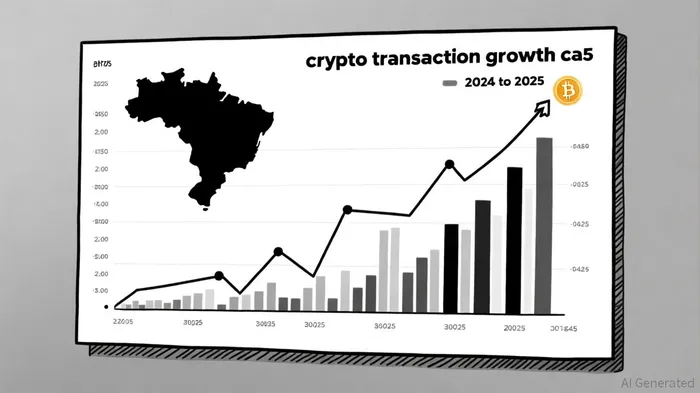
Brazil's inflation rate, though easing to 5.13% in September 2025, remains above the Central Bank's 4.5% target, eroding purchasing power and fueling demand for alternative stores of value, according to Trading Economics. This environment has driven a surge in crypto adoption, with $318.8 billion in transactions recorded between July 2024 and June 2025-a 100% year-over-year increase, according to an FXLeaders report. Stablecoins like USDTUSDT-- and USDCUSDC-- dominate these flows, serving as a hedge against inflation and a medium for cross-border remittances, according to Yahoo Finance.
The Brazilian government's recent imposition of a flat 17.5% tax on all crypto gains under Provisional Measure 1303 has sparked controversy. Critics argue this policy risks pushing retail investors toward unregulated platforms, yet it also underscores the growing institutional recognition of crypto as a taxable asset class, according to Cointelegraph. Meanwhile, Brazil's exploration of a Sovereign Strategic Reserve of Bitcoin-advancing through Bill 4501/2024-signals a shift toward institutional adoption, mirroring El Salvador's bold experiment while adopting a more measured approach, as reported by Global Law Today.
Regulatory Momentum: A Framework for Growth
Brazil's regulatory landscape has evolved rapidly. The 2023 Virtual Assets Law (BVAL) established a legal framework for crypto businesses, mandating anti-money laundering (AML) and know-your-customer (KYC) compliance for Virtual Asset Service Providers (VASPs), according to the International Bar Association. In 2025, the Central Bank of Brazil (BCB) introduced operational standards for VASPs, including minimum capital requirements, further legitimizing the sector, according to Bloomberg.
However, new forex rules tightening cross-border transaction limits-such as a $10,000 cap for individuals-pose challenges for crypto exchanges facilitating international transfers, according to Risk Management Masters. While these rules do notNOT-- explicitly mention crypto, their indirect impact could force platforms to adopt stricter compliance measures, potentially slowing retail adoption. Yet, the BCB's parallel development of the digital real (Drex) CBDC, slated for a 2025 launch, suggests a long-term vision to integrate digital finance into Brazil's economy, according to In The Near Future.
OranjeBTC's Strategic Play: Bridging Traditional and Digital Finance
OranjeBTC's entry into Brazil is a masterstroke of strategic alignment. The firm, backed by the Winklevoss twins, Adam Back, and other crypto luminaries, went public on Brazil's B3 stock exchange via a reverse IPO on October 7, 2025, under the ticker OBTC3, according to Capwolf. Holding 3,650 BitcoinBTC-- (worth $420 million), OranjeBTC ranks among the top 30 global corporate Bitcoin holders, CoinDesk reported. Its strategy combines expanding its Bitcoin treasury with an educational initiative through its subsidiary, Intergraus, to demystify crypto for Brazilian investors, Bloomberg reported.
This dual approach addresses a critical gap in Brazil's market: while retail adoption is robust, institutional participation remains nascent. By offering a regulated equity vehicle (OBTC3) to access Bitcoin, OranjeBTC bridges traditional finance and digital assets, appealing to both risk-averse investors and crypto-native users. The firm's CEO, Guilherme Gomes, has emphasized that "combining Bitcoin's growth potential with education is key to long-term adoption," a sentiment echoed by Brazil's sophisticated capital markets, according to Invezz.
Competitive Dynamics and Institutional Potential
OranjeBTC's strategy contrasts with that of local fintech rival Meliuz, the first Brazilian firm to implement a Bitcoin treasury. While Meliuz focuses on institutional clients, OranjeBTC's public listing democratizes access, enabling retail investors to participate in Bitcoin's upside without direct exposure to volatile markets, according to an FXLeaders report. This model could catalyze further institutional adoption, particularly as Brazil's government considers Bitcoin for its Sovereign Strategic Reserve-a move that would legitimize the asset as a macroeconomic tool, Global Law Today noted.
Investment Implications: A High-Growth, High-Volatility Play
For investors, OranjeBTC's Brazil venture represents a high-growth opportunity in a market poised for disruption. Brazil's crypto ecosystem is expanding at a pace outstripping even Argentina and Mexico, with 18–19% of Brazilians now owning crypto, according to Disruption Banking. However, regulatory uncertainty-particularly around tax policy and forex rules-introduces volatility. The firm's $420 million Bitcoin treasury provides a buffer, but its success hinges on navigating Brazil's evolving regulatory environment while scaling its educational initiatives, Bloomberg reported.
In the long term, OranjeBTC's ability to capitalize on Brazil's macroeconomic tailwinds-rising crypto adoption, institutional curiosity, and a young, tech-savvy demographic-could position it as a regional leader. Yet, investors must remain vigilant about short-term risks, including potential regulatory crackdowns and the inherent volatility of Bitcoin itself.
Conclusion
OranjeBTC's entry into Brazil is more than a corporate expansion-it's a strategic bet on the future of finance in a country where crypto is rapidly becoming part of the economic fabric. As Brazil's regulatory framework matures and its macroeconomic challenges persist, the firm's hybrid model of treasury growth and education may prove to be a winning formula. For investors, the key will be balancing the allure of Brazil's crypto boom with the realities of a market still finding its footing.






Comentarios
Aún no hay comentarios