
Emerging Market Industrial Equipment Demand: Strategic Investment Opportunities in European Heavy Machinery Exporters
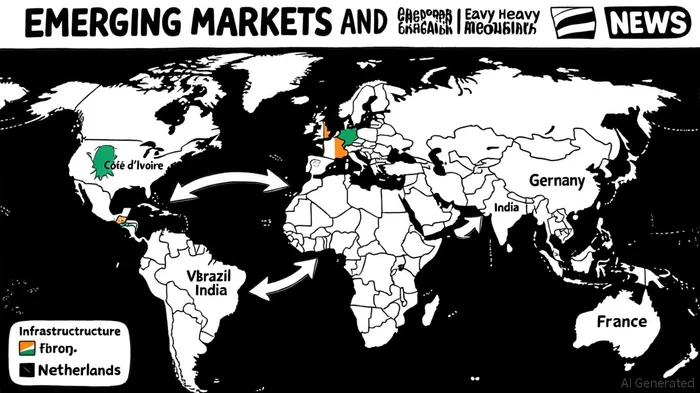
The global industrial machinery and equipment market is undergoing a transformative phase, driven by urbanization, infrastructure development, and technological innovation. For European heavy machinery exporters, this presents a unique window of opportunity to capitalize on demand in emerging markets, where structural growth trends are reshaping industrial landscapes.
A Booming Global Market with Emerging Market Catalysts
According to a report by Gartner, the global industrial machinery market is projected to surge from USD 714.5 billion in 2024 to USD 1.61 trillion by 2034, growing at a compound annual growth rate (CAGR) of 9%[3]. This expansion is fueled by mechanization in agriculture, infrastructure spending, and smart packaging solutions. Emerging markets, in particular, are pivotal to this growth. For instance, the construction segment—accounting for 43.2% of the 2024 market—relies heavily on excavators, bulldozers, and loaders, which are in high demand for both residential and commercial projects[3].
In the U.S., cities like Charleston, South Carolina, and El Paso, Texas, exemplify this trend. Charleston has 2.7 million square feet of industrial space under construction, supported by a 3.5% annual job growth rate[1]. Meanwhile, El Paso's industrial property prices have surged 145% year-over-year, reflecting its emergence as a logistics and manufacturing hub[1]. These regional dynamics underscore a broader pattern: emerging markets are becoming critical nodes in global supply chains.
European Exporters: Navigating Growth and Challenges
European heavy machinery exporters face a mixed landscape in 2024. While sectors like semiconductor manufacturing and packaging machinery show resilience, others—such as textile and printing machinery—struggle with declining demand[1]. The EU's total machinery exports reached 133 billion euros in 2024, with semiconductor manufacturing machinery growing by 7.9% in euro terms[1]. This strength is anchored by firms like ASML (Netherlands), which dominates extreme ultraviolet (EUV) lithography, and Infineon (Germany), a leader in power semiconductors[1].
However, challenges persist. Exports to markets like Taiwan, Russia, and Pakistan have fallen below pre-pandemic levels[1]. Conversely, countries such as Côte d'Ivoire and Vietnam are emerging as bright spots. Côte d'Ivoire's stable economy and robust logistics infrastructure have driven demand for cream separators and industrial meat processing equipment[1]. Vietnam's food processing sector is similarly expanding, with imports of advanced machinery rising[1].
Strategic Sectors and Geographies for European Firms
1. Food Processing Machinery
The global food processing machinery market is expected to grow at a CAGR of 5.73% from 2025 to 2030, driven by automation and stricter food-safety regulations[2]. European firms with expertise in hygienic, high-efficiency equipment—such as cream separators and meat processing tools—are well-positioned to capture this demand. Côte d'Ivoire and Vietnam, with their growing food processing infrastructures, represent high-potential markets[1].
2. Metalworking Machinery in Brazil and India
Brazil and India are witnessing structural growth in metalworking machinery, particularly numerically controlled bending presses and other specialized equipment[2]. Brazil's expansion of EV clusters and infrastructure projects under PAC 2024-2027, coupled with India's “Make in India” initiative, create favorable conditions for European exporters[3]. A CEO survey found that 58.4% of European manufacturers view India as the most promising market for business development, compared to 28.4% for China[1].
3. Sustainability and Electrification
Europe's push for decarbonization is reshaping its machinery exports. Electric and hybrid equipment, led by Germany and the UK, are gaining traction as emerging markets prioritize sustainability[3]. This aligns with global trends, as the heavy machinery market is projected to grow at a CAGR of 5.11% from 2025 to 2033, driven by electrification and automation[3].
Risks and Mitigation Strategies
Despite these opportunities, European exporters must navigate challenges. High initial costs, regulatory compliance, and supply chain disruptions could hinder short-term growth[2]. However, the shift toward automation and digital transformation—such as IoT integration in machinery—offers a pathway to enhance efficiency and competitiveness[3].
Conclusion
Emerging markets are redefining the industrial equipment landscape, offering European heavy machinery exporters a mix of challenges and opportunities. By focusing on high-growth sectors like food processing and metalworking, and leveraging their technological and sustainability expertise, European firms can secure a competitive edge. As infrastructure investments and urbanization accelerate, strategic partnerships and localized solutions will be key to unlocking long-term value in these dynamic markets.







Comentarios
Aún no hay comentarios