
Emerging Gold Exploration Opportunities in the Nevada Hot Springs Range: A New Frontier for Eminent Gold
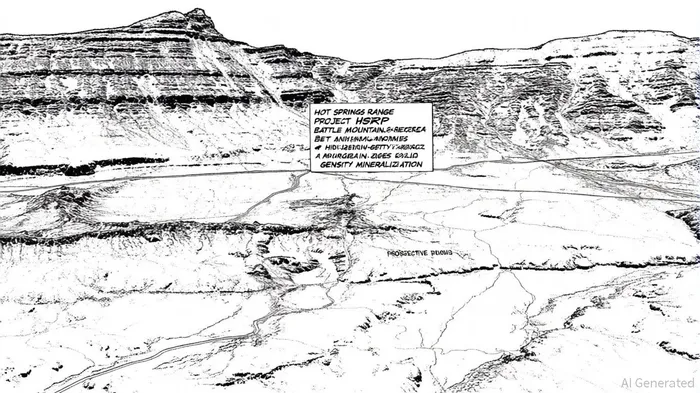
In the ever-evolving landscape of U.S. gold exploration, underappreciated districts often hold the key to transformative discoveries. Eminent Gold Corp.'s Hot Springs Range Project (HSRP) in Nevada exemplifies this potential, emerging as a compelling case study in overlooked geological promise. Situated at the intersection of two prolific mineral belts—the NNE-trending Battle Mountain-Eureka Mineral Belt and the NE-trending Getchell Trend—the HSRP combines structural complexity, favorable lithology, and proximity to world-class deposits to position itself as a high-potential gold district[1].
Drilling Success and Geological Consistency
Eminent's recent drilling at the Otis target has delivered robust results, reinforcing the project's alignment with Carlin-type gold systems. Notable intercepts include 7.9 meters of 1.2 g/t Au and 4 meters of 2.4 g/t Au, with mineralization occurring within a northeast-trending structural corridor[2]. These results are not isolated anomalies but part of a broader pattern: a gravity geophysics program identified five distinct exploration targets, three of which corroborate existing targets (Otis, Sitka, and Eden) and extend the cumulative strike length of NE-trending faults to over 10 kilometers[3].
The presence of iron oxide alteration—a hallmark of Carlin-type systems—further strengthens the case for economic viability. As stated by Eminent's President and CEO, Paul Sun, the project's geological architecture increasingly mirrors the Getchell Trend, a region that has historically produced over 19 million ounces of gold[4]. This analogy is critical: Carlin-type deposits, characterized by low-sulfidation, fine-grained gold in carbonate host rocks, are among the most economically recoverable gold systems globally[5].
Underappreciated Geology in a Proven Gold Province
Nevada's Hot Springs Range remains largely unexplored despite its proximity to the Getchell-Turquoise Ridge mines and its structural parallels to the Carlin Trend. The area's geology—Mississippian-age calcareous sediments and andesites thrust over Permian phyllites—creates a template for Carlin-type mineralization[6]. Yet, unlike the extensively developed Carlin Trend, the Hot Springs Range has no historical production, leaving its gold endowment untapped.
Recent geophysical surveys have added urgency to this narrative. A high-density anomaly, interpreted as a magmatic intrusion, and a gravity low, suggesting a recessively weathered basin, are both considered highly prospective features in Nevada's gold systems[7]. These anomalies, combined with anomalous geochemistry and structural continuity, indicate a district-scale gold system that could rival established trends.
Strategic Positioning in the U.S. Gold Sector
The HSRP's potential is amplified by its location within a structurally complex and underexplored region. While the Carlin and Getchell Trends have collectively produced over 50 million ounces of gold, the Hot Springs Range remains a blank slate for modern exploration[8]. This underinvestment creates a unique opportunity: Eminent's gravity survey and drilling have already outlined a 10-kilometer corridor of mineralized faults, with open-ended targets that could expand further.
For investors, the implications are clear. Eminent's systematic approach—combining geophysics, drilling, and structural analysis—has de-risked the project while highlighting its scalability. The company's plan to resume drilling in Q4 2025[9] underscores its confidence in the system's potential, particularly along the Otis fault, where prior drilling intersected gold over a 400-meter segment[10].
Conclusion: A District in the Making
Eminent Gold's Hot Springs Range Project represents a rare convergence of geological favorability, strategic location, and underappreciated potential. By leveraging modern exploration techniques, the company has transformed a historically overlooked district into a high-probability target for Carlin-type gold discoveries. As the U.S. gold sector continues to seek new frontiers, the HSRP stands out as a project with the scale and structural complexity to redefine Nevada's gold landscape.
For investors, the next phase of drilling and geophysical follow-up will be critical. If Eminent's open-ended mineralization expands into a district-scale system, the Hot Springs Range could join the ranks of Nevada's most significant gold districts—a scenario that would validate the company's bold vision and reward early-stage investors.







Comentarios
Aún no hay comentarios