
Emerging Drone Security Solutions: A Lucrative Investment Opportunity in Airport Safety Tech
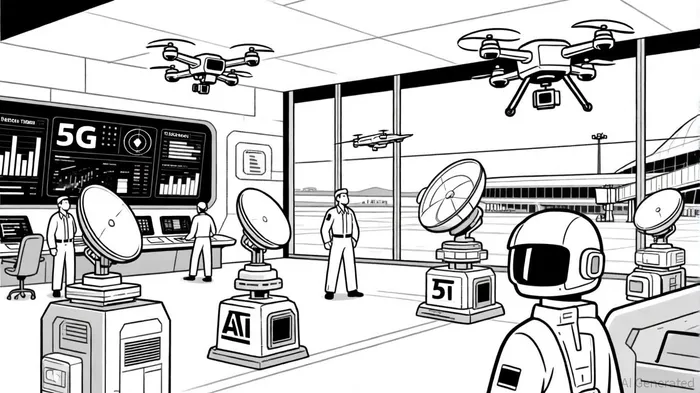
The global drone security market is undergoing a seismic shift, driven by escalating threats from unauthorized drone activity and rapid technological innovation. For investors, the airport safety segment represents a particularly compelling opportunity, with market valuations and growth projections underscoring its potential. According to a report by The Business Research Company, the global safety and security drones market is projected to surge from $2.15 billion in 2024 to $2.57 billion in 2025, growing at a compound annual growth rate (CAGR) of 19.5%[1]. By 2029, this figure is expected to nearly double to $5.35 billion, fueled by advancements in hybrid and vertical takeoff and landing (VTOL) designs, secure communication protocols, and AI-driven automation[1].
Airport Drone Defense: A Niche with Explosive Growth
The airport drone defense system market, a critical subset of this broader sector, is poised for even more dramatic expansion. Data from DataInsightsMarket reveals that this niche was valued at $1.5 billion in 2025 and is forecasted to reach $5.2 billion by 2033, growing at a CAGR of 15%[3]. This trajectory is driven by the urgent need to counter rogue drones near airports, which pose risks ranging from flight disruptions to smuggling and terrorism. Radar systems currently dominate the market due to their reliability and cost-effectiveness, but the integration of AI and machine learning is rapidly enhancing threat detection accuracy and response times[3].
The U.S. market further amplifies this opportunity. Grand View Research notes that the U.S. drone market size reached $25.07 billion in 2024 and is expected to hit $28.44 billion in 2025, with hardware accounting for over 59% of the market share[2]. By 2030, the U.S. market is projected to balloon to $52.51 billion at a CAGR of 13.0%, reflecting robust demand for both commercial and defense applications[2].
Technological Innovations and Key Players
The surge in demand has catalyzed innovation among leading companies. General Atomics, a titan in unmanned systems, recently secured a $99.2 million contract from the U.S. Department of Defense to develop the GHOST drone, a hybrid-electric platform with 60-hour endurance and reduced acoustic/thermal signatures[1]. The company also achieved a critical safety certification for its Protector drone from British aviation authorities, signaling progress in international airspace integration[1]. Similarly, SkySafe, a leader in drone detection, partnered with Amentum to deploy its cloud-based SaaS solution along the U.S. Southern border, funded by the Department of Defense and Homeland Security[2].
In the counter-drone space, companies like DroneShield and Rafael are pioneering AI-powered detection systems and kinetic/laser defense mechanisms[3]. Publicly traded firms such as AeroVironmentAVAV-- and Kratos Defense & Security are also making waves, with Kratos recently securing contracts for tactical drones and counter-UAS solutions[3]. These companies are not only addressing immediate security gaps but are also positioning themselves at the forefront of a market that is increasingly reliant on integrated, intelligence-driven platforms combining biometrics, edge computing, and 5G connectivity[2].
Regulatory Tailwinds and Strategic Opportunities
Regulatory developments in 2025 have further solidified the investment case. The Federal Aviation Administration (FAA) and Transportation Security Administration (TSA) jointly proposed the Normalizing Unmanned Aircraft Systems Beyond Visual Line of Sight Operations (BVLOS) rule, which includes TSA-led security threat assessments for drone operators and real-time Remote ID requirements[1]. Concurrently, the FAA's Enhanced Sensitive Airspace Operations Rule (ESAOR), effective November 2025, mandates stricter drone rules near critical infrastructure, including dynamic airspace restrictions and tiered licensing[1]. These measures, while imposing operational hurdles, also create demand for compliant technologies and services.
The Trump administration's executive orders in June 2025 have added momentum, prioritizing American-made drones and accelerating BVLOS regulatory reforms[2]. Meanwhile, the Department of Defense's Replicator program has allocated over $1 billion to scale offensive and defensive drone technologies, with the Army alone requesting $447 million for counter-UAS programs in fiscal 2025[2]. These initiatives, coupled with state-level policies favoring domestic drone manufacturers, are expanding the addressable market beyond federal contracts[2].
Risks and Mitigations
Despite the optimism, challenges persist. Tariff-related uncertainties between the U.S. and key suppliers like Germany, Taiwan, and the Netherlands threaten supply chains for critical components such as collision-avoidance sensors[1]. However, the shift toward domestic manufacturing and strategic partnerships—such as General Atomics' work with international allies—mitigates these risks[1].
Conclusion
The airport drone security market is a high-conviction investment opportunity, driven by technological innovation, regulatory tailwinds, and escalating demand for integrated solutions. Companies leading in radar, AI, and counter-drone technologies—such as General Atomics, SkySafe, and DroneShield—are well-positioned to capitalize on this growth. As the FAA and TSA continue to refine regulations, investors who align with firms at the intersection of innovation and compliance will likely reap substantial rewards.







Comentarios
Aún no hay comentarios