
Emerging DeFi Protocols in 2025: Decoding Revenue Scalability and User Growth Dynamics
The decentralized finance (DeFi) landscape in 2025 has evolved into a sophisticated ecosystem, driven by protocols that prioritize efficiency, interoperability, and institutional-grade security. With global Total Value Locked (TVL) reaching $123.6 billion in Q2 2025, the sector is no longer a niche experiment but a critical infrastructure layer for global finance Top DeFi Protocols 2025. Protocols like JupiterJUP--, AaveAAVE--, and Stargate have emerged as leaders, leveraging innovative strategies to scale revenue and attract users. This analysis explores how these protocols achieve financial resilience and growth, offering insights for investors navigating this rapidly maturing market.
Revenue Scalability: Fee Structures and Strategic Allocation
Revenue scalability in DeFi hinges on protocols' ability to monetize liquidity, optimize fee structures, and reinvest earnings into ecosystem growth. Jupiter Exchange, for instance, dominates Solana's DeFi space with $101.01 million in 30-day fees in Q2 2025, according to the adoption report. Its Q3 2025 strategy-allocating 50% of protocol fees to $JUP buybacks-has already driven a 15.56% price surge within 90 minutes of announcement Jupiter's 50% allocation. This approach notNOT-- only rewards token holders but also reduces supply, enhancing scarcity and long-term value.
Aave, meanwhile, has diversified its revenue streams through real-world asset (RWA) integration. Aave's v4 upgrade enabled tokenization of treasuries and real estate, attracting $2.5 billion in liquidity from partnerships like World Liberty FinancialWLFI-- (WLFI). With average quarterly revenue hitting $24.6 million in 2025-a 5x increase since 2022-Aave's modular architecture allows seamless cross-chain expansion, particularly on EthereumETH-- Layer 2s like ArbitrumARB-- and Base.
Stargate Finance, a cross-chain liquidity layer, generates revenue through low-fee transfers (as low as 0.06% for non-STG tokens) and dynamic pool rebalancing. In June 2025 alone, it processed $2.9 billion in transfer volume and 800,000 transactions, as detailed in the Stargate DAO update. Its acquisition by LayerZeroZRO-- in a DAO-led process further solidifies its role as a foundational infrastructure for multi-chain DeFi.
User Growth: Cross-Chain Integration and Institutional Adoption
User growth in DeFi is increasingly tied to cross-chain interoperability and institutional adoption. Protocols that bridge fragmented ecosystems-like Stargate and Synapse-have seen exponential adoption. Stargate's integration of 50+ blockchains and 30+ new Omnichain Fungible Tokens (OFTs) in 2025, noted in the Stargate DAO update, has positioned it as a critical infrastructure layer, enabling seamless asset transfers between Ethereum, SolanaSOL--, and Base.
Sui's DeFi ecosystem also exemplifies user growth through innovation. By introducing Bitcoin-related assets like sBTC and xBTC, SuiSUI-- attracted a new cohort of BitcoinBTC-- holders into DeFi. TVL on Sui peaked at $2.5 billion in Q2 2025, with Bluefin and Momentum protocols achieving 43.95% TVL growth, as reported in the Top DeFi Protocols 2025 analysis.
Institutional adoption is another key driver. Platforms like GnosisGNO-- and TokenMinds have prioritized security and scalability, enabling traditional financial institutions to tokenize assets on-chain. BlackRock's tokenized treasuries and real estate platforms have injected billions into DeFi protocols, with RWAs now accounting for a significant portion of TVL, a trend highlighted in coverage of Jupiter's fee allocation announcement.
Case Studies: Protocols Leading the Charge
Jupiter Exchange: Jupiter's dominance in Solana's PerpDEX market (84% share) and its Jupiter Perps product underscore its ability to capture market share, a point emphasized in reporting on the 50% fee allocation. The launch of Jupiter Studio in June 2025 further expanded its ecosystem, generating $100 million in trading volume within 24 hours, according to the same coverage.
Aave: Aave's TVL of $25.87 billion in July 2025-22% of the total DeFi TVL-highlights its role as a credit market leader, consistent with analysis of its v4 upgrade. Its expansion to 14 blockchains and RWA partnerships have diversified its user base, with Ethereum's 90% TVL share complemented by growth on Base and Arbitrum, as outlined in the Top DeFi Protocols 2025 report.
Stargate Finance: Stargate's integration of Hydra Chains and OFTs has enabled dynamic capital routing, reducing reliance on single-chain liquidity. Its DAO-led governance model, exemplified by the LayerZero acquisition, ensures community-driven innovation, as discussed in the Stargate DAO update.
Conclusion: Investment Considerations for 2025
The DeFi protocols leading in 2025 share common traits: robust fee structures, cross-chain interoperability, and strategic RWA adoption. For investors, protocols with strong developer activity, institutional partnerships, and governance transparency-like Jupiter, Aave, and Stargate-present compelling opportunities. However, risks such as regulatory uncertainty and smart contract vulnerabilities remain. Protocols that prioritize security audits and compliance, while maintaining decentralized governance, are likely to outperform in the long term.
As the DeFi ecosystem matures, the focus will shift from speculative growth to sustainable infrastructure. Protocols that balance innovation with stability will define the next phase of decentralized finance.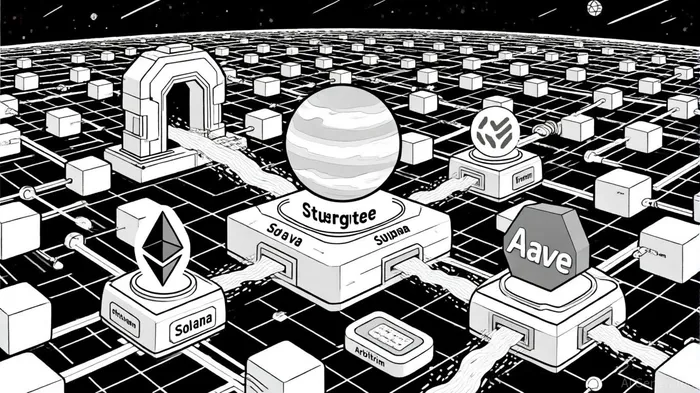






Comentarios
Aún no hay comentarios