
Emerging Crypto Market Dynamics: Bitcoin's Dominance, Ethereum's Resilience, and Solana's Surge
The crypto market in 2025 is witnessing a tectonic shift in momentum and user adoption, driven by divergent trajectories among Bitcoin, Ethereum, and Solana. As regulatory clarity and macroeconomic tailwinds reshape the landscape, investors must dissect these dynamics to identify long-term value creators.
Bitcoin: Regulatory Optimism Fuels Dominance
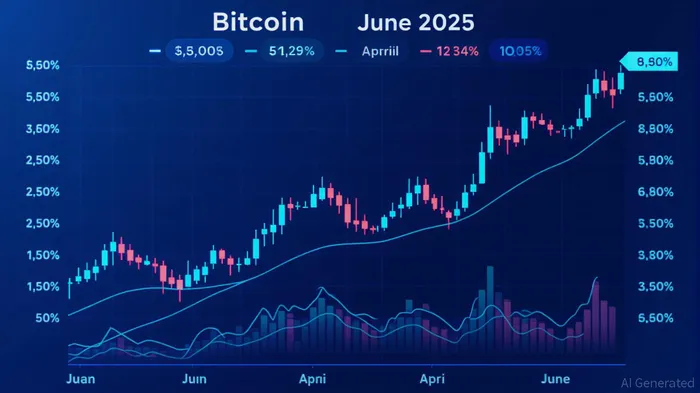
Bitcoin's resurgence in 2025 has been nothing short of meteoric. From April to June, it surged over 52% year-to-date, peaking above $100,000 and reclaiming a 62.1% market dominance share[1]. This momentum is underpinned by regulatory optimism: the appointment of a crypto-friendly chair at the U.S. Securities and Exchange Commission (SEC) has signaled institutional approval, attracting capital inflows[1].
Notably, Bitcoin's performance contrasts with its 2024 struggles, where macroeconomic headwinds and ETF skepticism weighed on prices. Now, with inflation easing and central banks hinting at digital assetDAAQ-- integration, Bitcoin is reasserting itself as the "risk-on" asset of choice[3].
Ethereum: DeFi Resilience Amid Price Volatility
Ethereum's story in 2025 is one of duality. While its price dipped 1.6% in April, closing near $1,793[1], its DeFi ecosystem defied the trend. Total Value Locked (TVL) in Ethereum-based protocols grew steadily, reflecting renewed interest in decentralized finance applications[1]. By June, Ethereum rebounded to $2,528–$2,555, but its Q2 trading volume fell to $19.5 billion daily, down from $24.4 billion in Q1[1].
This divergence highlights Ethereum's structural challenge: while its foundational utility (smart contracts, DeFi) remains robust, price action lags behind its 2025 opening high of $3,337[1]. For Ethereum to reclaim its 2021-era dominance, Layer 2 scaling solutions and EIP-4844 upgrades must translate into tangible user growth.
Solana: Network Revenue and DApp Dominance
Solana has emerged as the 2025 breakout star. Its Q2 network revenue of $685.97 million outpaced Bitcoin ($50.48 million), Ethereum ($129.09 million), and TronTRON-- ($165.26 million)[4], driven by a thriving DApp ecosystem and meme coin launchpads. Despite a January peak correction, Solana's price rebounded 11.69% in April, fueled by institutional accumulation and macroeconomic tailwinds like falling U.S. inflation[3].
However, Solana's decentralized exchanges (DEXs) faced headwinds: Orca, Meteora, and Raydium saw trading volumes drop 40.5%–73.4% quarter-over-quarter[1]. This underscores a critical tension—while Solana's infrastructure and developer activity are thriving, user behavior remains fragmented between centralized and decentralized liquidity pools.
User Adoption: The DEX-CEX Divide
Q2 2025 marked a pivotal shift in user adoption. Decentralized exchanges (DEXs) captured record volumes: spot trading hit $876.3 billion (up 25.3% QoQ), while perpetual volumes reached $898.0 billion[1]. PancakeSwap's 45% market share dominance[1] signals a growing preference for self-custody and composability.
Conversely, centralized exchanges (CEXs) saw spot trading volumes plummet 27.7% QoQ to $3.9 trillion[1], as retail investors migrate to DEXs for yield opportunities and governance participation. This trend mirrors the 2023–2024 "DEX renaissance," but with heightened institutional participation in on-chain derivatives.
Conclusion: Navigating the New Normal
The 2025 crypto market is defined by three key dynamics:
1. Bitcoin's regulatory tailwinds are cementing its role as a macro hedge and store of value.
2. Ethereum's DeFi resilience suggests long-term utility, but price recovery hinges on scaling solutions.
3. Solana's DApp dominance and network revenue outperformance position it as a prime beneficiary of the "meme coin" and on-chain innovation wave.
For investors, the path forward lies in balancing exposure to Bitcoin's blue-chip stability, Ethereum's foundational innovation, and Solana's execution velocity. As DEXs continue to erode CEX dominance, user adoption will increasingly favor protocols that prioritize composability and self-sovereignty.






Comentarios
Aún no hay comentarios