
Emerging Crypto ETFs and Their Strategic Implications for Retail and Institutional Investors
The cryptocurrency market's evolution in 2025 has been marked by a seismic shift in institutional engagement, driven by the emergence of spot ETFs for altcoins like XRPXRP-- and DOGEDOGE--. These products, once mired in regulatory limbo, are now poised to redefine risk-adjusted return profiles for investors. As the U.S. Securities and Exchange Commission (SEC) navigates its delayed approvals, the interplay between regulatory readiness and market dynamics offers critical insights for both retail and institutional players.
Regulatory Readiness: A Ticking Clock for XRP and DOGE ETFs
The SEC's extended review periods for XRP and DOGE ETFs have created a unique window for market speculation. As of October 2025, major issuers like Grayscale and 21Shares face final decision dates in late October, while Franklin's XRP ETF awaits a November 14 verdict [1]. Analysts like Dom Kwok of EasyA argue that these delays reflect the SEC's struggle to balance innovation with investor protection, particularly for assets beyond BitcoinBTC-- and EthereumETH-- [1].
For XRP, the regulatory landscape has improved significantly. Ripple's August 2025 legal victory—where the SEC and Ripple mutually dismissed appeals—confirmed XRP's non-security status on public exchanges, reducing institutional hesitancy [4]. This clarity has already spurred adoption: SantanderSAN-- and PNC Bank now use RippleNet for cross-border payments, cutting costs and settlement times [4]. By contrast, DOGE remains a regulatory wildcard. Its ETF approval, expected in December, hinges on the SEC's willingness to normalize meme coins as investable assets [2].
Risk-Adjusted Returns: XRP's Edge Over DOGE
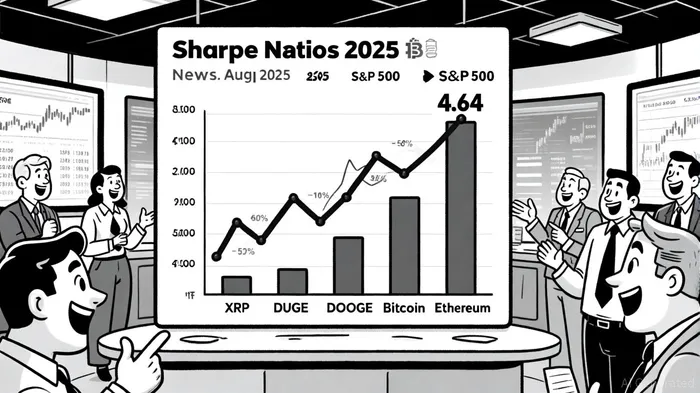
When evaluating risk-adjusted returns, XRP outperforms DOGE across key metrics. As of August 2025, XRP-USD boasted a Sharpe ratio of 4.64, dwarfing DOGE-USD's 1.32 [3]. This suggests XRP delivers superior returns per unit of risk, a critical factor for institutional investors prioritizing portfolio efficiency. Volatility metrics reinforce this: XRP's daily standard deviation of 82.27% is marginally lower than DOGE's 83.50%, despite both tokens being inherently more volatile than traditional assets [3].
Beta coefficients further highlight divergent risk profiles. XRP's beta of 1.25 relative to the S&P 500 indicates it is 25% more volatile than the broader market [3], while Bitcoin's beta of 2.8x underscores its extreme speculative nature [3]. DOGE, though unmeasured directly, is inferred to have a beta exceeding 1.0 due to its social media-driven price swings and lack of utility-driven demand [5]. For example, DOGE's 59.04% annual return in 2025 came with a Sharpe ratio of 1.15, reflecting its high-risk, high-reward trajectory [5].
Institutional Adoption and Liquidity Dynamics
The launch of XRP and DOGE ETFs under the Investment Company Act of 1940 has accelerated institutional adoption. The REX-Osprey XRP ETF, for instance, generated $37.7 million in first-day volume—surpassing Citigroup's market cap—while the DOGE ETF attracted $17 million [3]. These figures signal growing confidence in altcoin ETFs as vehicles for diversification. Ripple's institutional partnerships, including its use in real-time currency conversion, further validate XRP's utility, contrasting with DOGE's reliance on speculative demand [4].
However, regulatory uncertainty persists. A shift in the SEC's stance—such as imposing new restrictions on crypto ETFs—could disrupt inflows. For example, XRP ETFs could attract up to $8 billion in capital if approved, but this potential hinges on sustained regulatory clarity [4].
Strategic Implications for Investors
For retail investors, XRP ETFs offer a regulated pathway to exposure with relatively lower volatility compared to Bitcoin or DOGE. The high Sharpe ratio and institutional backing make XRP a compelling choice for those seeking balanced growth. DOGE ETFs, meanwhile, cater to risk-tolerant investors willing to bet on social media-driven trends, though their long-term utility remains unproven.
Institutional investors must weigh XRP's growing adoption against DOGE's speculative nature. XRP's integration into cross-border payment systems and its potential ETF approval position it as a strategic asset for diversifying exposure to blockchain infrastructure. DOGE, while less utility-driven, could serve as a hedging tool in highly volatile portfolios, provided its regulatory risks are managed.
Conclusion
The XRP and DOGE ETF landscape in 2025 represents a pivotal moment for crypto investing. While regulatory delays persist, the risk-adjusted return profiles of these assets—particularly XRP's superior Sharpe ratio and lower volatility—position them as strategic tools for diversification. As the SEC's decisions loom, investors must balance the promise of institutional adoption with the inherent risks of a still-evolving regulatory framework.





Comentarios
Aún no hay comentarios