
Emerging Blockchain Infrastructure vs. Speculative Crypto Dynamics: A Strategic Investment Analysis
The Blockchain Trilemma and the Rise of BlockDAG
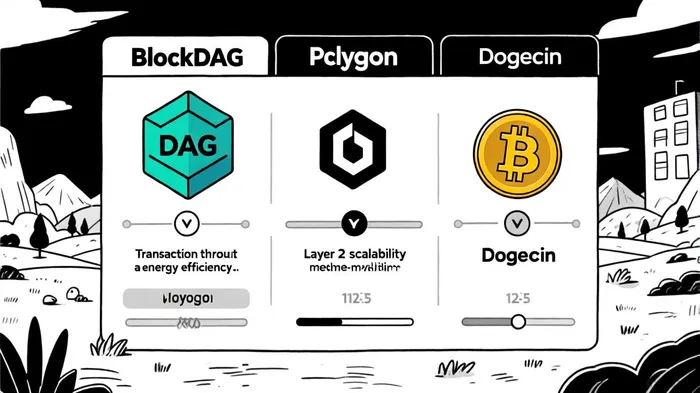
The 2025 cryptocurrency landscape is defined by a stark divergence between next-generation blockchain infrastructure and speculative assets. At the forefront of this shift is BlockDAG (Directed Acyclic Graph), a technology redefining scalability and efficiency. Unlike traditional linear blockchains, BlockDAG's parallel processing architecture enables 10,000–15,000 transactions per second (TPS) while maintaining energy efficiency[1]. This is a critical leap over Ethereum's 15–45 TPS and Bitcoin's 5–7 TPS, addressing the blockchain trilemma of scalability, security, and decentralization[3].
By November 2024, BlockDAG's network had processed 362,599 transactions and secured 285,058 blocks, demonstrating robust adoption[1]. Projects like Phantom, IOTAIOTA--, and NanoXNO-- have leveraged BlockDAG for privacy-focused transactions and zero-fee payments, while its hybrid DAG-PoW model ensures resilience against 51% attacks[4]. The technology's real-world applications in DeFi, IoT, and supply chain management further underscore its institutional-grade potential[5].
Polygon's Layer-2 Ambitions and Institutional Hurdles
Polygon (POL) has positioned itself as a Layer-2 scaling solution for EthereumETH--, achieving 1,000 TPS in July 2025 through its Bhilai hardfork upgrade[6]. Its Gigagas roadmap aims for 100,000 TPS by 2026, with intermediate targets like 5,000 TPS by October 2025[6]. However, Polygon's progress is tempered by technical challenges. A critical consensus bug in 2025 disrupted network activity, raising concerns about stability[2].
Despite these hurdles, Polygon's TVL grew to $832 million in Q2 2025, driven by partnerships with Stripe, Reliance Jio, and BlackRock[6]. Its AggLayer initiative aims to enhance cross-chain liquidity, but the ecosystem remains reliant on Ethereum's dominance. While Polygon's energy efficiency (0.0063 kWh per transaction) is superior to Dogecoin's 54.1463 kWh[5], its incremental approach contrasts with BlockDAG's disruptive architecture.
Dogecoin's Volatility and Meme-Driven Narrative
Dogecoin (DOGE) continues to thrive on speculative fervor, with its price surging on ETF hype and social media momentum. By April 2025, institutional investments in memeMEME-- coins had surged 4.5-fold to $300 million, with DOGEDOGE-- and Shiba InuSHIB-- leading the charge[7]. However, this growth is underpinned by volatility: DOGE's price fluctuates heavily, with whale selling and negative futures funding rates signaling divided sentiment[1].
Dogecoin's technical limitations—30 TPS and energy-intensive PoW mining—highlight its unsuitability for institutional adoption[5]. While the Grayscale DogecoinDOGE-- Trust and potential ETF approval offer short-term catalysts, the asset lacks the infrastructure or developer ecosystem to sustain long-term value[8].
Institutional Adoption and Miner Trends: A Divergent Path
Institutional capital is increasingly favoring projects with tangible infrastructure. BlockDAG's $400 million presale and 3 million X1 miner app users reflect its appeal to both retail and institutional investors[3]. The project's $100 million liquidity plan and phased airdrops aim to stabilize its market presence, contrasting with Dogecoin's reliance on speculative trading[9].
Polygon's institutional adoption is growing, but its TVL of $832 million pales against BlockDAG's execution-driven model[6]. Meanwhile, Dogecoin's miner landscape is dominated by ASICs with hash rates up to 20 GH/s, making profitability contingent on low-cost electricity and industrial-scale operations[10].
Strategic Positioning for 2025 and Beyond
The data underscores a clear investment thesis: next-gen protocols like BlockDAG offer scalable, energy-efficient infrastructure with real-world applications, while meme-driven assets like Dogecoin remain high-risk, high-reward propositions. Polygon's Layer-2 roadmap is promising but faces stiff competition from DAG-based solutions.
For investors, prioritizing projects with hybrid architectures, institutional validation, and developer ecosystems—such as BlockDAG—aligns with the long-term trajectory of blockchain innovation. As the 2025 crypto cycle unfolds, the divide between infrastructure and speculation will only widen, making strategic positioning in DAG-based protocols a compelling choice.






Comentarios
Aún no hay comentarios