
Emerging Blockchain Infrastructure Plays: BlockDAG's Scalability and Hyperliquid's Resilience Signal Sector Strength
Blockchain infrastructure has long been the silent engine of the crypto sector's evolution. In 2025, two projects-BlockDAG and Hyperliquid-stand out as barometers of resilience. BlockDAG's hybrid Directed Acyclic Graph (DAG) + Proof-of-Work (PoW) architecture claims to solve the scalability trilemma, while Hyperliquid's price recovery amid volatile conditions underscores the sector's adaptive strength. Together, they reveal a broader narrative: infrastructure innovation and market dynamics are increasingly intertwined.
BlockDAG: A Scalability Engine for the Next-Gen Blockchain
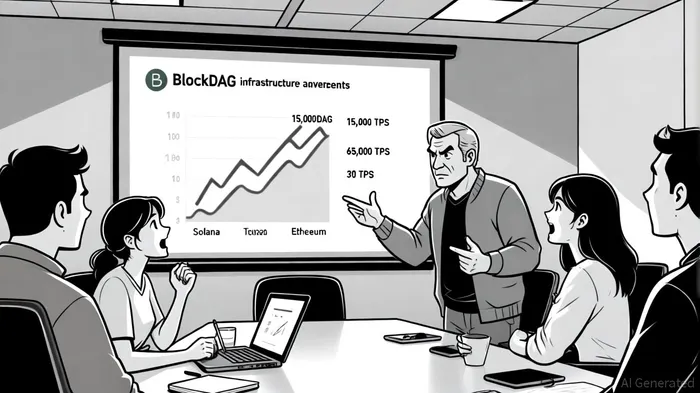
BlockDAG's hybrid model combines DAG's parallel processing with PoW's security, enabling it to process 2,000–15,000 transactions per second (TPS), according to a CoinCentral review. This dwarfs Ethereum's 30 TPS and Solana's 65,000 TPS, positioning it as a viable backbone for real-time applications like DeFi and iGaming, as noted in the Crypto Reporter guide. Early testnet benchmarks confirm linear scalability, with 10 blocks processed per second and room for expansion as adoption grows, according to 36Crypto's report.
The project's adoption metrics are equally compelling. Over 2.5 million downloads of its X1 mobile miner app and 19,000 X10 hardware miners sold have created a decentralized mining network, ensuring security and resilience, as covered in CoinPulse coverage. A $353 million presale and listings on 20 exchanges further validate its market potential, according to an Analytics Insight article. However, challenges remain: node synchronization delays and unmet roadmap promises have raised questions about long-term stability, in a MEXC analysis.
Hyperliquid's Price Recovery: A Test of DeFi Resilience
Hyperliquid's HYPE token has shown remarkable resilience in 2025, trading near $45.54 as of October 10, according to an OnTheNode analysis. Technical indicators like RSI and MACD suggest a potential rebound to $50–$55 if buyers hold above $42, per a Blockonomi prediction. This recovery is driven by institutional interest and Hyperliquid's dominance in decentralized perpetual trading, with $30 billion in daily volume and 80% market share, as described in a Redstone report.
The platform's dual-layer architecture (HyperCore and HyperEVM) enables seamless integration of permissioned and permissionless systems, fostering innovation in financial engineering, as noted in a BusinessDay piece. Additionally, Hyperliquid's community-driven model-where spot deployers retain 50% of trading fees-has driven organic adoption, according to an XT blog post. Yet, short-term volatility persists due to token unlocks and whale activity, as reported in a Dapp.Expert roundup.
The Interplay: Infrastructure and Market Sentiment
While no direct integration between BlockDAG and Hyperliquid exists, their trajectories highlight a symbiotic relationship. BlockDAG's EVM compatibility and 15,000 TPS capacity could theoretically support DeFi platforms like Hyperliquid by reducing latency and increasing throughput, as discussed in a Gate blog post. This infrastructure-first approach mitigates bottlenecks, enabling platforms to scale without compromising security.
Meanwhile, Hyperliquid's price recovery reflects broader market confidence in DeFi's ability to adapt. As BlockDAG's presale and hardware adoption gain traction, they create a narrative of technological progress that indirectly bolsters investor sentiment for DeFi projects, according to a BusinessDay analysis. This is evident in Hyperliquid's recent partnerships, including a USDH stablecoin initiative, which align with the sector's push for liquidity and stability, as noted in a Crypto-Economy roundup.
Risks and Realities
Neither project is without risks. BlockDAG's delayed exchange listings and regulatory scrutiny in sectors like online gambling could hinder growth, as discussed in a Medium post. Hyperliquid, meanwhile, faces competition from centralized exchanges and must navigate tokenomics challenges to sustain its price rally, per a Blockonomi outlook.
Conclusion: A Sector in Motion
BlockDAG and Hyperliquid exemplify the crypto sector's resilience in 2025. BlockDAG's infrastructure advancements address foundational scalability issues, while Hyperliquid's price recovery demonstrates the market's appetite for innovation. Together, they signal a maturing ecosystem where technological progress and market dynamics reinforce each other. For investors, this duality offers a compelling case for long-term exposure to blockchain infrastructure plays.






Comentarios
Aún no hay comentarios