
Emerging Blockchain Infrastructure Innovations in 2025: Arbitrum's Struggles vs. BlockDAG's Presale Momentum
Market Dynamics and Investor Sentiment: A Tale of Two Ecosystems
The cryptocurrency landscape in 2025 is defined by divergent trajectories between established Layer 2 solutions and emerging Layer 1 innovators. ArbitrumARB-- (ARB), once a darling of EthereumETH-- scaling, has faced a prolonged price correction, dropping from a peak of $2.40 in January 2024 to $0.46 in Q3 2025. This decline is attributed to token vesting unlocks, Ethereum's bearish trend, and intensifying competition from Base and other rollups [1]. Meanwhile, BlockDAG (BDAG) has surged into the spotlight with a $420M+ presale, leveraging a hybrid Directed Acyclic Graph (DAG) and Proof-of-Work (PoW) architecture to position itself as a scalable alternative to traditional blockchains [2].
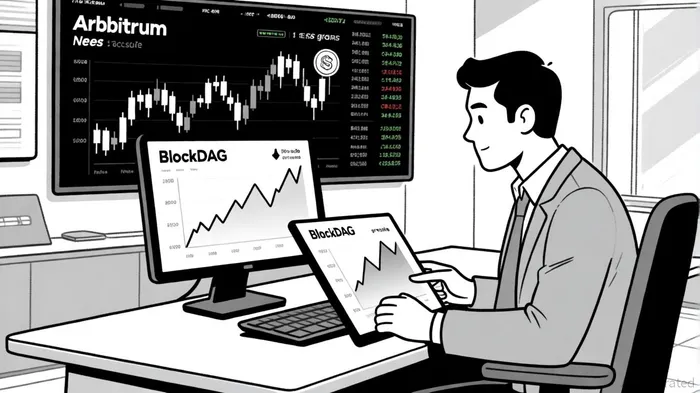
Investor sentiment reflects these dynamics. Arbitrum's Fear & Greed Index score of 27 underscores a bearish outlook, compounded by conflicting technical indicators like RSI and MACD [1]. Conversely, BlockDAG's presale has attracted 312,000 holders and 3 million X1 app users, with daily inflows exceeding $1 million. Analysts project a 36x ROI if BDAG reaches $0.05 by 2025, driven by its DAG's 1,400 TPS and EVM compatibility [3].
Technological Innovations and Scalability: Efficiency vs. Disruption
Arbitrum's core strength lies in its Ethereum-centric optimizations. The Nitro v3 upgrade in March 2025 reduced transaction confirmation times by 15% and gas fees by 20%, while ArbiBridge enhanced cross-chain liquidity [1]. These improvements have bolstered DeFi adoption, with TVL reaching $3.29 billion and 40 million monthly transactions. However, Arbitrum's reliance on Ethereum's price recovery remains a vulnerability; sustained ARBARB-- gains above $1 require Ethereum to break $3,000 [1].
BlockDAG, by contrast, is redefining scalability through its DAG architecture. By enabling parallel transaction processing and merging PoW with Proof-of-Engagement, the platform claims 1,400 TPS without compromising decentralization [3]. Its live testnet, supported by 20,000 global mining machines, has already attracted 4,500 builders developing AI and DeFi applications [4]. This infrastructure-driven approach positions BlockDAG as a standalone solution, less tethered to Ethereum's cycles.
Future Outlook and Investment Considerations
For Arbitrum, the path forward hinges on the BOLD upgrade, which will enable permissionless validation and further reduce costs [1]. Institutional partnerships, such as Gemini's on-chain equity transactions, add credibility. However, macroeconomic headwinds and Base's Coinbase integration pose risks. Price forecasts range from $0.18 (bearish) to $1.20 (bullish) by year-end, contingent on Ethereum's performance [1].
BlockDAG's roadmap is equally ambitious. With a projected $0.20–$0.35 price target by 2030, the project's focus on real-world utility-such as decentralized GPU computing and AI tools-could drive mass adoption [3]. Yet, its speculative nature and reliance on presale hype introduce volatility. Investors must weigh its high-growth potential against regulatory uncertainties and competition from SolanaSOL-- and AvalancheAVAX-- [4].
Conclusion: Divergent Strategies, Shared Ambitions
Arbitrum and BlockDAG exemplify contrasting approaches to blockchain innovation. Arbitrum's incremental upgrades and Ethereum integration offer stability but face headwinds from market cycles and competition. BlockDAG's disruptive DAG architecture and presale-driven momentum highlight the appeal of scalability and decentralization for a new generation of users. For investors, the choice between these projects depends on risk tolerance: Arbitrum for those betting on Ethereum's resilience and BlockDAG for those seeking high-growth, infrastructure-led disruption.






Comentarios
Aún no hay comentarios