
Emerging Blockchain Architectures and Investment Momentum in 2025: A Comparative Analysis of Cardano's PoS and BlockDAG's X1/X10
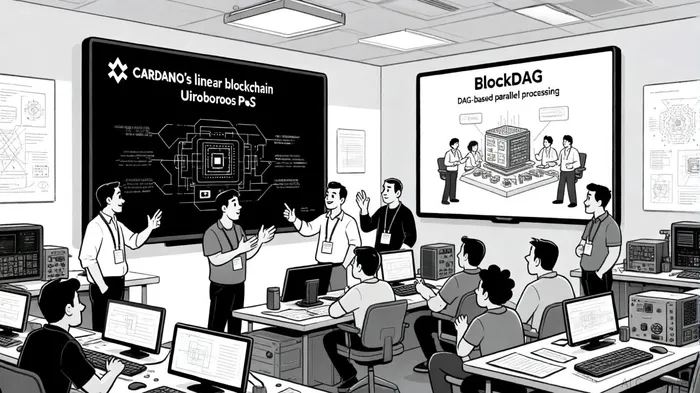
In 2025, the blockchain landscape is being reshaped by divergent architectural philosophies. Traditional proof-of-stake (PoS) models, exemplified by CardanoADA-- (ADA), continue to emphasize academic rigor and energy efficiency. Meanwhile, innovative Directed Acyclic Graph (DAG) solutions like BlockDAG's X1/X10 ecosystem are redefining scalability and developer accessibility. This analysis explores how these competing architectures are influencing investor momentum, technical performance, and real-world adoption.
Technical Performance: TPS, Scalability, and Energy Efficiency
Cardano's Ouroboros PoS protocol prioritizes security and sustainability, achieving energy efficiency by eliminating the need for resource-intensive mining[1]. However, its linear blockchain structure limits scalability, with transaction throughput (TPS) estimates significantly lower than newer DAG-based systems[2]. In contrast, BlockDAG's hybrid DAG+Proof-of-Work (PoW) architecture processes up to 15,000 TPS—far outpacing traditional chains like SolanaSOL-- (1,133 TPS) and EthereumETH-- (15–45 TPS)—by enabling parallel transaction validation[3].
Energy efficiency remains a key differentiator. Cardano's PoS model consumes minimal energy, aligning with global sustainability goals[1]. BlockDAG's PoW mechanism, while traditionally energy-intensive, leverages DAG's parallel processing to reduce validation overhead[3]. This hybrid approach balances scalability with environmental considerations, appealing to investors seeking both performance and pragmatism.
Investor Adoption Rates and Market Position
BlockDAG's rapid presale success—$351 million raised with 24.3 billion coins sold—reflects strong investor confidence in its high-growth potential[4]. A projected launch price of $0.05 implies a 3,025% return for early adopters, attracting speculative capital[4]. This momentum is fueled by a developer-first approach: over 4,500 builders have joined the ecosystem, creating 300+ decentralized applications (dApps) supported by tools like the X1 mobile app and X10 miner[5].
Cardano, meanwhile, maintains a steady but slower trajectory. Its focus on long-term infrastructure—such as the Hydra scaling solution and Voltaire governance upgrades—positions it as a stable, institutional-grade asset[6]. Analysts project ADAADA-- could reach $1.80 by year-end, driven by its energy-efficient PoS model and academic credibility[7]. However, critics argue its deliberate development pace lags behind the agility of DAG-based competitors[8].
Real-World Applications and Ecosystem Growth
BlockDAG's ecosystem is expanding rapidly, with real-world applications in DeFi, AI, and Web3 dashboards[5]. The X1 App democratizes mining via mobile devices, while the X10 miner targets enterprise-grade scalability. These tools, combined with 24/7 hackathons, have accelerated the deployment of 300+ live projects[5]. By 2026, the platform aims to support 1,000 dApps, cementing its role as a utility-driven blockchain[9].
Cardano's roadmap emphasizes foundational upgrades, such as native staking and cross-chain interoperability, to solidify its position as a “blockchain for the future.” While these features enhance security and governance, they lack the immediate utility of BlockDAG's application-focused approach[10].
Conclusion
The 2025 blockchain race highlights a critical trade-off: Cardano's methodical, energy-efficient PoS model versus BlockDAG's high-throughput DAG architecture. For investors prioritizing long-term stability and institutional adoption, Cardano's academic rigor and energy efficiency remain compelling. However, those seeking aggressive growth and real-world utility may favor BlockDAG's developer-centric ecosystem and scalable infrastructure.
As macroeconomic trends and stablecoin adoption continue to shape the crypto market, platforms delivering tangible utility—whether through PoS or DAG—will dominate investor sentiment. The coming months will test whether Cardano's patience pays off or if BlockDAG's speed and innovation redefine the industry's trajectory.






Comentarios
Aún no hay comentarios