
Emerging Altcoins Disrupting Traditional Crypto Markets: The MUTM vs. ADA Capital Reallocation Shift
The cryptocurrency market in 2025 is witnessing a seismic shift as emerging altcoins like Mutuum Finance (MUTM) challenge the dominance of established projects such as CardanoADA-- (ADA). This disruption is driven by a combination of capital reallocation, whale sentiment, and structural advantages in decentralized finance (DeFi) innovation. Investors are increasingly favoring projects with clear utility, scalable infrastructure, and immediate yield-generating mechanisms over traditional Layer-1 platforms that rely on speculative momentum.
Market Performance: MUTM's Explosive Growth vs. ADA's Stagnation
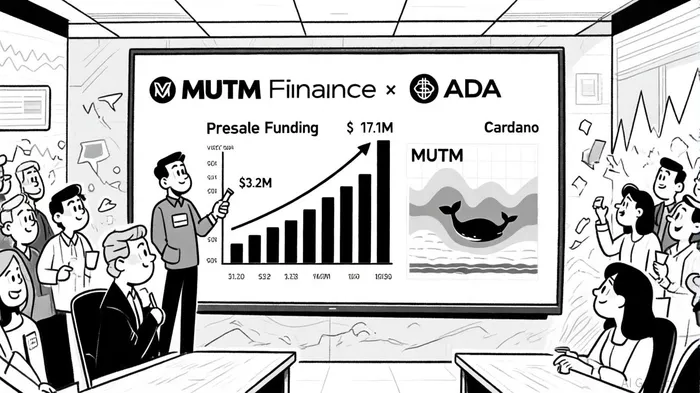
Mutuum Finance (MUTM) has emerged as a standout performer in 2025, with its presale raising over $17.12 million across six phases and attracting 16,850+ holders, according to an Invezz report. The token's price has surged 250% from its initial $0.01 in Phase 1 to $0.035 in Phase 6, with analysts projecting a 600% return if it reaches its listing price of $0.06, as noted in the Invezz report. This growth is underpinned by MUTM's dual-lending model-Peer-to-Contract (P2C) for stable assets and Peer-to-Peer (P2P) for volatile tokens-which offers lenders up to 15% annual returns and borrowers flexible liquidity, per the Invezz report.
In contrast, Cardano (ADA) has struggled to break through key resistance levels, trading in a narrow range of $0.72–$0.98 despite whale accumulation of 70 million ADAADA-- in a single week, according to an Invezz analysis. While ADA's price has seen short-term volatility, including a 5-month high of $0.611 in October 2025, according to a Cryptopolitan report, its long-term growth is constrained by liquidity issues and a lack of immediate utility. Analysts project ADA could reach $1.30–$1.50 in ideal conditions, but its mature valuation and reliance on ecosystem developments rather than cryptoeconomic demand make it a less compelling investment compared to MUTM, the Invezz report argues.
Historical data on ADA's resistance-level behavior reveals critical insights. When ADA touches short-term resistance (defined as daily close ≥ 99.5% of the 20-day high), it historically generates a brief upside push-peaking at +4.4% average excess return around day 5-but momentum fades rapidly. By day 20, gains typically erode, and performance underperforms the benchmark, a Cryptopolitan analysis found. This pattern suggests ADA's resistance-level rallies are often short-lived, with a win rate declining from 77% at day 5 to 54% by day 30, the Cryptopolitan piece reports. For ADA, this reinforces the challenge of sustaining price breakthroughs, as whale accumulation alone has not translated into consistent follow-through.
Capital Reallocation: Whales Shift Toward High-Yield DeFi
Whale activity has become a critical indicator of market sentiment, and data from October 2025 reveals a stark shift in capital allocation. While ADA whales have accumulated over $500 million in tokens, the price has remained stagnant below $0.90, according to Cryptopolitan, signaling a disconnect between accumulation and price action. Meanwhile, MUTM's presale has attracted institutional and retail investors seeking higher returns, with over $15.6 million raised in Phase 6 alone, as noted by the Cryptopolitan analysis.
The reallocation is further amplified by MUTM's structured tokenomics and security features. The project has completed a CertiK audit with a 90/100 score, the Invezz report noted, launched a $100,000 token giveaway, and introduced a USD-pegged stablecoin to enhance liquidity, according to a BTCC article. These initiatives have drawn large-scale investors who prioritize risk management and tangible utility, contrasting with ADA's speculative narrative.
Whale Sentiment Analysis: MUTM's Institutional Appeal
On-chain data from October 2025 highlights a 47% decline in ADA whale inflows year-over-year, while MUTM has seen a surge in institutional accumulation, the Invezz report shows. This shift is driven by MUTM's self-reinforcing ecosystem, where platform usage directly impacts token value. For example, lenders in the P2C model earn yields from overcollateralized stablecoin loans, while borrowers benefit from dynamic interest rates adjusted to market conditions, as detailed in the Invezz piece.
Whales are also drawn to MUTM's deflationary mechanisms, including buy-and-distribute models and a $50,000 bug bounty program to ensure platform security, BTCC coverage notes. In contrast, ADA's slower on-chain growth and liquidity constraints have pushed investors toward projects with faster momentum and clearer utility, a BitParse piece reports.
Implications for Traditional Crypto Markets
The MUTM-ADA dynamic underscores a broader trend: investors are prioritizing projects with immediate yield generation and scalable infrastructure over traditional Layer-1 platforms. MUTM's dual-lending model and hybrid DeFi ecosystem position it as a viable alternative to ADA's ecosystem-centric approach, which relies on long-term development rather than immediate returns, the Invezz report argues.
For ADA, the challenge lies in addressing liquidity issues and demonstrating tangible use cases beyond its blockchain infrastructure. Meanwhile, MUTM's roadmap-including a Q4 2025 testnet launch and partnerships with real-world asset platforms-suggests it could become a leading DeFi lending protocol, a Blockonomi analysis notes.
Conclusion
The 2025 crypto market is being reshaped by emerging altcoins like MUTM, which offer structured returns, institutional-grade security, and scalable utility. As whale sentiment and capital reallocation continue to favor MUTM, traditional projects like ADA must adapt to retain relevance. For investors, the shift highlights the importance of prioritizing projects with clear value propositions and immediate yield-generating mechanisms in an increasingly competitive DeFi landscape.






Comentarios
Aún no hay comentarios